
2008: Elena Esposito, “Finanzwirtschaft und Gesellschaft: Zukunft aus den Daten der Vergangenheit” / “Finance and Society: Future from the Data of the Past”
Elena Esposito, “Finanzwirtschaft und Gesellschaft: Zukunft aus den Daten der Vergangenheit” / “Finance and Society: Future from the Data of the Past”
Berlin Mosse Lecture
https://mosselectures.wisc.edu/berlin/
Thursday, 5 June 2008, 19:00 CET
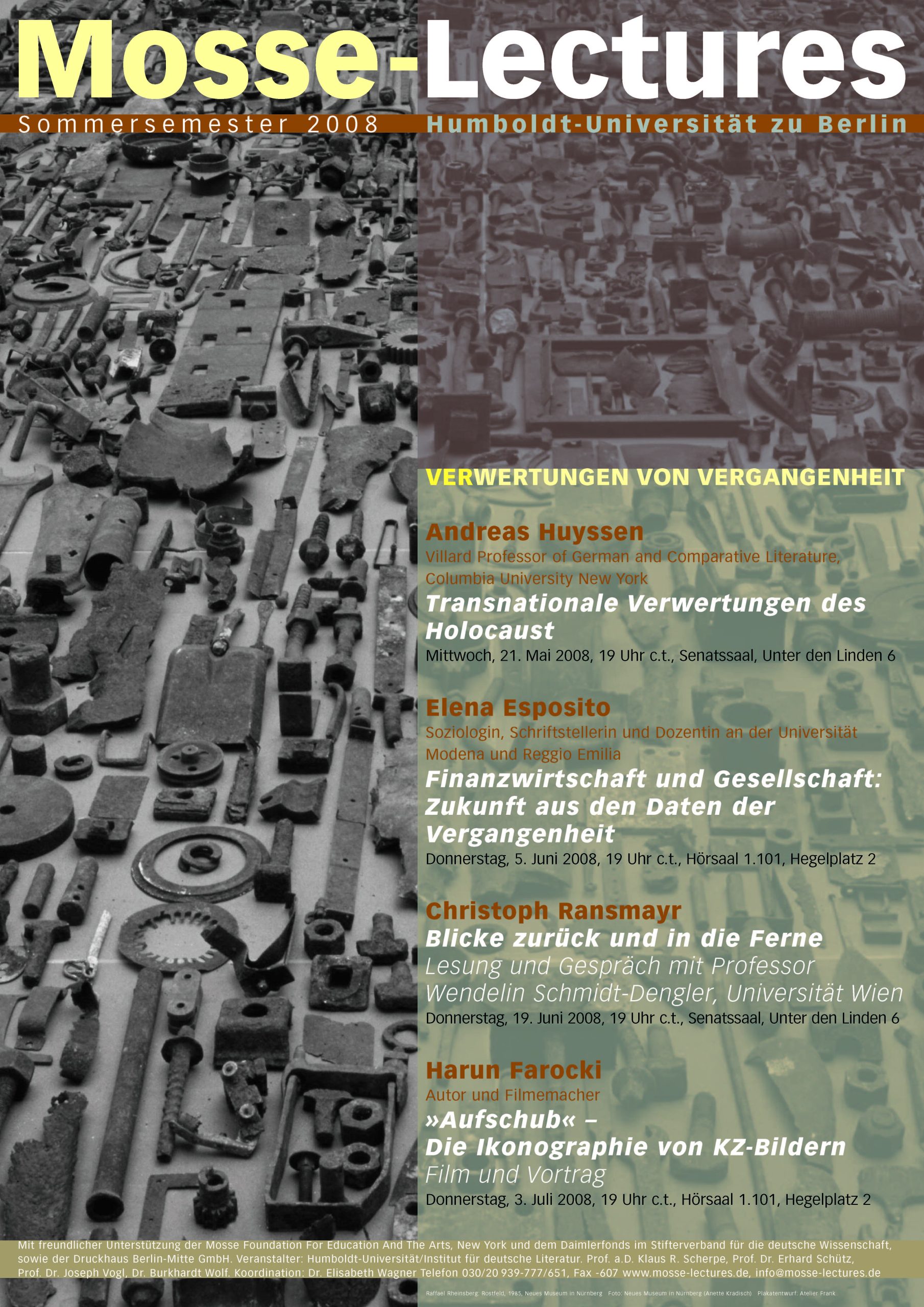
Hörsaal 1.101 of Humboldt University
Hegelplatz 2
10117 Berlin
GERMANY
Sponsored by:
The Mosse Foundation
Global Mosse Lecture Series
Daimler-Fonds im Stifterverband für die deutsche Wissenschaft
Preußische Seehandlung
Humboldt University
Humboldt University Institut für deutsche Literatur
Lecture Description: Wie der Name selbst zeigt, steht die Neuzeit für das Neue, die Zukunft, die Variation, im betonten Kontrast zu den traditionellen Gesellschaften, wo Neuheit nur als Störung und Behinderung galt. Eben dies jedoch führte zu einer eigentümlichen Einseitigkeit; einerseits die abstrakte Vorstellung, die Zukunft habe schon längst begonnen, andererseits die oft unreflektierte Sehnsucht nach der Vergangenheit und ihren Lebensformen. Der Vortrag will zeigen, wie die Neu-Zeit unserer Gesellschaft komplexer verstanden werden kann und muss. Die Perspektiven der Vergangenheit und der Zukunft sind von verschiedenen Gegenwarten aus zu unterscheiden, die im Lauf der Zeit aufeinander folgen und sich verwickeln, so dass der Zukunftshorizont der Gegenwart (die gegenwärtige Zukunft) beeinflusst, was künftig gegenwärtig sein und vermutlich anders sein wird als wir es heute erwarten. Die Finanzmärkte zeigen, wie diese Verflechtung von Zeitebenen in den Operationen unserer Gesellschaft schon aktiv ist und konkret erlaubt, Profite zu erwirtschaften. Um Gewinne zu machen, braucht man nicht zu erraten, was sich künftig realisieren wird, man muss nur genau beobachten, was heute, in der gegenwärtigen Zukunft, erwartet wird.
Lecture Series Description: Talk of Posthistoire or “post history” has itself become historic. Also the talk about an imperfect past seen as a promise for the future. Thinking about how something has turned out seems to be lost in the ubiquity of everyday opinions and emotions as well as in the boundless dynamic of digital memories. The past is made into a permanent virtual present, a “nostalgia for the present”, as Fredric Jameson puts it. Nonetheless everything past is fashionable: “la mode retro” as delight in the text of the past, in myriad formats and on all channels. These conditions provide an upswing for endless reviews in the media: retrospectives and revisions, the reshuffle of pasts under the reality of oblivion in today’s information society. Which new forms of repetition/re-recording, of re-writing, of staging and masquerading past knowledge are there, and how many can there be? How can the old data carriers book, library, card index and archive utilise their stored wisdom and the implied stability thereof for the (re-)generation of knowledge, perception and experience? How is the renewed fascination with the antiquated to be transferred into and applied as new methods and techniques for the adaptation of our established canon of values? What do we read in the sources, the testimonials and files to which a Franz Kafka had set to with libidinous fervor? What value has the temporalisation of the past under the auspices of deferred action, of the future perfect, the “there will have been”?

Elena Esposito is Professor of Sociology at the University Bielefeld and the University of Bologna. A leading figure in sociological systems theory, she has published extensively on the theory of society, media theory, memory theory and the sociology of financial markets. Her current research on algorithmic prediction is supported by a five-year Advanced Grant from the European Research Council.
https://elena-esposito.eu/
