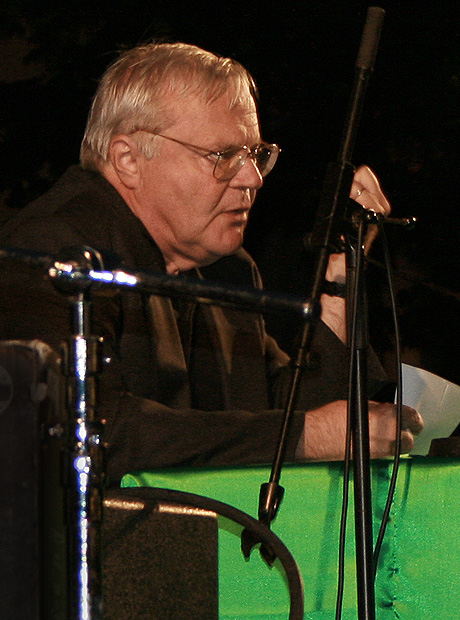
2008: Christoph Ransmayr, “Blicke zurück und in die Ferne”/”Looks Back and into the Distance: Reading and Conversation”
Christoph Ransmayr, “Blicke zurück und in die Ferne”/”Looks Back and into the Distance: Reading and Conversation”
Berlin Mosse Lecture
https://mosselectures.wisc.edu/berlin/
Thursday 19 June, 19:00 CET
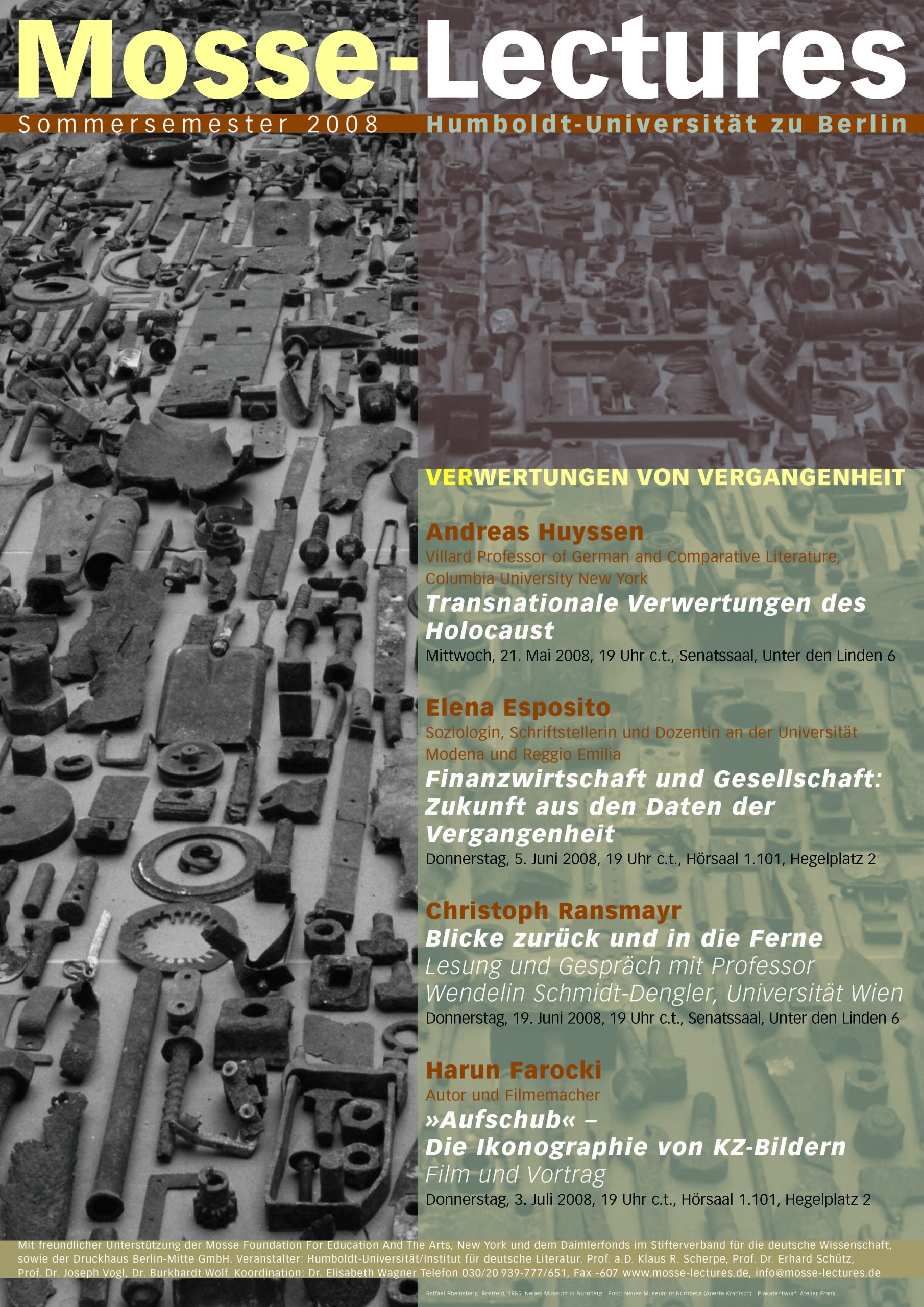
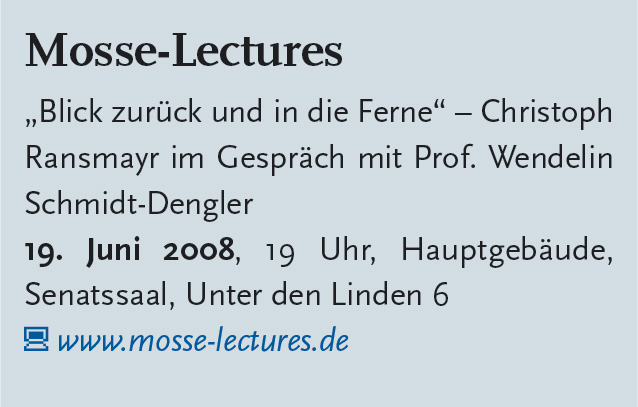
Senatssaal of Humboldt University
Unter den Linden 6
10117 Berlin
GERMANY
Sponsored by:
The Mosse Foundation
Global Mosse Lecture Series
Daimler-Fonds im Stifterverband für die deutsche Wissenschaft
Preußische Seehandlung
Humboldt University
Humboldt University Institut für deutsche Literatur
Moderator: Wendelin Schmidt-Dengler (1942-2008, Universität Wien)
Lecture Description: Wo sind noch Bilder auf dieser Welt, am Ende der Welt, in einer anderen Welt? Reisen im Raum und in der Zeit sind der Stoff, aus dem Christoph Ransmayr seine Romane macht; ins Eismeer auf den Spuren der k.u.k. Nordpolexpedition, ins Archiv der alten Welt zum Exil am Schwarzen Meer, ins Niemandsland der Nachkriegszeit wie es hätte sein können, zum Fliegenden Berg ins östliche Tibet im 21. Jahrhundert. Christoph Ransmayr wird aus seinen Romanen die Anfänge lesen. Wendelin Schmidt-Dengler von der Universität Wien, den die österreichischen Autoren liebevoll »ihren« Professor nennen, als Kritiker von ihnen hoch geschätzt, wird die Lesung begleiten und kommentieren.
Lecture Series Description: Talk of Posthistoire or “post history” has itself become historic. Also the talk about an imperfect past seen as a promise for the future. Thinking about how something has turned out seems to be lost in the ubiquity of everyday opinions and emotions as well as in the boundless dynamic of digital memories. The past is made into a permanent virtual present, a “nostalgia for the present”, as Fredric Jameson puts it. Nonetheless everything past is fashionable: “la mode retro” as delight in the text of the past, in myriad formats and on all channels. These conditions provide an upswing for endless reviews in the media: retrospectives and revisions, the reshuffle of pasts under the reality of oblivion in today’s information society. Which new forms of repetition/re-recording, of re-writing, of staging and masquerading past knowledge are there, and how many can there be? How can the old data carriers book, library, card index and archive utilise their stored wisdom and the implied stability thereof for the (re-)generation of knowledge, perception and experience? How is the renewed fascination with the antiquated to be transferred into and applied as new methods and techniques for the adaptation of our established canon of values? What do we read in the sources, the testimonials and files to which a Franz Kafka had set to with libidinous fervor? What value has the temporalisation of the past under the auspices of deferred action, of the future perfect, the “there will have been”?
Christoph Ransmayr is an Austrian writer known for novels, short stories, and plays that center on travel and historical events. His works include Die letzte Welt [The Last World] (1988), and Morbus Kitahara (1995). He was awarded the Nicolas Born Prize in 2018, among many other distinctions.