
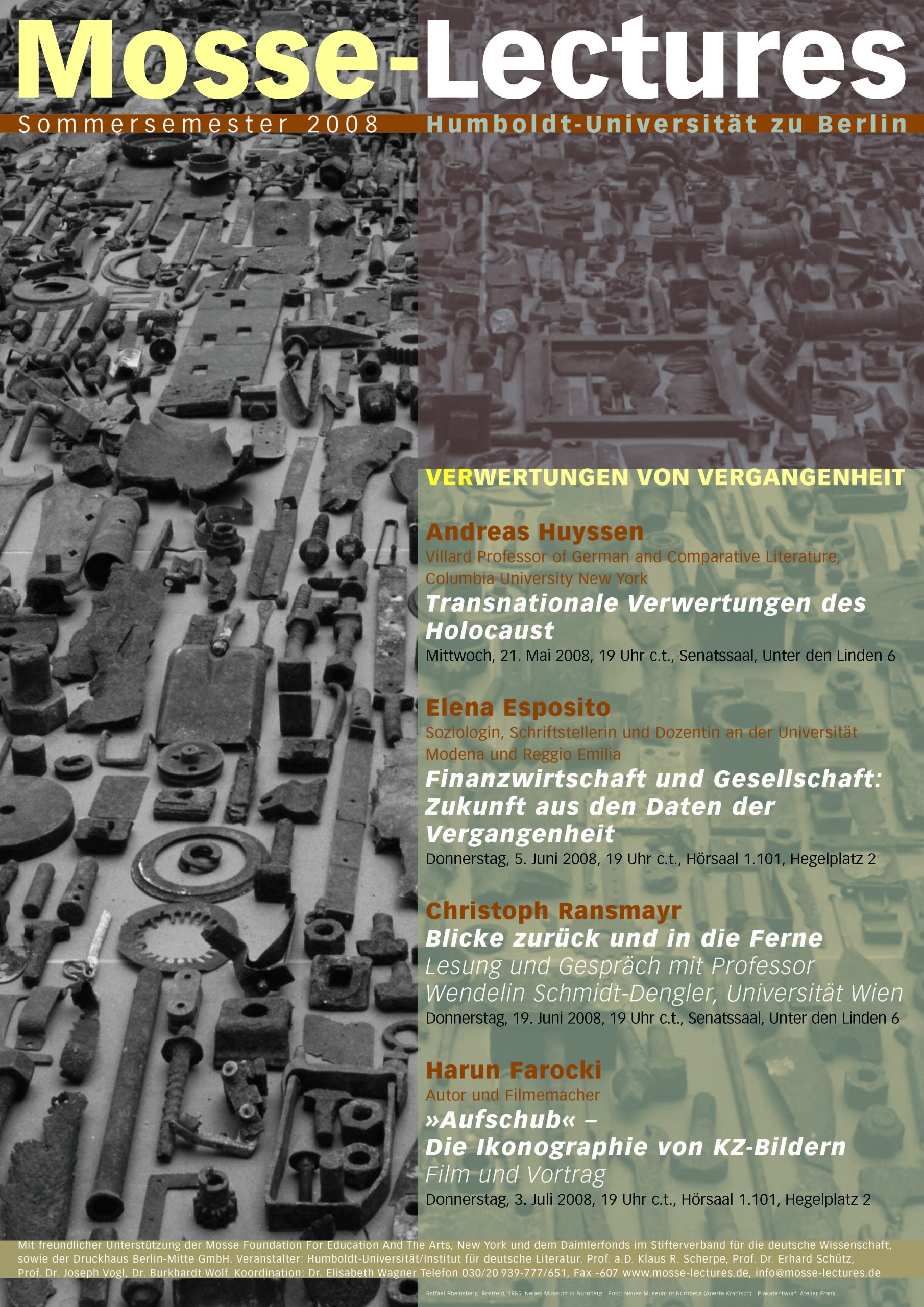
2008: Andreas Huyssen, “Transnationale Verwertungen des Holocaust” / “Transnational Exploitation of the Holocaust”
Andreas Huyssen, “Transnationale Verwertungen des Holocaust” / “Transnational Exploitation of the Holocaust”
Berlin Mosse Lecture
https://mosselectures.wisc.edu/berlin/
Thursday 21 May 2008, 19:00 CET
Senatssaal of Humboldt University
Unter den Linden 6
1. Stock
10117 Berlin
GERMANY
Sponsored by:
The Mosse Foundation
Global Mosse Lecture Series
Daimler-Fonds im Stifterverband für die deutsche Wissenschaft
Preußische Seehandlung
Humboldt University
Humboldt University Institut für deutsche Literatur
Lecture Description: Das territorial und national gebundene Konzept kollektiver Erinnerung verfehlt die gegenwärtige Praxis transnationaler Aneignungen eines medial zirkulierenden Holocaust Diskurses, der sich in diverse politisch und historisch anders gelagerte Traumageschichten eingeschrieben hat. Der Vortrag schlägt vor, den Blick auf Verwertungen des Holocaust Diskurses zu lenken, die weltweit, aber jeweils spezifisch lokal mit einander widersprechenden, aber gleichzeitig voneinander abhängigen Verflechtungs- und Überbietungsstrategien operieren. Besondere Aufmerksamkeit verdient dabei das Verhältnis von transnationalem Holocaust Diskurs und der Erinnerung an koloniale Herrschaft in Theorie und Praxis des Postkolonialismus.
Lecture Series Description: Talk of Posthistoire or “post history” has itself become historic. Also the talk about an imperfect past seen as a promise for the future. Thinking about how something has turned out seems to be lost in the ubiquity of everyday opinions and emotions as well as in the boundless dynamic of digital memories. The past is made into a permanent virtual present, a “nostalgia for the present”, as Fredric Jameson puts it. Nonetheless everything past is fashionable: “la mode retro” as delight in the text of the past, in myriad formats and on all channels. These conditions provide an upswing for endless reviews in the media: retrospectives and revisions, the reshuffle of pasts under the reality of oblivion in today’s information society. Which new forms of repetition/re-recording, of re-writing, of staging and masquerading past knowledge are there, and how many can there be? How can the old data carriers book, library, card index and archive utilise their stored wisdom and the implied stability thereof for the (re-)generation of knowledge, perception and experience? How is the renewed fascination with the antiquated to be transferred into and applied as new methods and techniques for the adaptation of our established canon of values? What do we read in the sources, the testimonials and files to which a Franz Kafka had set to with libidinous fervor? What value has the temporalisation of the past under the auspices of deferred action, of the future perfect, the “there will have been”?
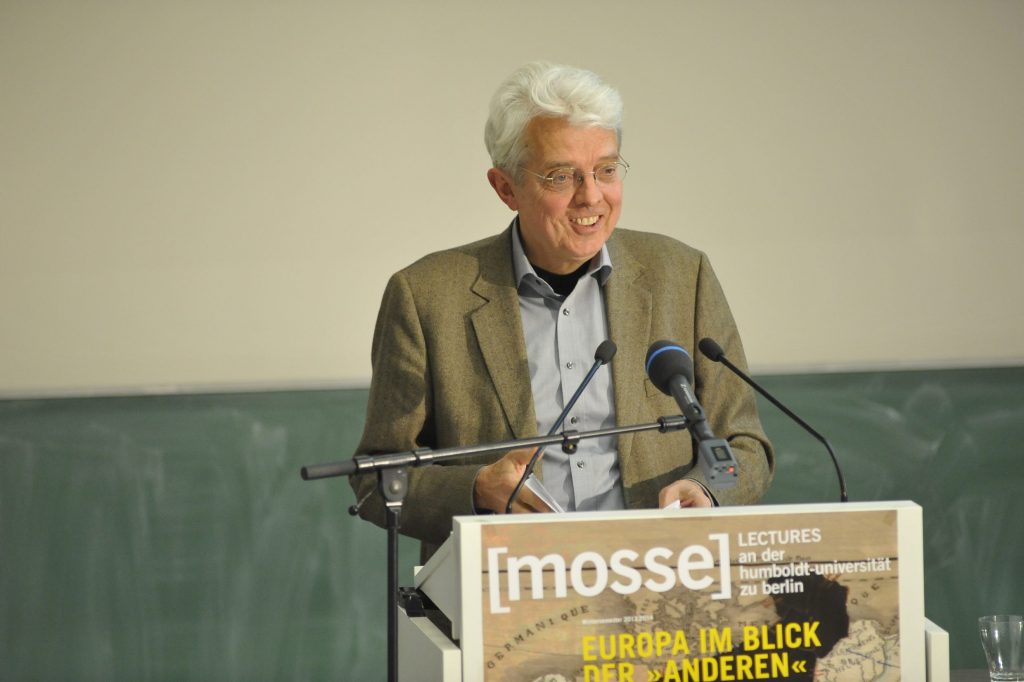
His books include Drama des Sturm und Drang (1980), After the Great Divide: Modernism, Mass Culture, Postmodernism (1986), Postmoderne: Zeichen eines kulturellen Wandels (ed. with Klaus Scherpe, 1986), Modernity and the Text: Revisions of German Modernism (ed. with David Bathrick, 1989), Twilight Memories: Marking Time in a Culture of Amnesia (1995), Present Pasts: Urban Palimpsests and the Politics of Memory (2003), the edited volume on the culture of non-Western cities entitled Other Cities, Other Worlds: Urban Imaginaries in a Globalizing World (2008) and Modernismo después de la posmodernidad (Gedisa, 2010), a book of essays on art and literature so far only available in Spanish. His most recent books are William Kentridge, Nalini Malani: The Shadowplay as Medium of Memory (2013), Miniature Metropolis: Literature in an Age of Photography and Film (2015) and Memory Art in the Contemporary World: Confronting Violence in the Global South (2022).
