2023: Adam Blackler, Matthew Unangst, Michelle Moyd, “German Imperial Projects”
Adam Blackler, Matthew Unangst, Michelle Moyd, “German Imperial Projects”
College of Charleston Mosse Lecture
https://mosselectures.wisc.edu/charleston/
Monday, 6 February 2023, 15:00 CST
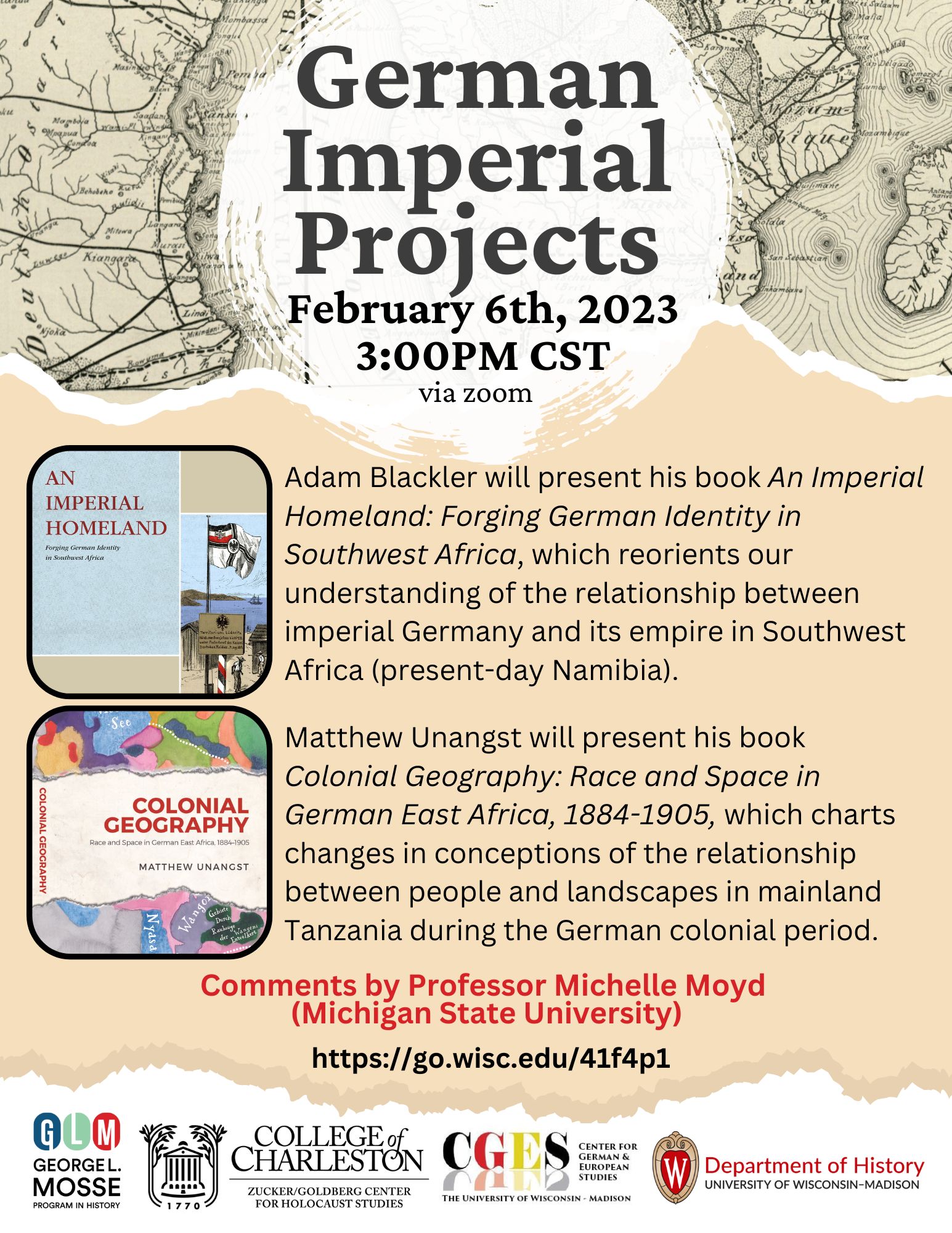
ZOOM
Chair: Chad S.A. Gibbs (College of Charleston)
Comment: Michelle Moyd (Michigan State University)
Sponsored by:
Global Mosse Lecture Series
George L. Mosse Program in History
The Mosse Foundation
College of Charleston Zucker/Goldberg Center for Holocaust Studies
Center for German & European Studies at the University of Wisconsin–Madison
University of Wisconsin–Madison Department of History
Lecture Description: Adam Blackler, An Imperial Homeland: Forging German Identity in Southwest Africa (University Park: Penn State University Press, 2022).
At the turn of the twentieth century, depictions of the colonized world were prevalent throughout the German metropole. Tobacco advertisements catered to the erotic gaze of imperial enthusiasts with images of Ovaherero girls, and youth magazines allowed children to escape into ‘exotic domains’ where their imaginations could wander freely. While racist beliefs framed such narratives, the abundance of colonial imaginaries nevertheless compelled German citizens and settlers to contemplate the world beyond Europe as a part of their daily lives.
An Imperial Homeland reorients our understanding of the relationship between imperial Germany and its empire in Southwest Africa (present-day Namibia). Colonialism had an especially significant effect on shared interpretations of the Heimat (home/homeland) ideal, a historically elusive perception that conveyed among Germans a sense of place through national peculiarities and local landmarks. Focusing on colonial encounters that took place between 1842 and 1915, Adam A. Blackler reveals how Africans confronted foreign rule and altered German national identity. As Blackler shows, once the façade of imperial fantasy gave way to colonial reality, German metropolitans and white settlers increasingly sought to fortify their presence in Africa using juridical and physical acts of violence, culminating in the first genocide of the twentieth century.
Matthew Unangst, Colonial Geography: Race and Space in German East Africa, 1884-1905 (Toronto: University of Toronto Press, 2022).
Colonial Geography charts changes in conceptions of the relationship between people and landscapes in mainland Tanzania during the German colonial period. In German minds, colonial development would depend on the relationship between East Africans and the landscape. Colonial Geography argues that the most important element in German imperialism was not its violence but its attempts to apply racial thinking to the mastery and control of space.
Utilizing approaches drawn from critical geography, the book argues that the development of a representational space of empire had serious consequences for German colonialism and the population of East Africa. Colonial Geography shows how spatial thinking shaped ideas about race and empire in the period of New Imperialism.