
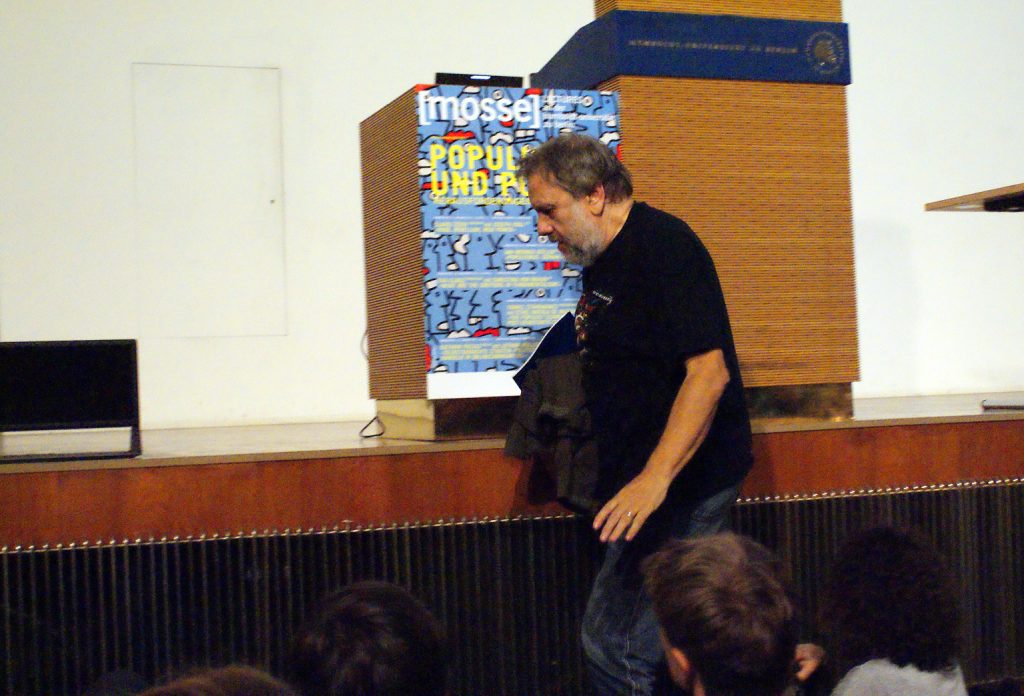
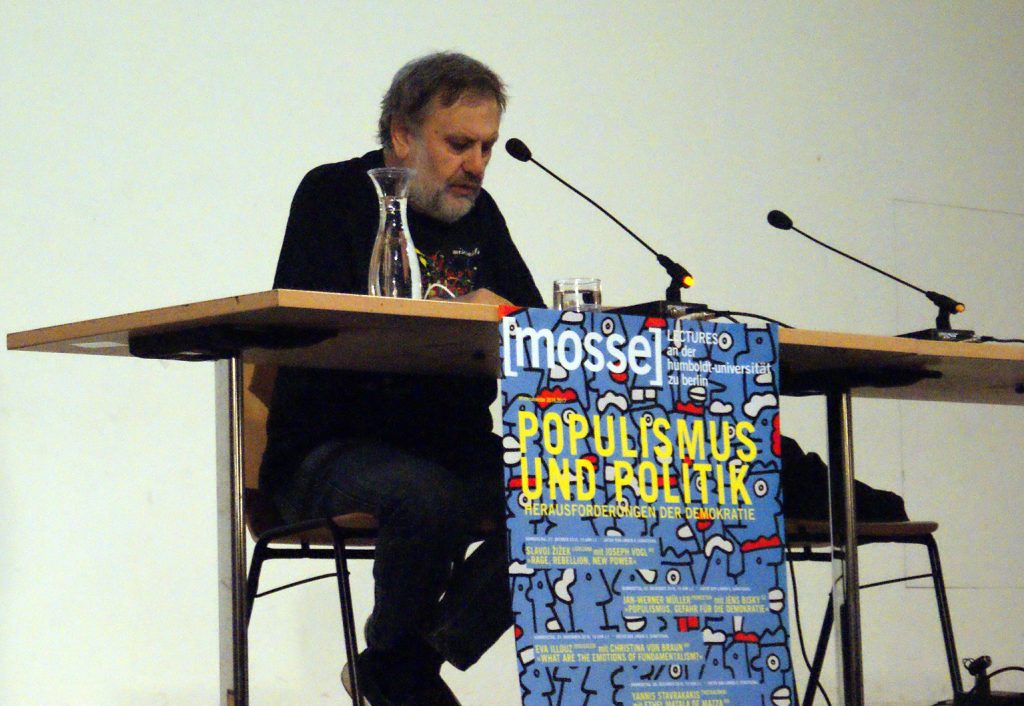
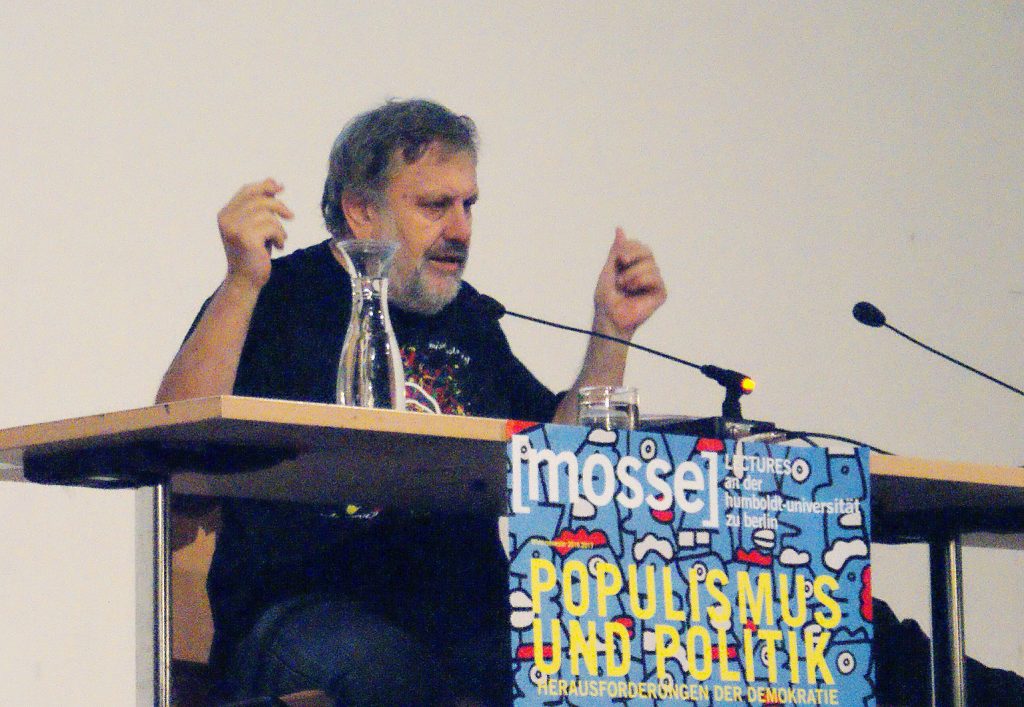
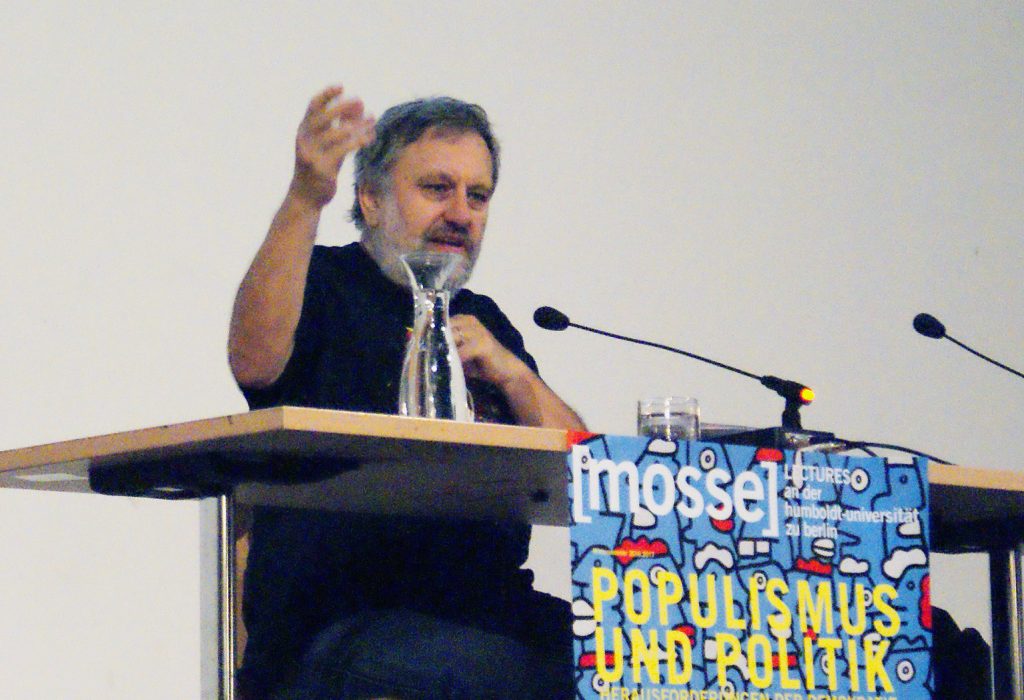
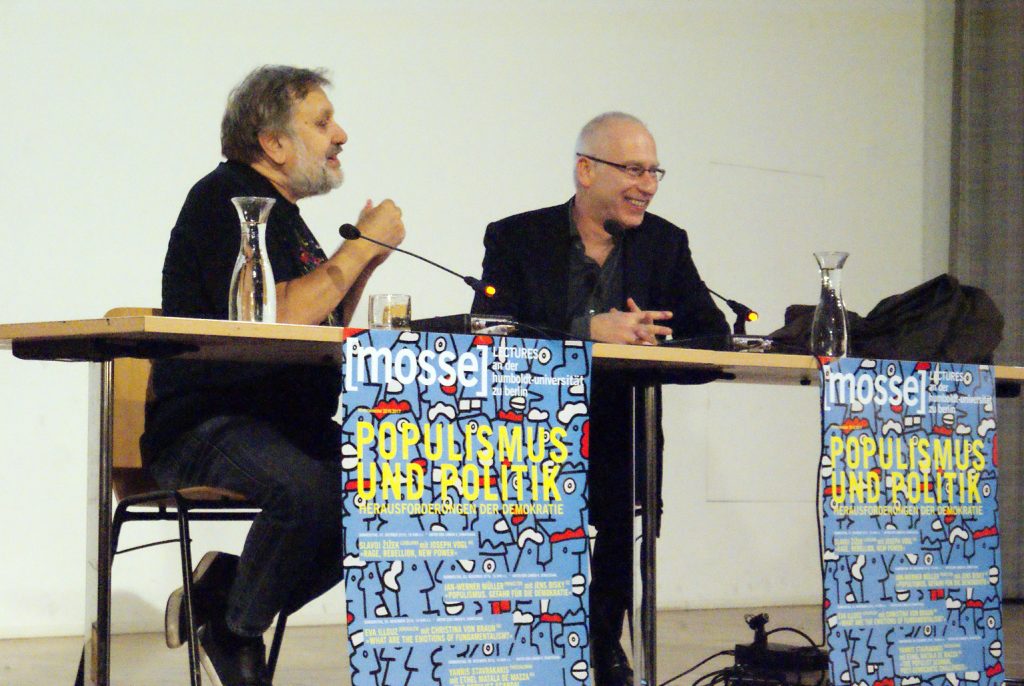
2016: Slavoj Žižek, “Rage, Rebellion, New Power”
Slavoj Žižek, “Rage, Rebellion, New Power”
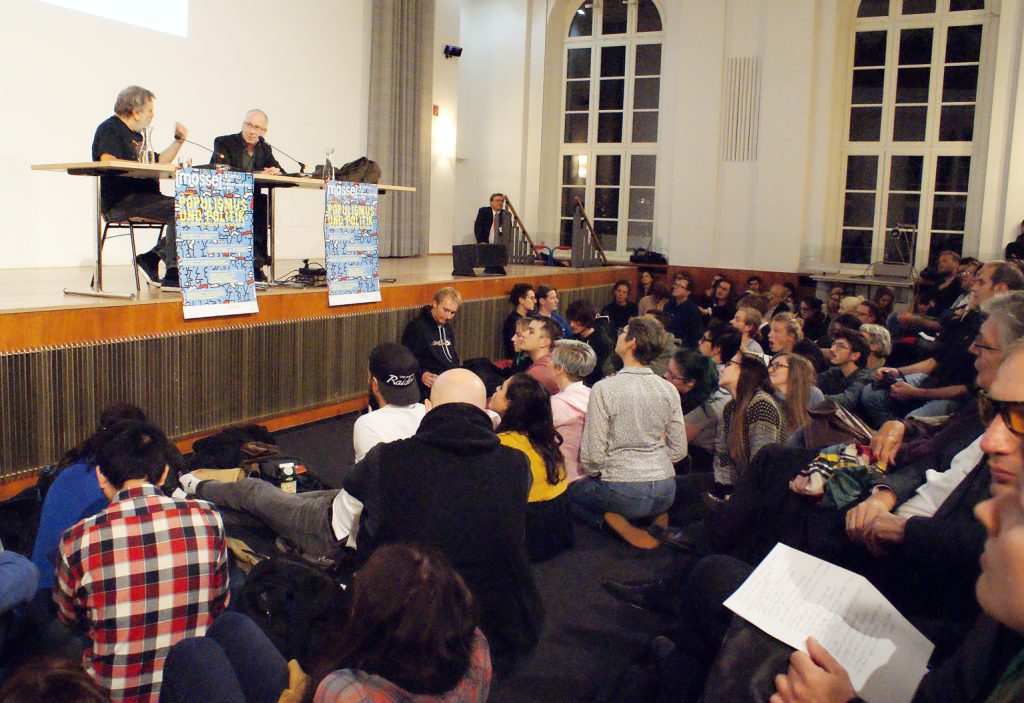
Berlin Mosse Lecture
https://mosselectures.wisc.edu/berlin/
Thursday, 27 October 2016, 19:00 CET
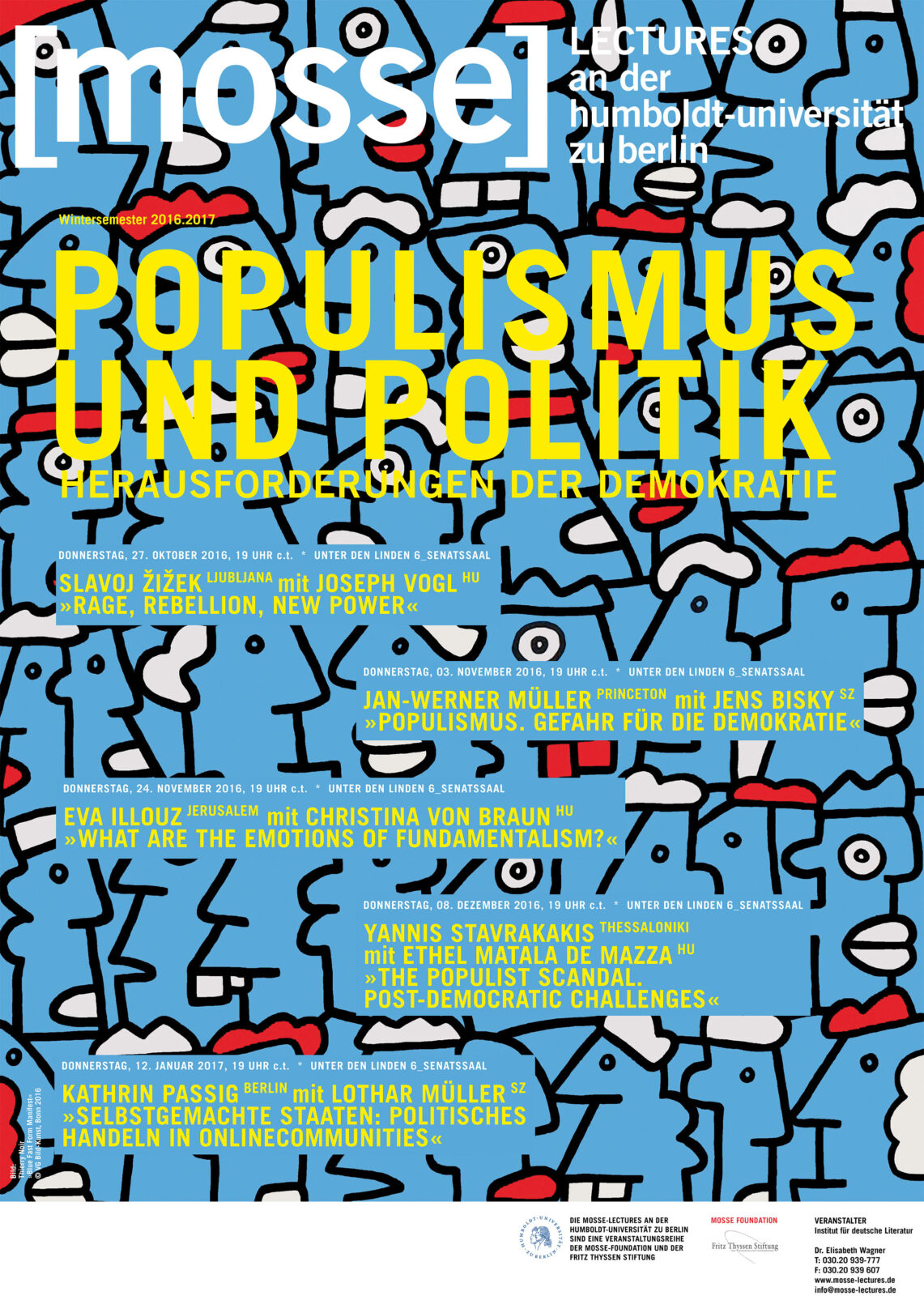
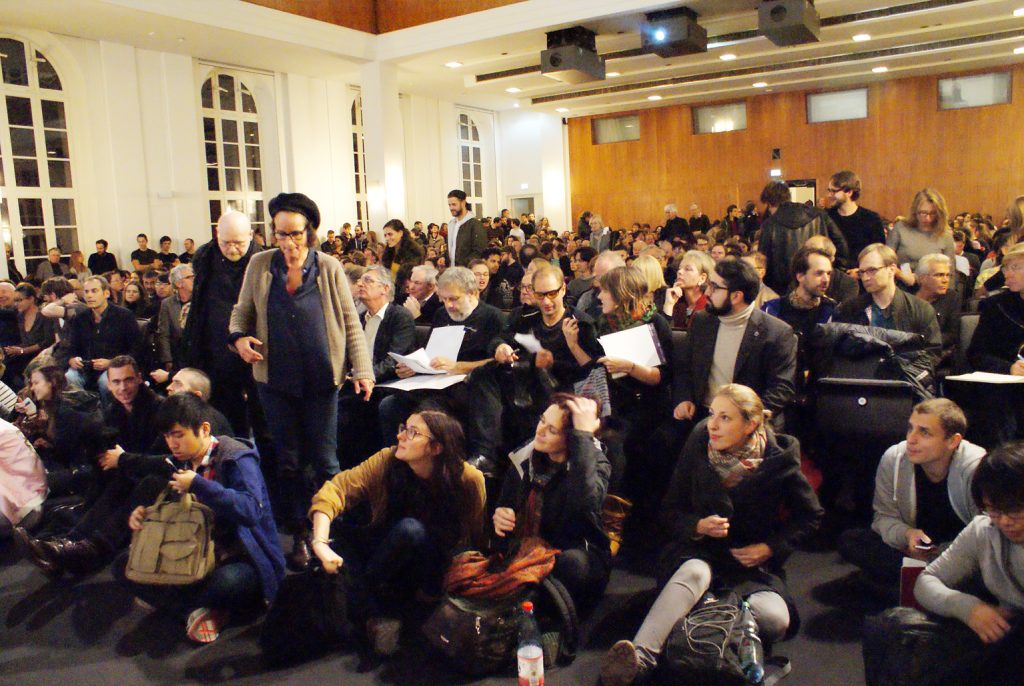
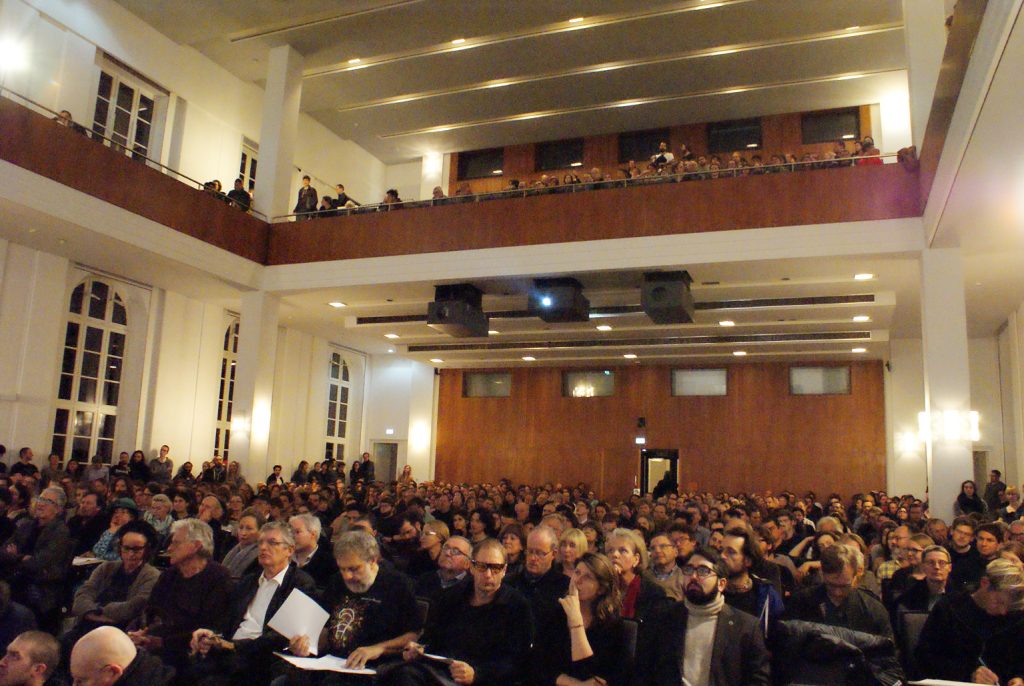
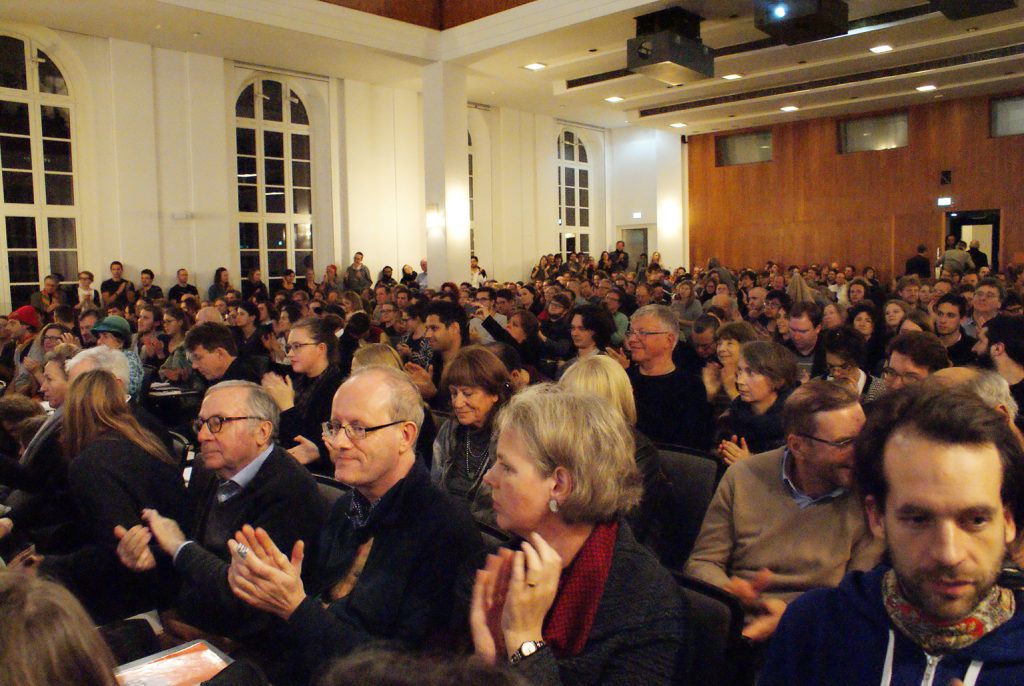
Auditorium maximum of Humboldt University
Unter den Linden 6
10117 Berlin
GERMANY
Sponsored by:
[mosse] LECTURES an der humboldt-universität zu berlin
The Mosse Foundation
Global Mosse Lecture Series
Fritz Thyssen Stiftung
Institut für deutsche Literatur
Humboldt University
Moderator: Joseph Vogl (Humboldt University)
Lecture Description: Das Verhältnis von Wut, Rebellion und neuer Macht bildet eine Art dialektische Triade des revolutionären Prozesses. Am Anfang stehen die mehr oder weniger chaotischen Ausbrüche von Wut, die Unzufriedenheit der Menschen, die sie mehr oder weniger gewaltsam demonstrieren, unorganisiert allerdings und ohne ein klares Ziel. Organisiert sich dieses Wutpotential so entsteht daraus, mit einem Minimum an Organisation, ein mehr oder weniger bewusstes Feindbild und eine Vorstellung davon, was sich zu ändern hätte. Wenn am Ende die Rebellion erfolgreich war, so sind die neuen Machthaber mit der gewaltigen Aufgabe kon-frontiert, die neue Gesellschaft zu organisieren – man denke an die Anekdote, die vom Gedankenaustausch zwischen Lenin und Trotzki am Vorabend der Oktoberrevolution erzählt wird. Lenin sagt: »Was passiert mit uns, wenn wir scheitern?« Darauf Trotzki: »Und was passiert mit uns, wenn wir erfolgreich sind?« Das Problem ist, dass wir die Triade von Wut, Rebellion und neuer Macht kaum jemals in die Ordnung eines logisch-schlüssigen Voranschreitens bringen können. Die chaotische Wut breitet sich beliebig und diffus aus oder sie schlägt um in den Populismus der Rechten; die erfolgreiche Rebellion verliert an Kraft und verliert sich in mancherlei Kompromissen. Wenn dies so ist, so müssen wir feststellen, dass die Wut nicht nur am Anfang, sondern auch am Ende so manchen emanzipatorischen Projekts steht, das am Ende scheitert.
Lecture Series Description: “Populism” is a political phenomenon, closely connected with the history of democracy. Presently in official policy and partly in political philosophy it has become a fighting term to qualify so called “populists” as illegitimate profiteers of public anger and politically bungling moralists and opportunists. However, in times of permanent crisis, growing social inequality, and confusing global conflicts in Europe and other parts of the world, in Latin America in particular, populism succeeds politically, confronting established parties and government actions with demands, essential to our understanding of democracy. The term “populism”, common in the Anglosaxon world, where it originated, still has a positive meaning there, in the sense of communitarian self-organization in opposition to private profit and the privileges of the political class. Emerging mass democracy faces the dilemma that the people can execute their sovereignty in acts of periodical voting only, thus delegating every day politics to their representatives. Rulers and ruled find themselves bound in an ambivalent relationship. The “political” in its original meaning of a personal experience and a collective imagination – the “participation of the nonparticipants” which Jacques Rancière has referred to – can never be monopolized completely by official politics. Though different, populist movements have in common that they raise issues of participation as well as those of dissociation and dissent often neglected by political professionals. Lacking a mandate, populists are powerful in their rhetoric, absorbing resentment and animosity, emerging at the fringes of civil society, and also at its heart.
This program of the Mosse-Lectures will deal with the fractures of democracy, the uneasy relationship of democracy and demagogy, of populism and extremism. A cultural critique of populism should guide us to the political experience of a democracy popular with its citizens.
Slavoj Žižek: Professor für Philosophie an der Universität Ljubljana und seit 2007 International Director des Birkbeck Institute for the Humanities an der University of London. Mit seinen zahlreichen, zumeist ins Deutsche übersetzten Monographien und durch seine publizistische Tätigkeit gilt er als einer der wichtigsten Theoretiker und Kritiker marxistischer und psychoanalytischer Provenienz; zuletzt erschienen: »Blasphemische Gedanken. Islam und Moderne« (2015), »Der neue Klassenkampf. Die wahren Gründe für Flucht und Terror« (2015), demnächst auch auf Deutsch: »Against the Double Blackmail: Refugees, Terror, and Other Troubles with the Neighbours«
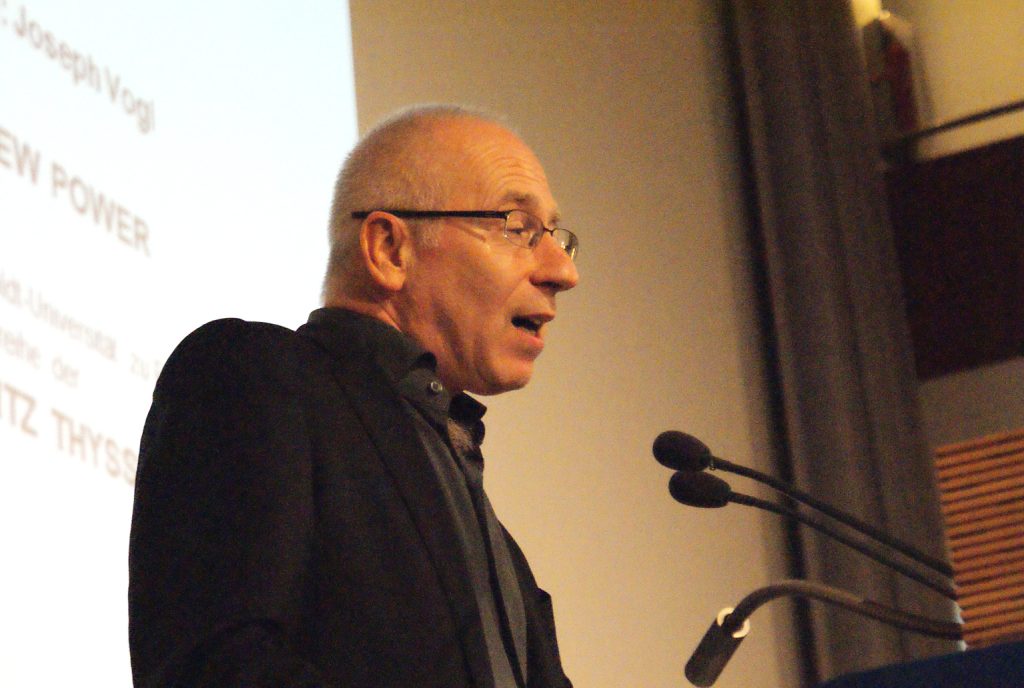

His research and teaching comprises literature from the eighteenth to the twentieth century, media and aesthetics, cultural and political theory. Recent research focuses on the history of financial economy, literature and economics, and the “poetics of knowledge” – the study of the relationships and interactions between forms of knowledge and poetic or aesthetic figures. He is the director or principal investigator of a range of research projects including “The Knowledge of Literature” (PhD-Net), “Small Forms in the History of Literature and Sciences” (Research Training Group), and “Matters of Activity: Image Space Material” (Cluster of Excellence).
Joseph Vogl published more than a hundred articles and book chapters, as well as numerous books and monographs. Among his most important written works are the monographs Ort der Gewalt. Kafkas literarische Ethik (1990); Kalkül und Leidenschaft. Poetik des ökonomischen Menschen (2002); Über das Zaudern (2007; On Tarrying, 2011). Besides his research in literature, cultural and media studies, he is well known for his intensive work on modern and present-day finance and economics, analyzing finance theories from the perspective of cultural history. This work culminated in his books Das Gespenst des Kapitals (2010; The Specter of Capital, 2014), Der Souveränitätseffekt (2015; The Ascendancy of Finance, 2017) and Kapital und Ressentiment. Eine kurze Theorie der Gegenwart (2021; Capital and Ressentiment: A Brief Theory of the Present, 2022), which received wide recognition in the fields of cultural studies as well as economics, and initiated a public debate. Further workings include translations from French to German (Deleuze, Lévi-Strauss, Lyotard) and numerous interviews on TV with Alexander Kluge (see Soll und Haben. Fernsehgespräche, 2009; Senkblei der Geschichten. Gespräche, 2020).
He was awarded the Günther Anders Prize for Critical Thinking (2022). For his book Der Souveränitätseffekt (The Ascendancy of Finance) Vogl was on the shortlist for the Leipzig Book Fair Prize 2015 in the category of non-fiction. In 1988 he received the Translation Prize for the Promotion of Franco-German Relations (DVA Foundation) for his translations of key works of modern French philosophy.
