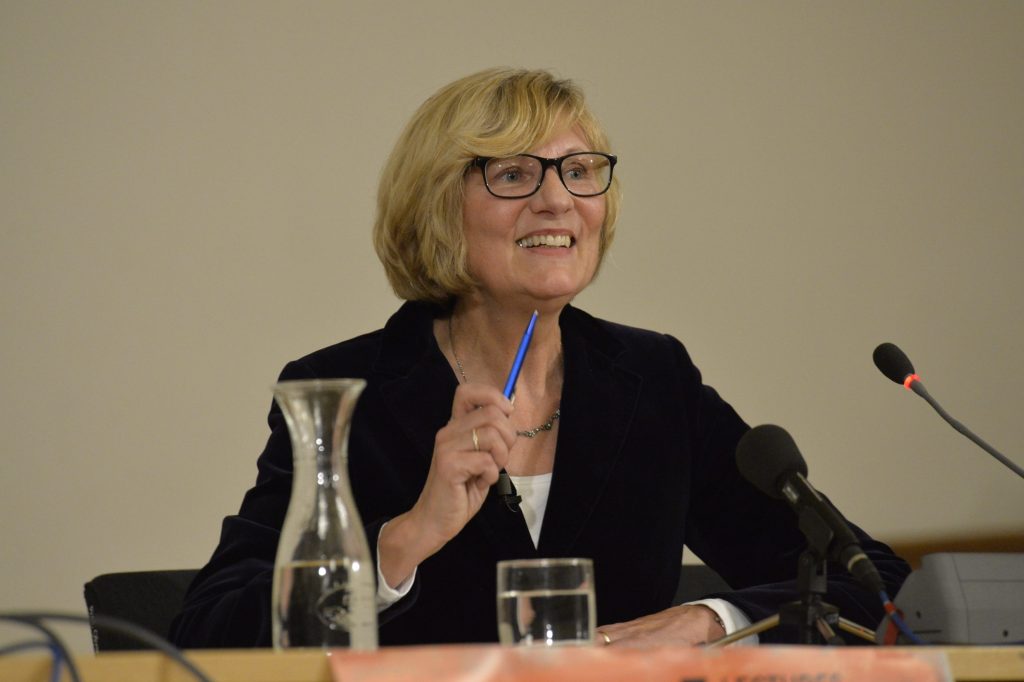
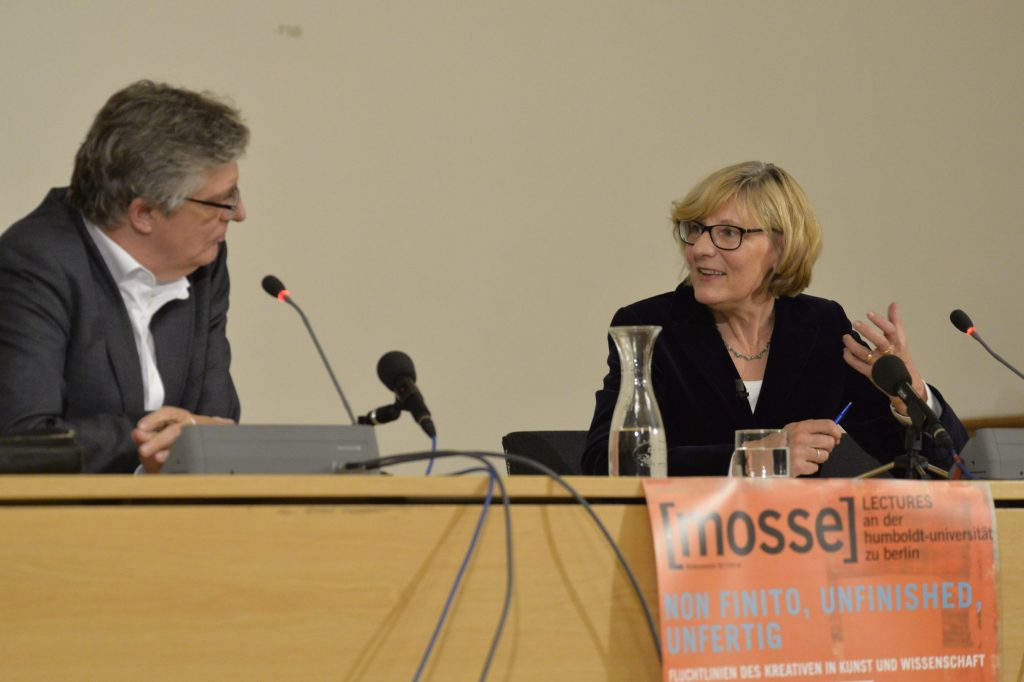
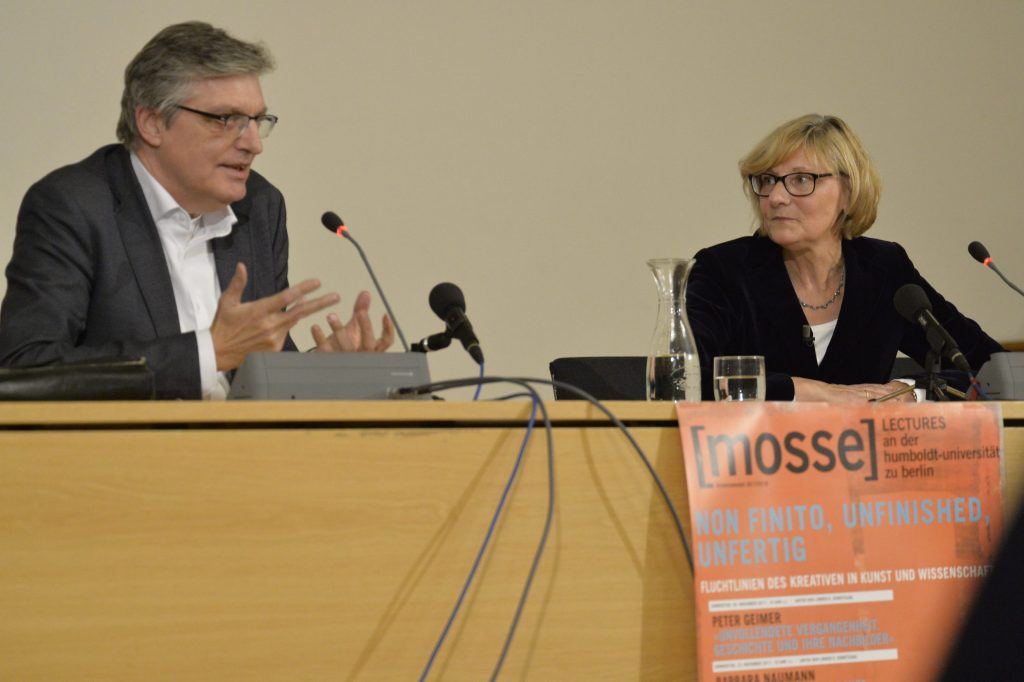
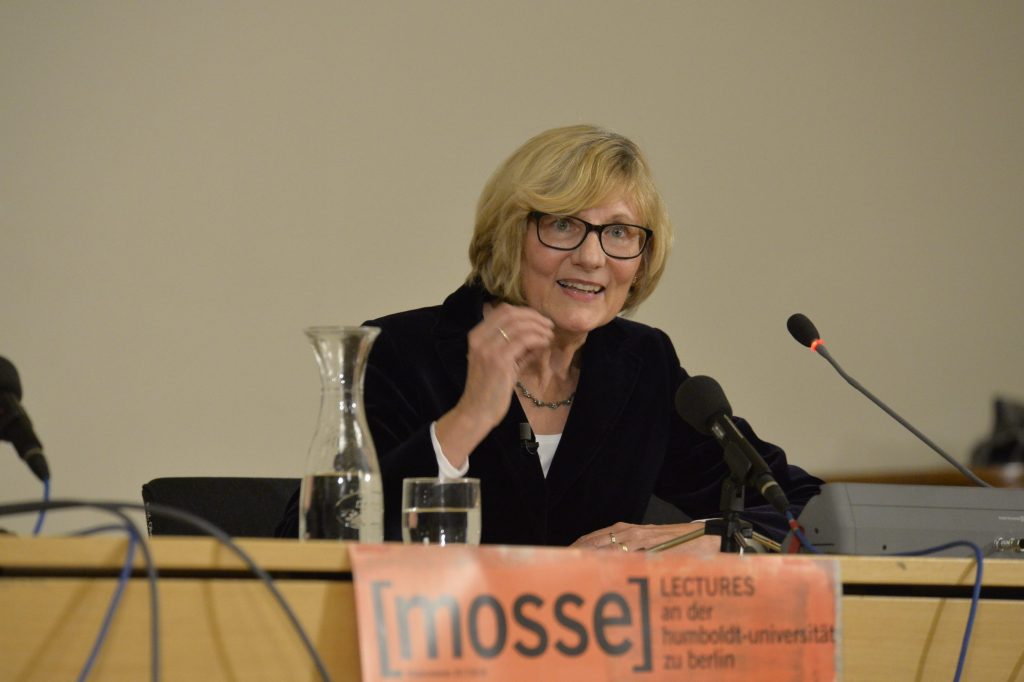
2017: Barbara Naumann: “Das unvollständige Ganze. Die unendliche Rede in Marcel Prousts ‘Recherche’” / “The Incomplete Whole: The Never-Ending Speech in Marcel Proust’s ‘Research’”
Barbara Naumann, “Das unvollständige Ganze. Die unendliche Rede in Marcel Prousts ‘Recherche'” / “The Incomplete Whole: The Never-Ending Speech in Marcel Proust’s ‘Research'”
Berlin Mosse Lecture
https://mosselectures.wisc.edu/berlin/
Thursday, 23 November 2017, 19:00 CET
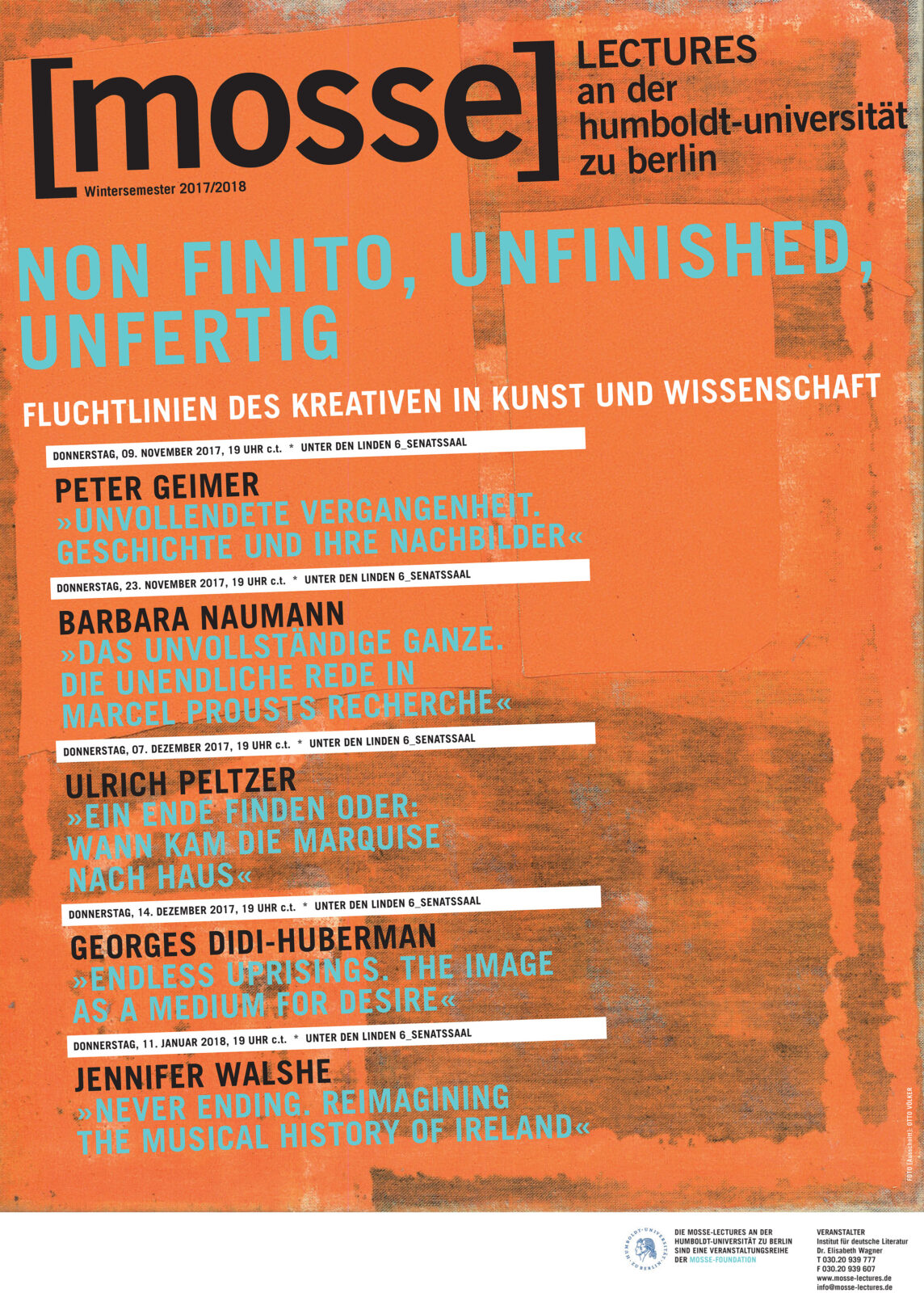
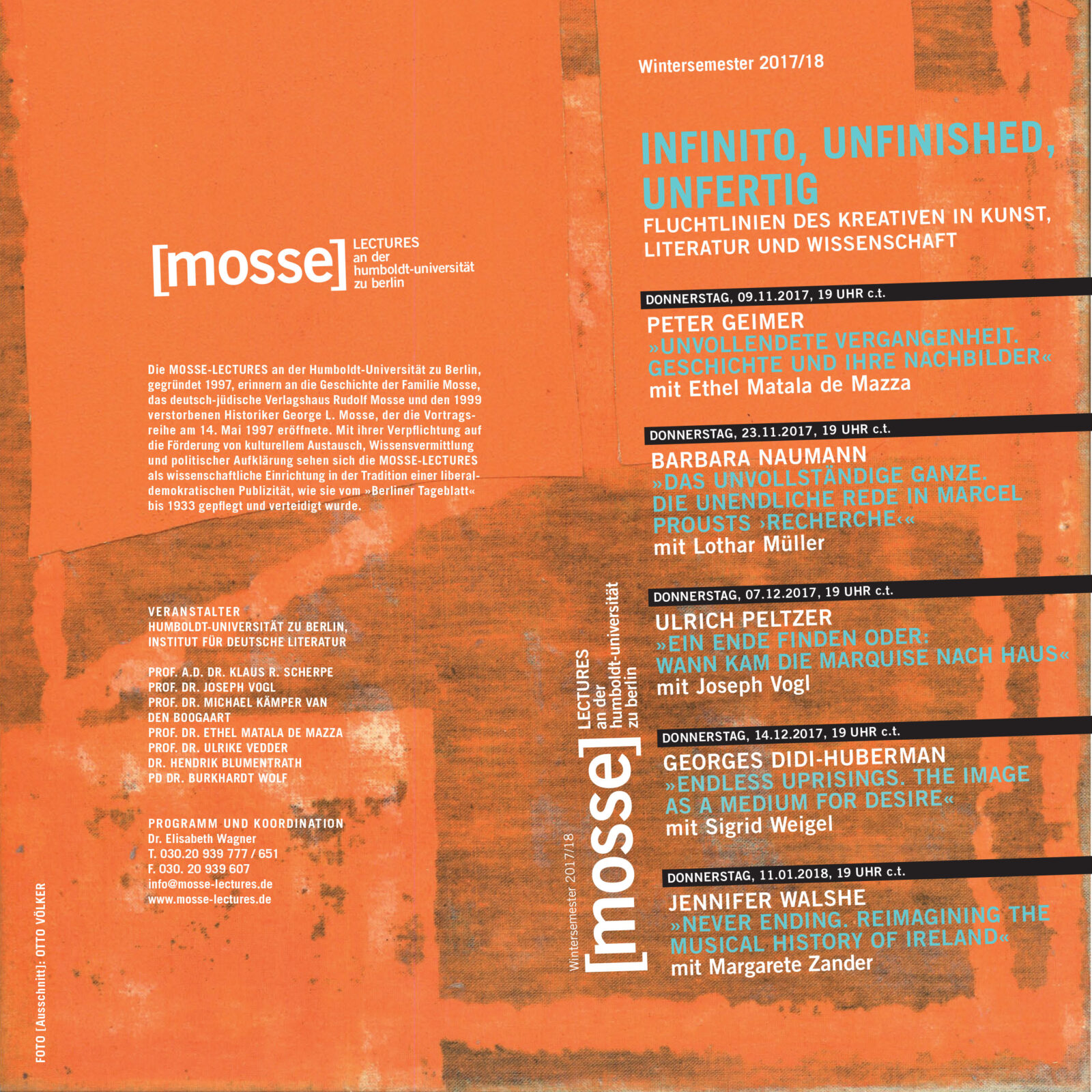
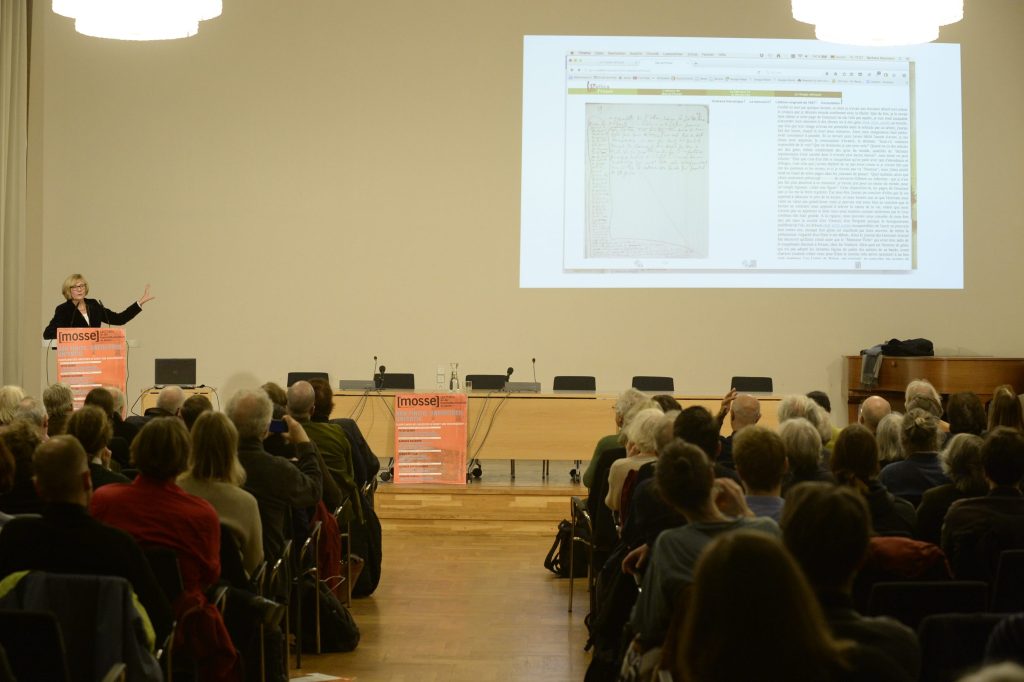
Senatssaal of Humboldt University
Unter den Linden 6
1. Stock
10117 Berlin
GERMANY
Sponsored by:
[mosse] LECTURES an der humboldt-universität zu berlin
The Mosse Foundation
Global Mosse Lecture Series
Institut für deutsche Literatur
Humboldt University
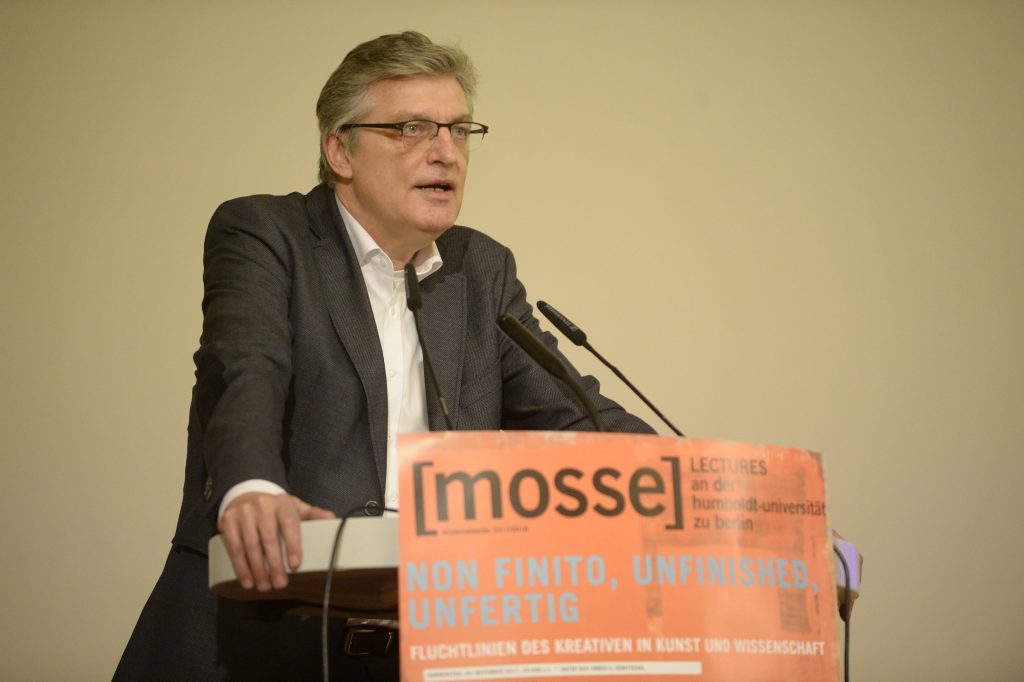
Moderator: Lothar Müller (Humboldt University)
Lecture Description: Prousts großes Romanwerk “Auf der Suche nach der verlorenen Zeit” (À la recherche du temps perdu) steht unter dem Vorzeichen eines Widerstreits: dem Antagonismus zwischen dem Willen zur geschlossenen Form und der Tendenz zur grenzenlosen Plauderei, zum endlosen Geschwätz. Dieser Widerstreit lässt sich bereits an der Werkgenese beobachten: Proust schrieb den Anfang und den Schluss des Romans zuerst. Er setzte mit der “wiedergefundenen Zeit” einen meta-physischen Rahmen, um dann die Erfahrung machen zu müssen, dass sein Werk aus der Mitte heraus zu einem endlosen Quell des Schreibens mutierte. Das Ausufern der Erzählung lässt sich in den ins Manuskript eingeklebten “Paperoles” bereits auf materieller Ebene nachvollziehen. Die von Proust intendierte metaphysische Rettung verlorener und vertaner Zeit im Romankunstwerk erweiterte sich im Prozess des Schreibens zu einem Unternehmen, dem nichts zu unwichtig, zu entlegen, zu ephemer sein konnte, um Erwähnung zu finden. Der Roman öffnet sich für die großen Fragen der Kunst, des Lebens und Sterbens ebenso wie für den ganz und gar unmeta-physischen Klatsch, Tratsch und das Rauschen alltäglicher Kleinigkeiten. Es ist die endlose Plauderei, die in Prousts Roman Regie führt.
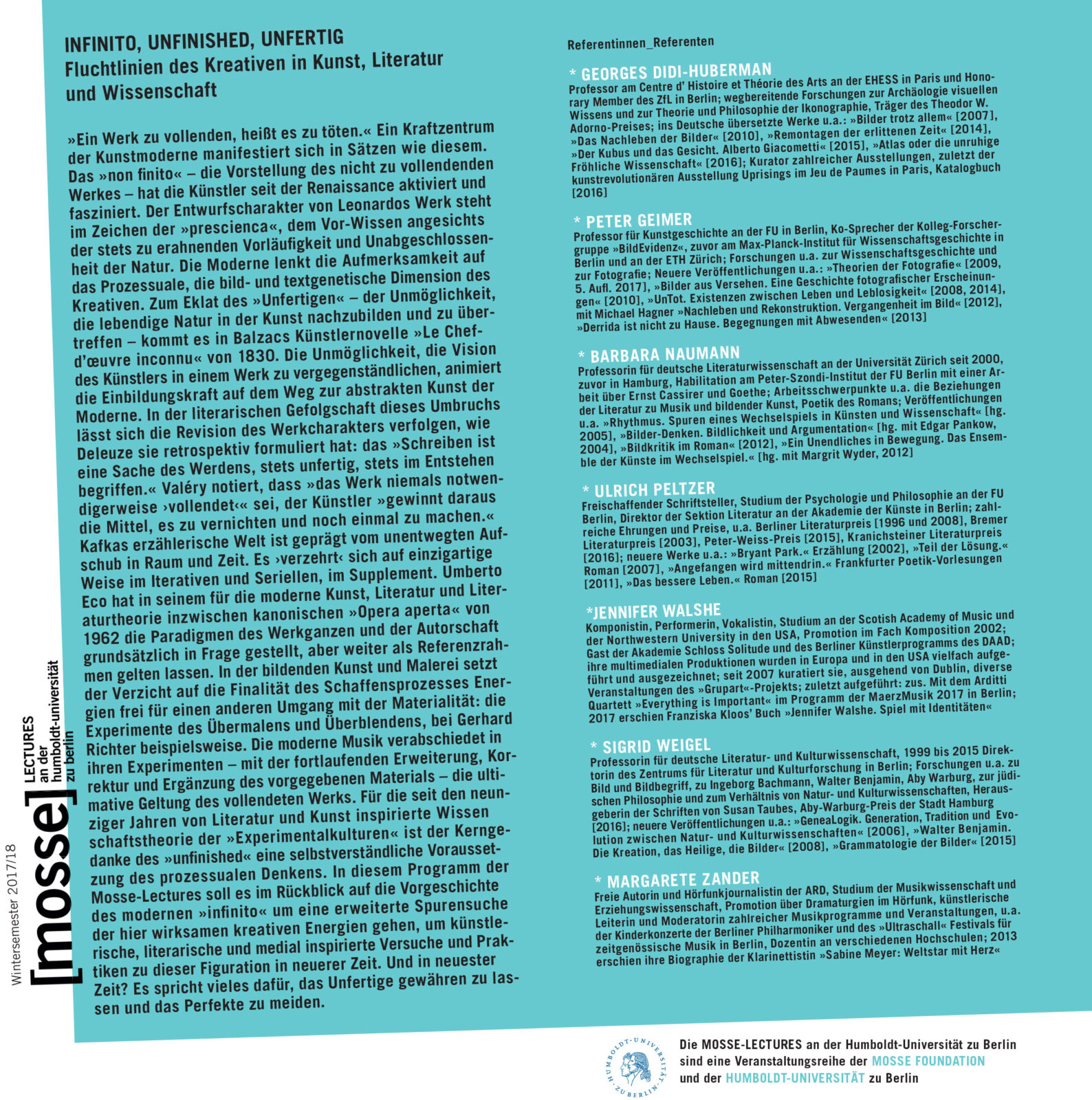
Lecture Series Description: “To complete a work means to kill it.” Manifestos of modern art have their center of energy in such sayings. The non finito – the idea of a work not to be completed – has fascinated artists since the Renaissance. The prospective design of Leonardo’s work acknowledges prescienza: the provisional and unfinished nature of creative work. In modernity process becomes dominant, thus emphasizing the genetic production of texts and images, all the way to the dissolution of the medium of representation itself. The scandal of the unfinished – the sheer impossibility to reproduce and surpass living nature in a work of art – erupts in Balzac’s “Le Chef-d’oeuvre inconnu”, published in 1830. The impossibility to fully materialize the artist’s vision can further be traced in the concept of aesthetic autonomy as it leads to modernist abstraction. In literature, too, we can observe how the original concept of the work as a whole is revised, when Deleuze states retrospectively: “writing is a thing of becoming, always unfinished, always in the making.” Valéry has noted that “by necessity, the work can never be completed”; the writer thus “gains a means to destroy it and make it anew.” Kafka’s narrative world is shaped by a permanent deferral in time and space; it ‘consumes’ itself in its modes of iteration, seriality, and supplementation. In his “Opera aperta” of 1962, canonical by now in literature, literary criticism and art studies, Umberto Eco has questioned the paradigms of authorship and the work as a whole, though still accepting them as an inevitable frame of reference. As the visual arts renounce the finality of the creative process, energies are set free to deal with materiality differently: the cross media experiments of overpainting and superimposing. In their experiments of extending, supplementing and revising the musical material, composers have dismissed the previous validity of completion. In recent times, software supported computer art has explored new ways of unlimited. Since the nineties, the theory of science, creatively inspired by art and literature, has privileged so called “experimental cultures”, where the notion of the unfinished is front and center. This set of Mosse-Lectures will review the past history of the non finito, and search for marks and signs of the unfinished in present day cultural production. We hope to trace and probe the creative energies of this configuration in practical artistic work and in theory.
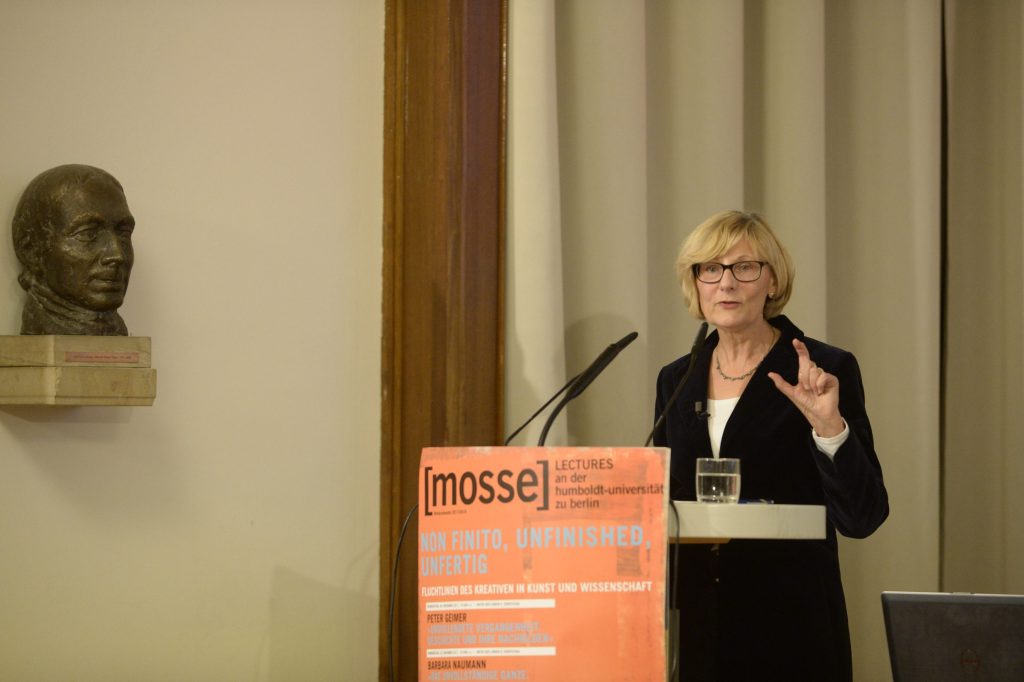
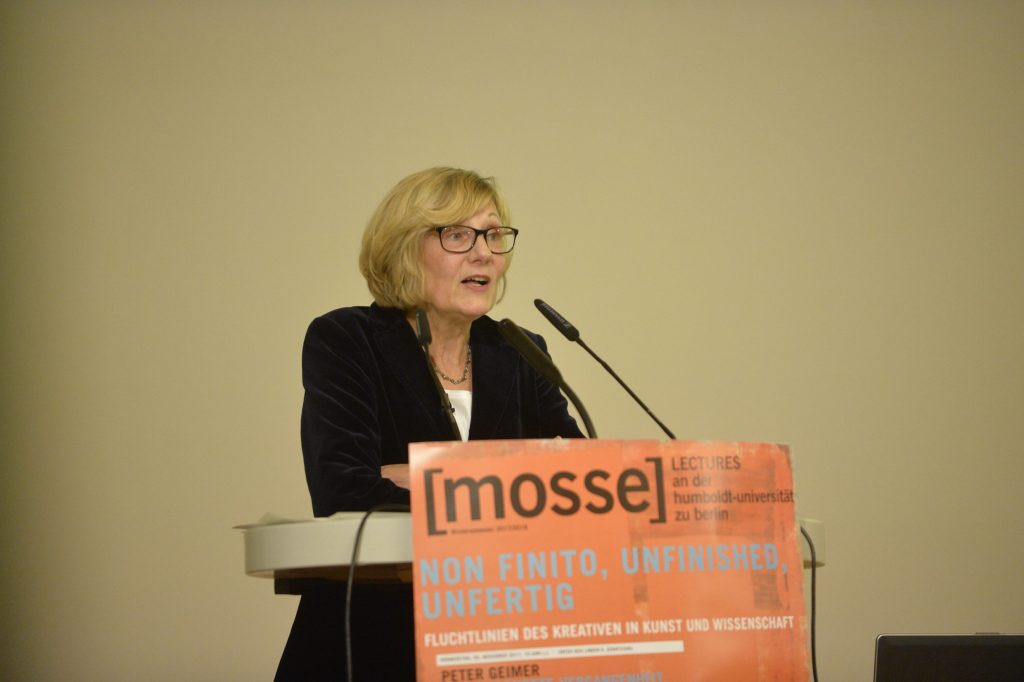
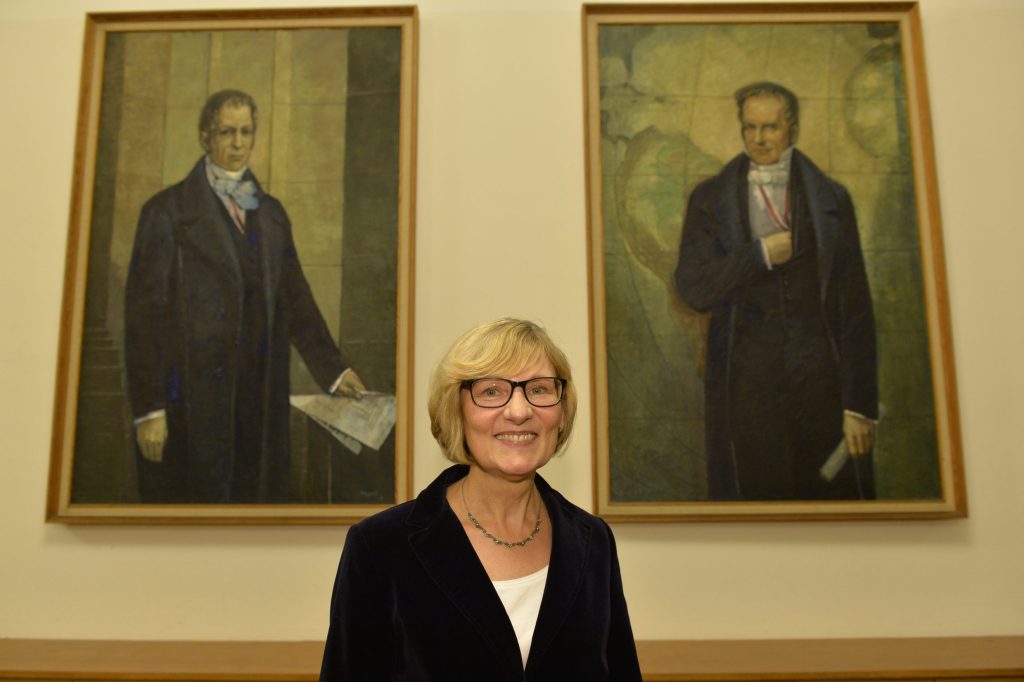
Barbara Naumann: Barbara Naumann ist Professorin für deutsche Literaturwissenschaft an der Universität Zürich seit 2000, zuvor in Hamburg, Habilitation am Peter-Szondi-Institut der FU Berlin mit einer Arbeit über Ernst Cassirer und Goethe; Arbeitsschwerpunkte u.a. die Beziehungen der Literatur zu Musik und bildender Kunst, Poetik des Romans; Veröffentlichung u.a. “Rhythmus. Spuren eines Wechselspiels in Künsten und Wissenschaft” (hg. 2005), “Bilder-Denken. Bildlichkeit und Argumentation” (hg. mit Edgar Pankow, 2004), Bildkritik im Roman” (2012), “Ein Unendliches in Bewegung. Das Ensemble der Künste im Wechselspiel” (hg. mit Margrit Wyder, 2012).
Lothar Müller has worked as an editor for the Frankfurter Allgemeine Zeitung and the Süddeutsche Zeitung, and lectured at the Institute for Comparative Literature at the Free University. Since 2010, he has served as Honorary Professor in the Institute for German Literature at the Humboldt University Berlin. He is the author of numerous publications, including Adrien Proust und sein Sohn Marcel. Beobachter der erkrankten Welt (2021) and Weiße Magie. Die Epoche des Papiers (2012). He was awarded the Berlin Prize for Literary Criticism in 2013.