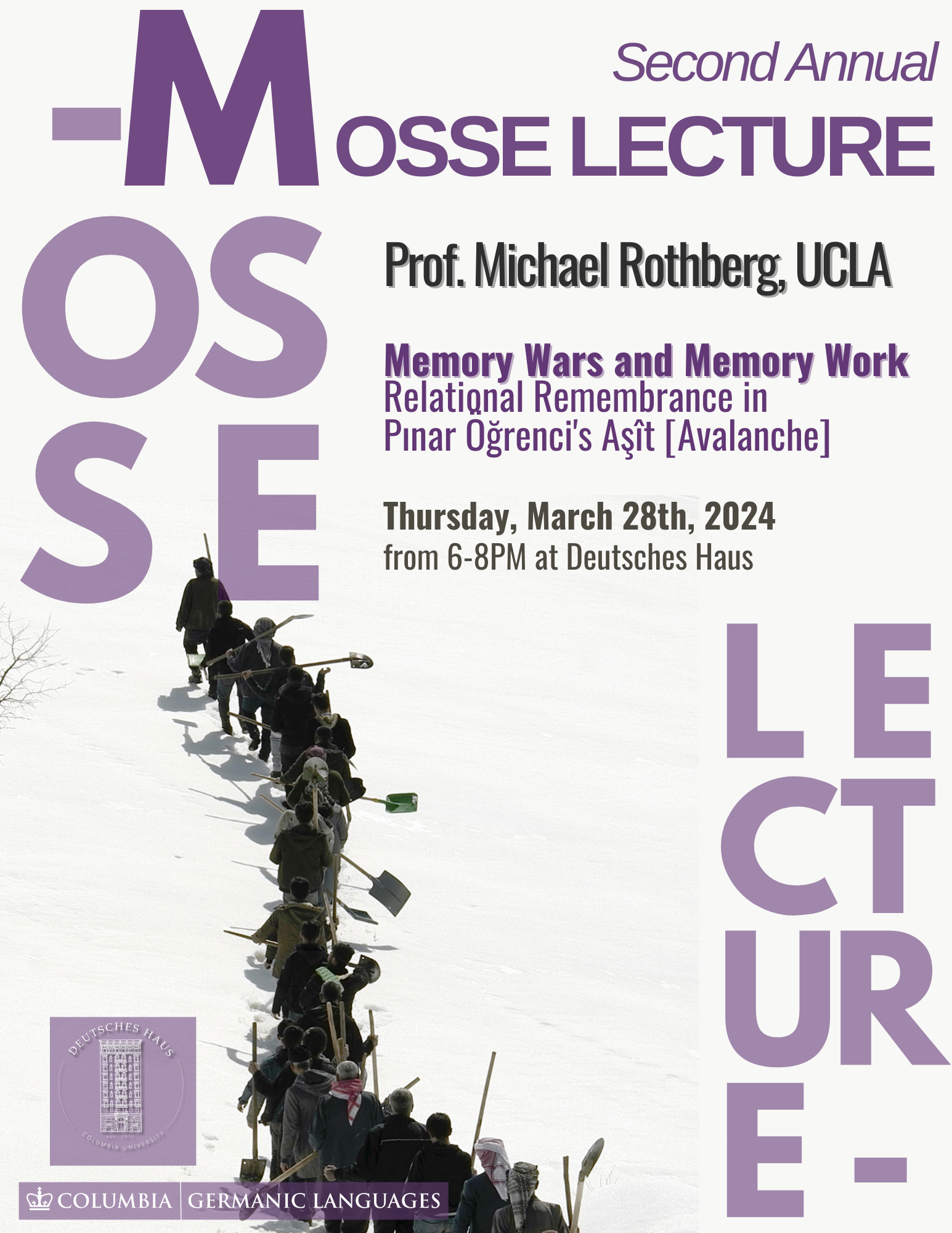
2024: Michael Rothberg, “Memory Wars and Memory Work: Relational Remembrance in Pınar Öğrenci’s Aşît [Avalanche]”
Michael Rothberg, “Memory Wars and Memory Work: Relational Remembrance in Pınar Öğrenci’s Aşît [Avalanche]”
Columbia University Mosse Lecture
mosselectures.wisc.edu/columbia
This lecture was published and is available to download for free: Michael Rothberg, From Memory Wars to Memory Work: Relational Remembrance in Pınar Öğrenci’s Aşît [The Avalanche] (Halle an der Saale: Universitätsverlag Halle-Wittenberg, 2026).
Thursday, 28 March 2024, 18:00-20:00 EST
Columbia University
Deutsches Haus
420 W 116th St.
New York, NY 10027
Chair: Claudia Breger (Columbia University)
Comment: Sonali Thakkar (New York University)
Sponsored by:
Global Mosse Lecture Series
The Mosse Foundation
George L. Mosse Program in History
Columbia University Department of Germanic Languages
Columbia University Department of Middle Eastern, South Asian, African Studies
Columbia University European Institute
Columbia University Institute for Comparative Literature and Society
Columbia University Seminar on Cultural Memory
Columbia University Society of Fellows and Heyman Center for the Humanities
Lecture Description: During the last few years, a series of acrimonious debates has taken place in Germany about Holocaust memory, antisemitism, and Israel/Palestine. In one of the most visible of those disputes, an enormous scandal rocked the 2022 Documenta 15 international art exhibit in Kassel. Set against the backdrop of Documenta, this lecture will review the recent memory wars in Germany and then turn to a work that was displayed at Documenta but was not part of the controversy swirling around the exhibit: Pınar Öğrenci’s film Aşît [The Avalanche]. This film, which concerns the tangled histories of violence directed against Armenians and Kurds in a remote town in eastern Turkey, does not address the terms of the German debate directly. However, as Rothberg will argue, in weaving together multiple histories of exile, trauma, and catastrophe, Aşît offers a mode of relational remembrance that suggests alternative possibilities for coming to terms with the past in contemporary Germany—and beyond.
Following his lecture, Professor Rothberg will be joined in conversation by Professor Sonali Thakkar of NYU, whose work focuses on postcolonial literature and theory and anticolonial thought and politics. A reception will conclude the evening.
Lecture Series Description: Each year the annual Mosse Lecture, presented by the Columbia Department of Germanic Languages, seeks to honor the legacy of the progressive Mosse publishing house founded by Rudolf Mosse, which helped to shape the democratic public sphere during the German Weimar Republic. Descendants of the Mosse Family include Prof. George L Mosse, the acclaimed historian of fascism, Dr. Hilde L. Mosse, a distinguished child psychiatrist who worked with Harlem children suffering from reading disabilities, Hans Strauch, an accomplished architect, and Roger Strauch, a successful high technology entrepreneur and venture capitalist. Hans and Roger co-lead The Mosse Foundation’s efforts to sustain and promote the Mosse Family’s philanthropic legacy to support distinguished educational, research, health, and arts institutions and progressive causes.
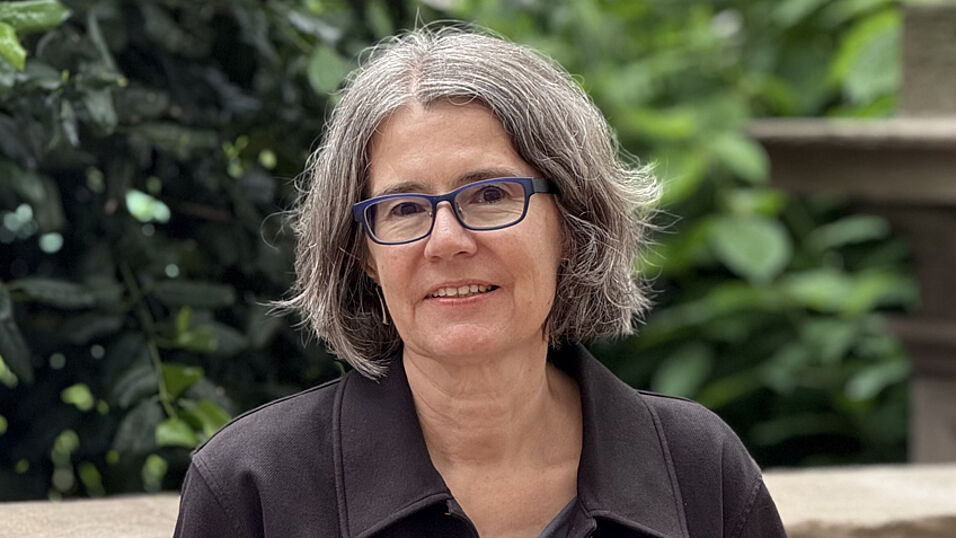
She is particularly interested in combining theory with historical perspectives, and cultural studies approaches with aesthetic inquiries and close reading practices. Her earliest book, Ortlosigkeit des Fremden (1998), traces the genealogy of modern representations of Romani and other itinerant people at the intersection of race and gender around 1800. Prof. Breger’s second book, Szenarien kopfloser Herrschaft (2004), investigates reconfigurations of royal imaginaries beyond sovereignty in twentieth-century German culture, in scenarios ranging from imperial Egyptology to queer drag king performances. More recent book publications include An Aesthetics of Narrative Performance: Transnational Theater, Literature and Film in Contemporary Germany (2012) and Making Worlds: Affect and Collectivity in Contemporary European Cinema (2020). She is currently completing a book manuscript that rethinks political aesthetics in a dialogue between twentieth-century Critical Theory and contemporary perspectives in new materialism and Actor-Network-Theory, affect, queer, and Black radical theory.