
2010: Paul Rabinow, “An Experiment in Discordancy: Reflections on Familiarity, Trust and Confidence in Synthetic Biology”
Paul Rabinow, “An Experiment in Discordancy: Reflections on Familiarity, Trust and Confidence in Synthetic Biology”
Berlin Mosse Lecture
https://mosselectures.wisc.edu/berlin/
Thursday, 18 November 2010, 19:00 CET
Senatssaal of Humboldt University
Unter den Linden 6
1. Stock
10117 Berlin
GERMANY
Sponsored by:
[mosse] LECTURES an der humboldt-universität zu berlin
The Mosse Foundation
Global Mosse Lecture Series
Fritz Thyssen Stiftung
Gerda Henkel Stiftung
Institut für deutsche Literatur
Humboldt University
Lecture Description: Mit Bezug auf Niklas Luhmanns Unterscheidung von Vertrautheit, Zuversicht und Vertrauen und John Deweys »Reconstruction in Philosophy« berichtet der Vortrag von einem Selbstversuch: von den Problemen, auf die ein Anthropologe stößt, wenn er den Versuch macht, als »teilnehmender Beobachter« die Forschungspraktiken und Risiken der synthetischen Biologie zu rekonstruieren. Der Vortrag thematisiert die unterschiedlichen Methoden und wechselseitigen Beziehungen zwischen den Biowissenschaften und den Humanwissenschaften: ein unausgeglichenes Machtverhältnis. Zu beobachten sind Gegensätzlichkeiten des forscherischen Verhaltens und verantwortlichen Handelns. Kann es dennoch im Luhmannschen Sinne ein »Systemvertrauen« geben, mit dem nach der Risikobewältigung, nach dem nächsten Schritt gefragt wird, der zu gehen ist?
Lecture Series Description: In times of global economic crisis, increasing worries about the stability of states and political systems and, in view of profound demographic changes, attention focuses inevitably on processes which determine continuity and transformation of cultures, as well as their finite nature and downfall. What procedures, interests and institutions ensure and renew the cultural reproduction as tradition, heritage or memory? What is the role of literature and art, educational policy or – particularly relevant today – the transdisciplinary life sciences, and how do their procedures of reproduction relate to current economical and ecological circumstances? How do we act on the basis of things that have long been negotiated? Or do modern reproduction techniques detache the reproduced completely from tradition, as Walter Benjamin suggested? What are the challenges to reproducing existing systems of science and art, of legislative and religious norms? And what differential quality is intended when the anthropologist Homi Bhabha describes cultural reproduction succinctly as „always the same, but not quite“?
In a series of historical and contemporary contributions which have their focal point in the upheavals and reforms of society, the Mosse-Lectures look at the dynamics and crises of cultural reproduction. Questions range from cultural history and theory to variegated expert knowledge and current interventions and governmental practices. What role do crises and the perception of crises play for the optimization or the dissolution of social and political systems? What factors determine the duration and the transformation, the securing and the erosion of cultural units? In which way do the social, biological and symbolical processes of reproduction correspond or diverge? What historic and current forms of knowledge are invoked in each case?
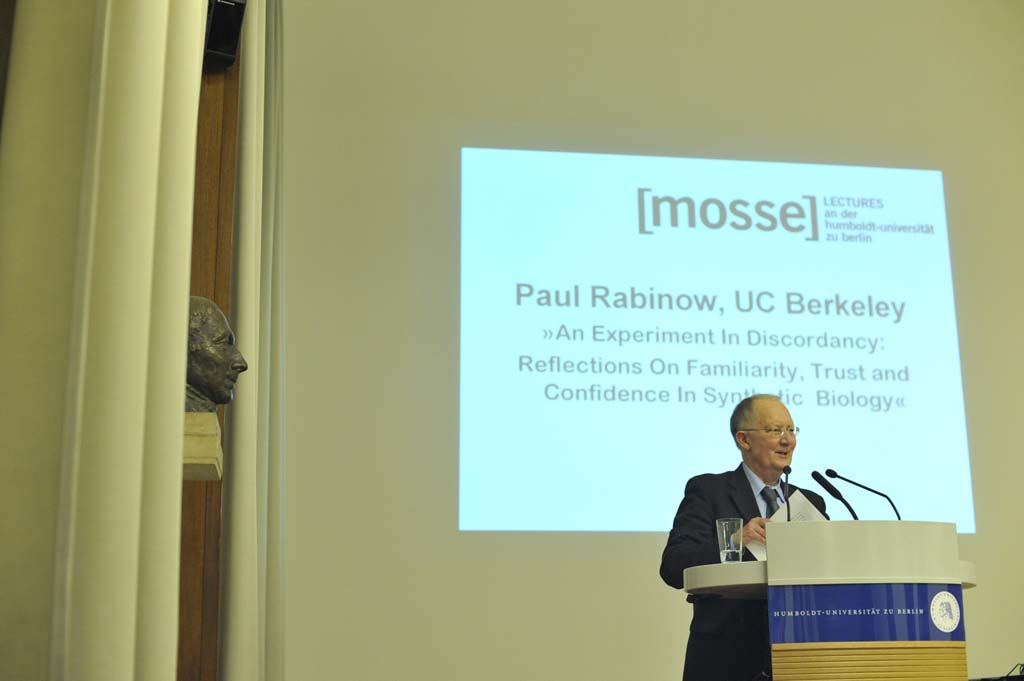
Photo Credit: Niels Leiser for the Mosse Lectures
Paul Rabinow: Professor für Anthropologie an der UC Berkeley, studierte an der University of Chicago und an der École Practique des Hautes Études in Paris. Seine Forschungsarbeiten haben ihren gemeinsamen Fokus in der Modernität als Problem, das sich ihm in der marokkanischen Feldforschung ebenso stellt wie in den Beziehungen von Wissen und Macht in der französischen Sozialplanung bis hin zu den Arbeiten im letzten Jahrzehnt zu den Lebenswissenschaften. Publikationen u.a.: Anthropos Today. Reflections on Modern Equipment (2003); Marking Time. On the Anthropology of the Contemporary (2007); »Concept Work« in Genetics and Social Sciences (2007); mit G. Marcus: Designs for an Anthropology of the Contemporary (2008). Auf Deutsch sind 2004 erschienen: Was ist Anthropologie? und Anthropologie der Vernunft. Für 2011 ist angekündigt: The Accompaniment: Assembling the Contemporary.
