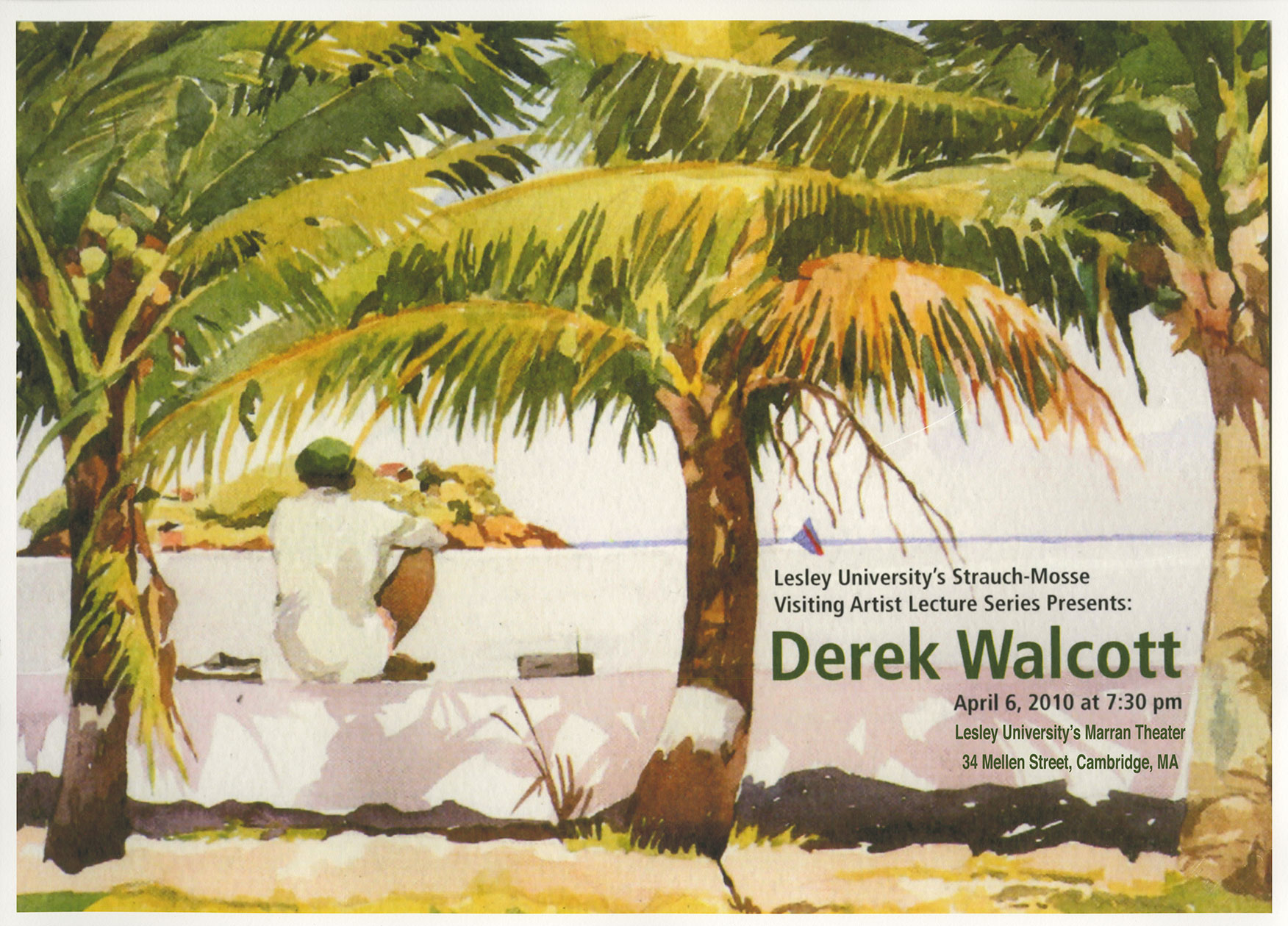
2010: Derek Walcott (1930-2017), “Wolcott Reads ‘White Egrets’”
Derek Walcott (1930-2017), “Wolcott Reads White Egrets”
Strauch-Mosse Visiting Artist Lecture Series at Lesley University
https://mosselectures.wisc.edu/boston/
Tuesday, 6 April 2010, 19:30 EST
Sponsored by:
Global Mosse Lecture Series
The Mosse Foundation
Lesley University
Lesley University
Marran Theater
34 Mellen St.
Cambridge, MA 02138
Lesley University news story:
Derek Walcott reading at Lesley University considers death and absence
April 7, 2010
Nobel laureate Derek Walcott spoke last night about the power of poetry to heal, giving little credence to the idea of writing as therapeutic release.
“I don’t think poets write to console themselves, not good ones,” Walcott, 80, told the audience packed in Lesley University’s Marran Theater. “But I do think that they console others. And they do console.”
Walcott, though, self-described as “old-fashioned, but I don’t care” with his criticism of free verse work and attention to mechanical detail, may find himself deep in the camp of consoler and far from consoled. White Egrets, his new collection of poetry, finds little but loss and loneliness along the wave-swept edges of Walcott’s native St. Lucia, outside the cathedrals of Sicily or rushing in a train along the plains of Andalusia.
“This is an elegy for a very fine young Italian poet, a woman who died,” Walcott said, introducing one reading, and it was as if the entire series of selections left the narrator standing always outside a funeral or surveying from the street a dying Caribbean culture. Later, in Sixty Years After, an elderly man sits in the St. Lucia airport, watching his companion “sitting in her own wheelchair, her beauty hunched like a crumpled flower.”
“The one whom I thought,” he writes, “as the fire of my young life would do her duty to be golden and beautiful and young forever.”
“Small waves still break against the small stone pier,” he recalls, “Where a boatman left me in the orange peace of dusk, a half-century ago.”
“Now the silent knives from the intercom went through us,” he finishes.
Walcott also imagined death as the end of civilization (“And then there was no empire/ all of a sudden”) and, in Barcelona, sound, music and celebration being stripped back from the city (“no practice ecstasy from the trembling tenor”).
The egrets of the title appeared again and again in the Caribbean locales of the readings, a quiet, taunting constant while time passes and death surrounds. They mark a focus for a man left without the people he had or knew.
“This is a book of doomed, Petrarchan, unrequited love; of remorse; of fortitude in measuring old age,” said Rosanna Warren, University Professor at Boston University, when introducing Walcott. “Egret, after all, rhymes with regret.”
Walcott’s visit to Lesley University marked his return to Boston, where he founded the Boston Playwrights’ Theatre at Boston University. In 1992, he won the Nobel Prize in literature. The awards committee wrote at the time that “West Indian culture has found its great poet.”
The reading was funded by the Strauch-Mosse Endowed Fund for Visiting Artists, established in 2008 through a gift from Hans Strauch, President of the Mosse Foundation and Lesley University Trustee. Attendees filled Marran Theater for the reading, as well as a reserve room where the reading was viewed through closed-circuit television.
About White Egrets: From Nobel Prize–winner Walcott comes a 14th collection of poems, richly textured in sound and image, and spanning many countries and memories. From his native Caribbean to Italy, Spain, England, the Netherlands, and the United States, Walcott meditates on the passage of time, fallen empires, bygone love affairs, and mortality. Throughout, in metrically complex verses, he writes about the vocation of the poet with a virtuosic ear and a painterly eye (Walcott is also an accomplished watercolor and oil painter): my craft and my craft’s thought make parallels/ from every object, the word and the shadow of the word/ makes a thing both itself and something else/ til we are metaphors and not ourselves/ in an empirical language that keeps growing. Walcott describes a wistful search for home in these poems—Silly to think of heritage when there isn’t much, he writes—while also expressing deep joy and thanks that he finds his true and permanent home in poetry. This is poetry’s weather, he says of a rainy day in Venice, a lovely moment in a beautiful book. (Apr.)
Copyright © Reed Business Information, a division of Reed Elsevier Inc. All rights reserved.