2004: Dolly Bellefleur / Ruud Douma, “Transformatiekunst, miskende muze” / “Transformation Art, Unsung Muse”
Dolly Bellefleur, “Transformatiekunst, miskende muze” / “Transformation Art, Unsung Muse”
Amsterdam Mosse Lecture
https://mosselectures.wisc.edu/amsterdam/
2004
Mozes en Aäronkerk
Waterlooplein 207
1011 PG
Amsterdam
Sponsored by:
Stichting George Mosse Fonds
IHLIA LGBTI Heritage
Universiteit van Amsterdam
Global Mosse Lecture Series
Universiteit van Amsterdam, afdeling sociologie en antropologie
dr. Gert Hekma
telefoon: 020-5287749
e-mail: g.hekma@uva.nl
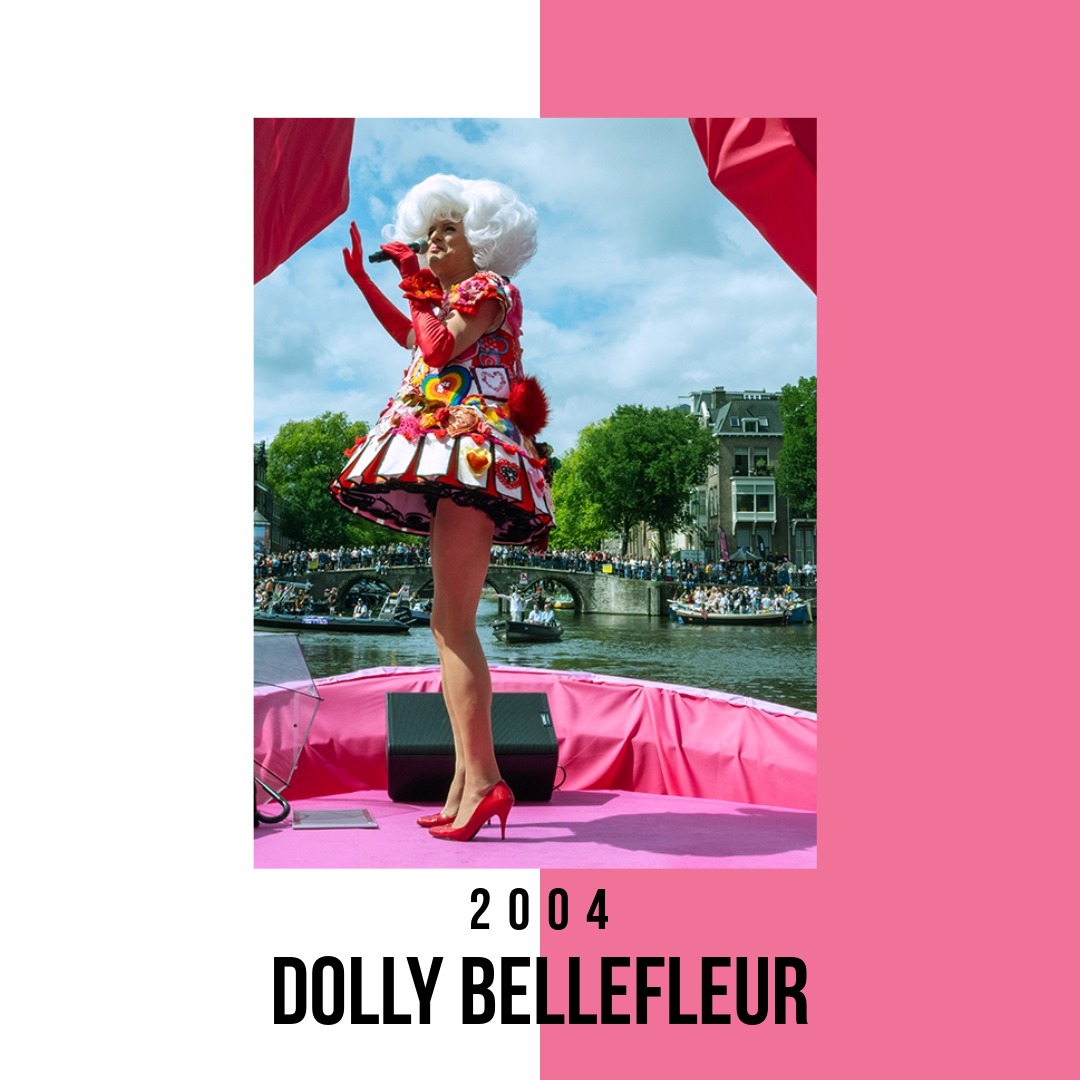
Dolly maakte van transformatiekunst een serieuze queer praktijk: speels, publiek en scherp. Een miskende muze kreeg zo een plaats in de geschiedenis van homo- en lesbische studies.
Foto: Eveline Renaud
The 2004 Mosse Lecture gave recognition to an art form often dismissed as entertainment. Dolly made transformation art into a serious queer practice: playful, public, and sharp. An overlooked muse was thus given a place in the history of gay and lesbian studies.
Photo: Eveline Renaud
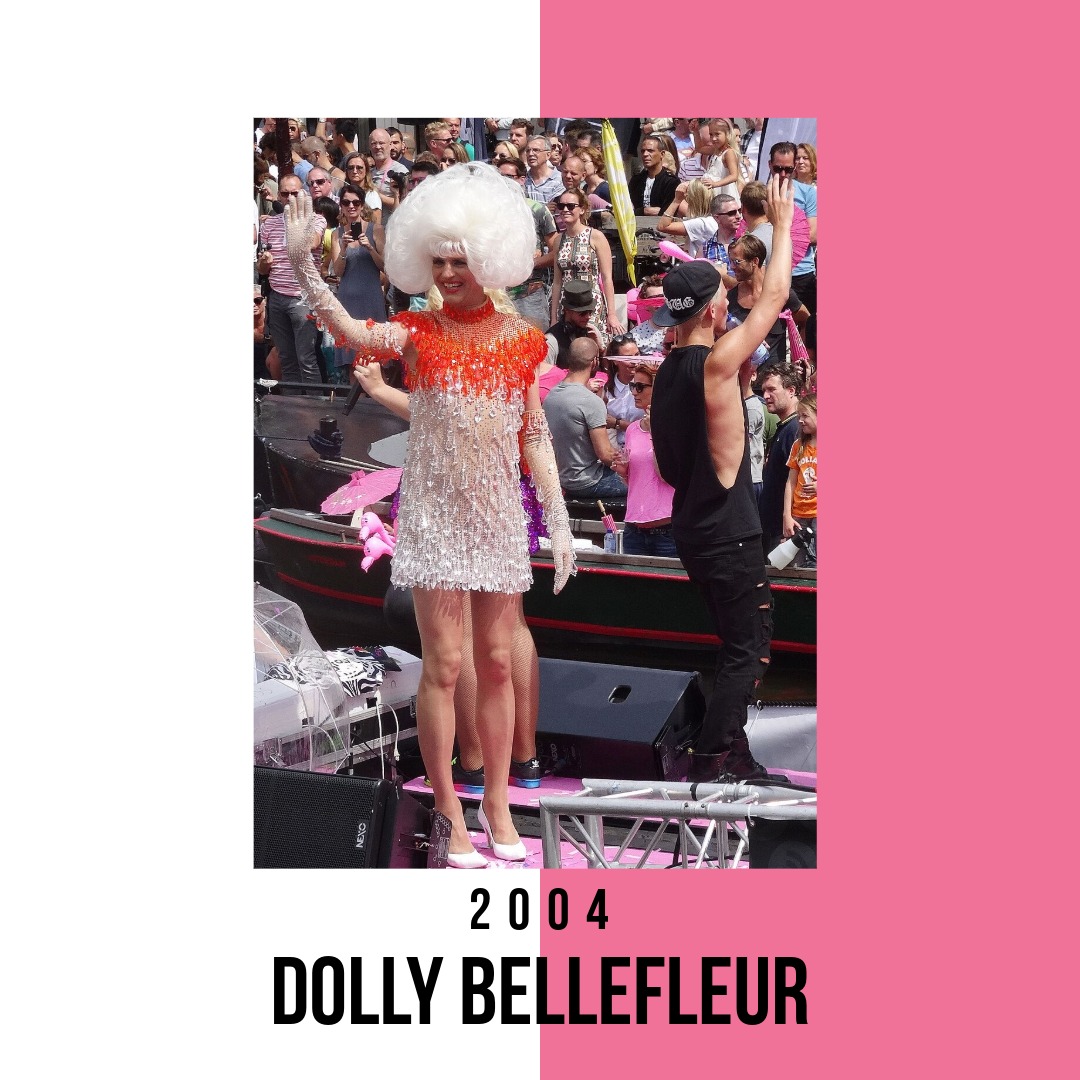
Haar werk laat zien hoe humor, stijl en taal ruimte maken voor LHBT+ zichtbaarheid.
Foto door Ronn
Dolly Bellefleur is more than a stage figure. As the alter ego of cabaret performer, lyricist, and rainbow activist Ruud Douma, she connects theater with political imagination. Her work shows how humor, style, and language create space for LGBTQ+ visibility.
Photo: Ronn
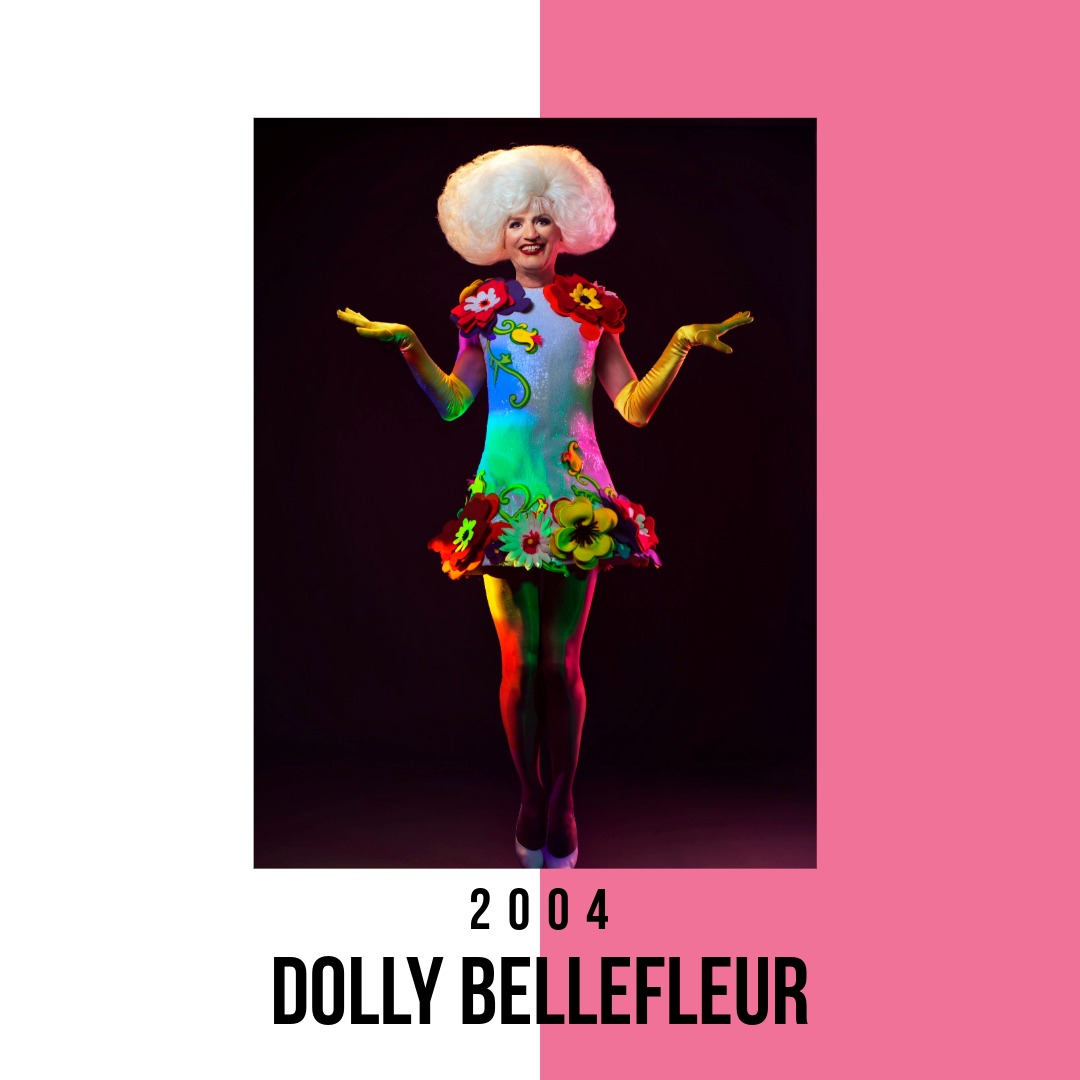
In 2004, theater maker Ruud Douma, alias Dolly Bellefleur, delivered the Mosse Lecture under the title “Transformation Art, Overlooked Muse.” With this title, Dolly placed transformation at the center of art, theater, and queer emancipation
Lecture Series Description: The annual Mosse lecture is an initiative of the George L. Mosse Fonds to promote the study of gay/lesbian history at the University of Amsterdam (UvA). It is organized in collaboration with IHLIA LGBTI Heritage. Mosse Lectures have been given by Hafid Bouazza, Marjan Sax, Ruud Douma aka Dolly Bellefleur, Bas Heijne, Maaike Meijer, Gerardjan Rijnders, Gerrit Komrij, Gloria Wekker, Stephan Sanders, M. Februari, Ted van Lieshout, Jet Bussemaker, Mohammed Benzakour, Hedy d’Ancona, Simon(e) van Saarloos, Gert Hekma, Karin Spaink, Joke Swiebel, and David Weissman.
Ruud Douma is a Dutch cabaret performer, lyricist, presenter, and LGBTQ+ activist, best known as the creator and performer of Dolly Bellefleur. Douma introduced Dolly Bellefleur in 1989 as his flamboyant and outspoken alter ego. Through this persona, he combines cabaret, original songs, humor, and satire with activism. Dolly’s performances and public appearances draw attention to human rights, discrimination, diversity, and, in particular, the social acceptance and emancipation of LGBTQ+ people. Douma has also expressed this activism through columns, poems, theater productions, comics, and self-written songs.
Since her debut, Ruud Douma’s Dolly Bellefleur has become a prominent figure in the Dutch LGBTQ+ movement, appearing at theaters, schools, Pride celebrations, demonstrations, commemorations, and community events. Dolly received the Andreaspenning from the City of Amsterdam in 2014 and the Bob Angelo Medal from COC Netherlands in 2020 for her longstanding contribution to LGBTQ+ emancipation. Since 2014, she has also created annual Dutch-language reinterpretations of the Netherlands’ Eurovision Song Contest entries. In April 2026, Ruud Douma was appointed a Knight of the Order of Orange-Nassau in recognition of his work promoting inclusion, human rights, LGBTQ+ acceptance, and the performing arts. In 2004, Douma delivered the annual Mosse Lecture as Dolly Bellefleur under the title “Transformatiekunst, miskende muze” [Transformation Art, Unsung Muse].
George Lachman Mosse (1918-1999), Amerikaans historicus van Duits-joodse oorsprong. Mosse deed onderzoek naar het Duitse nationaal-socialisme en de samenhang met mannelijkheid en (homo)seksualiteit. Hij werd in 1955 hoogleraar geschiedenis aan de universiteit van Wisconsin en schreef standaardwerken over het nazisme als The Crisis of German Ideology (1964, 2021) en Toward the Final Solution (1978, 2020). Later werd zijn belangstelling gewekt voor homo- en genderstudies. Mosse was onder meer gasthoogleraar in Amsterdam, Jeruzalem, Kaapstad, Cambridge, Parijs en Washington.