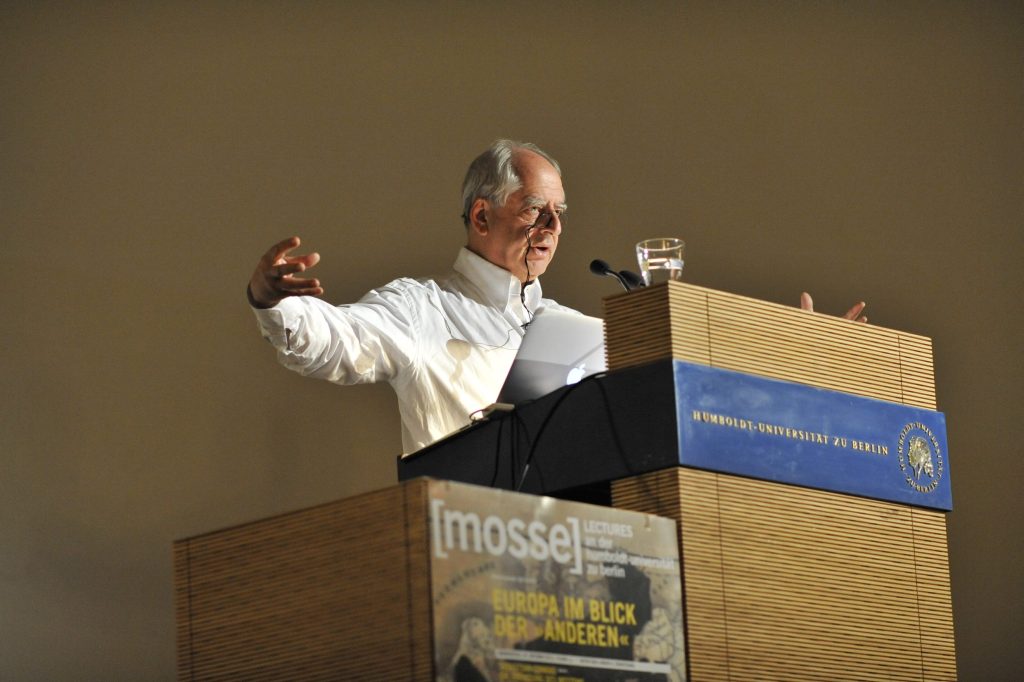
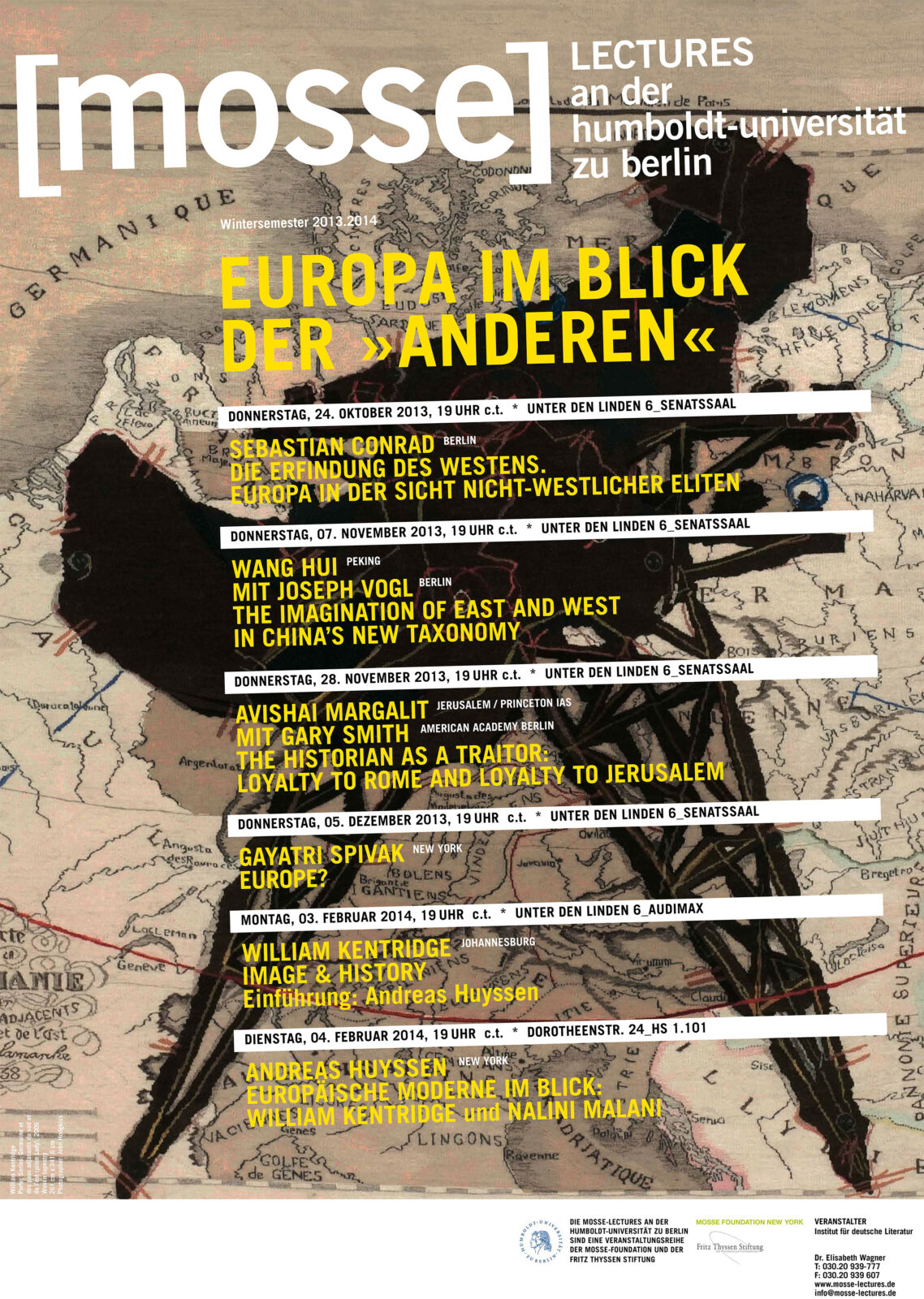
2014: William Kentridge, “Image & History”
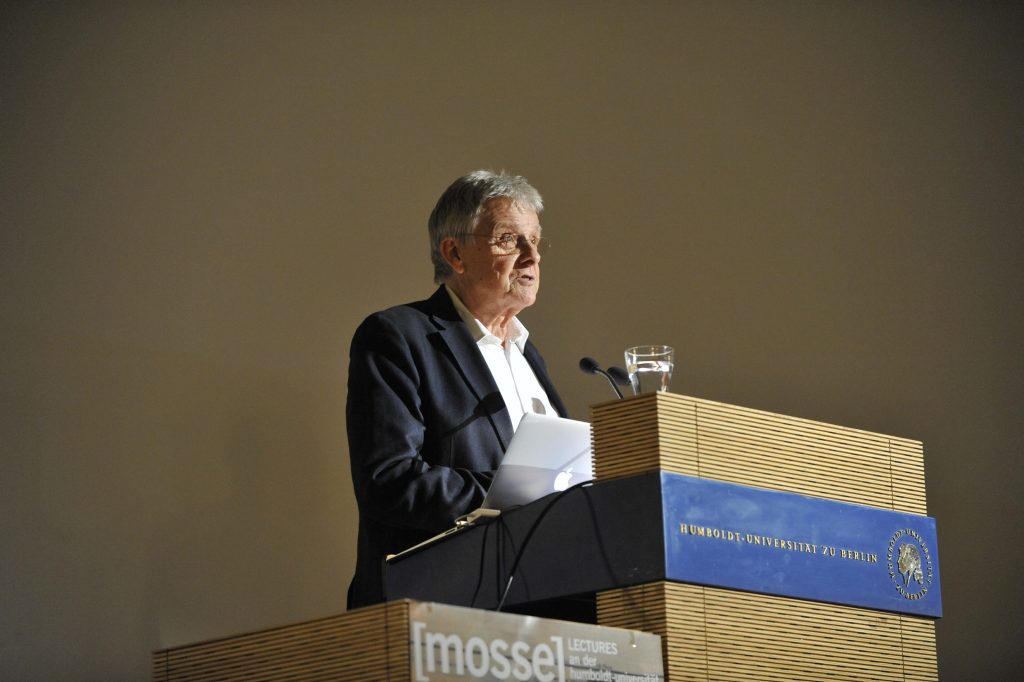
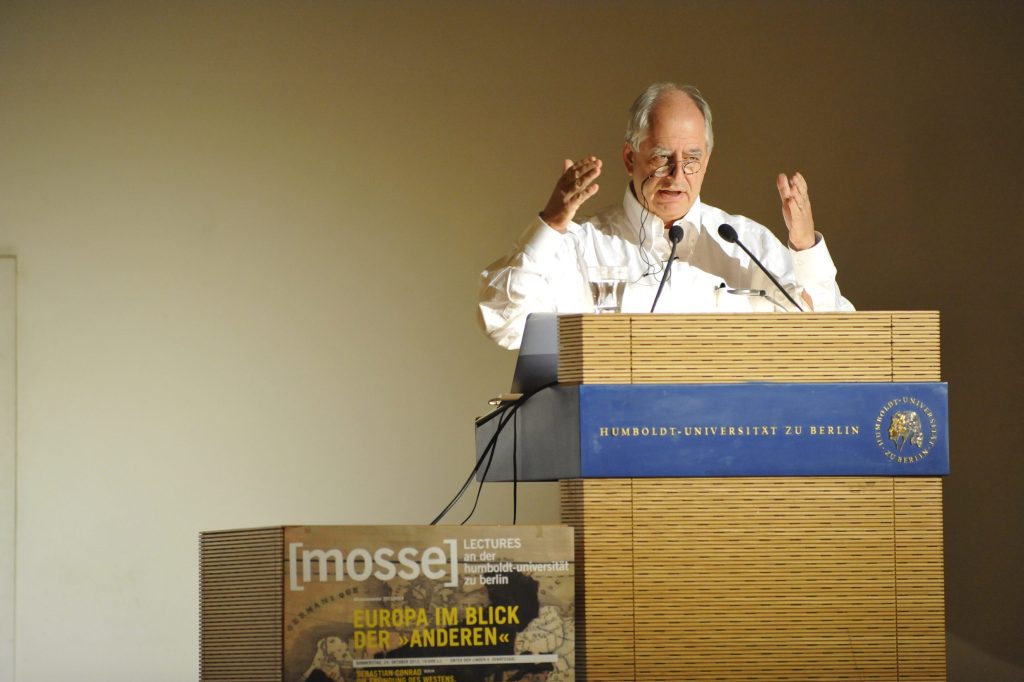
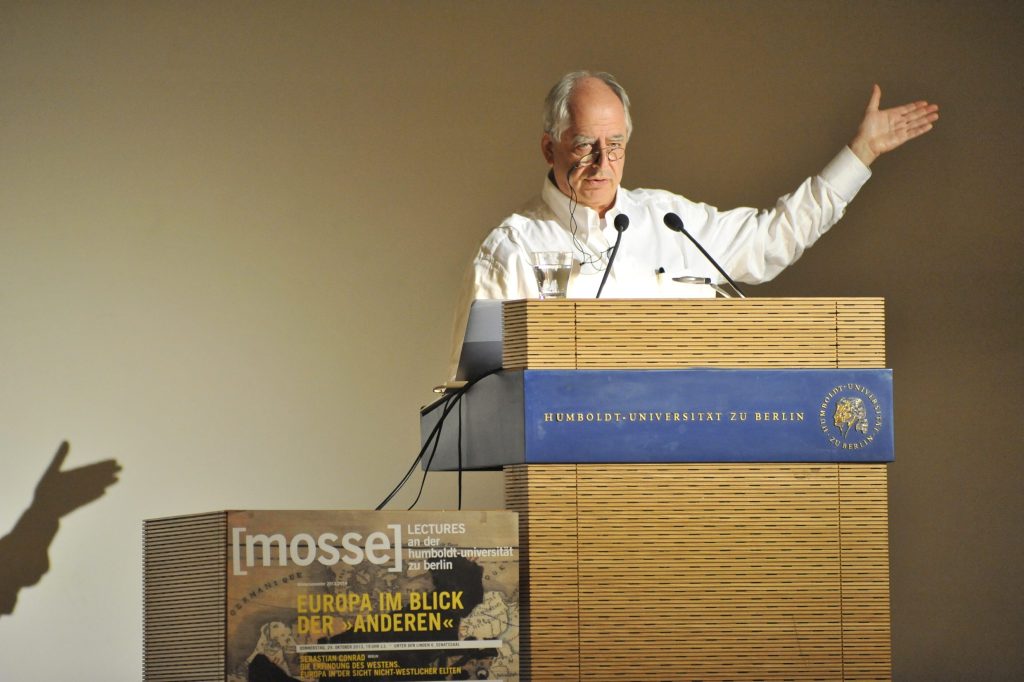
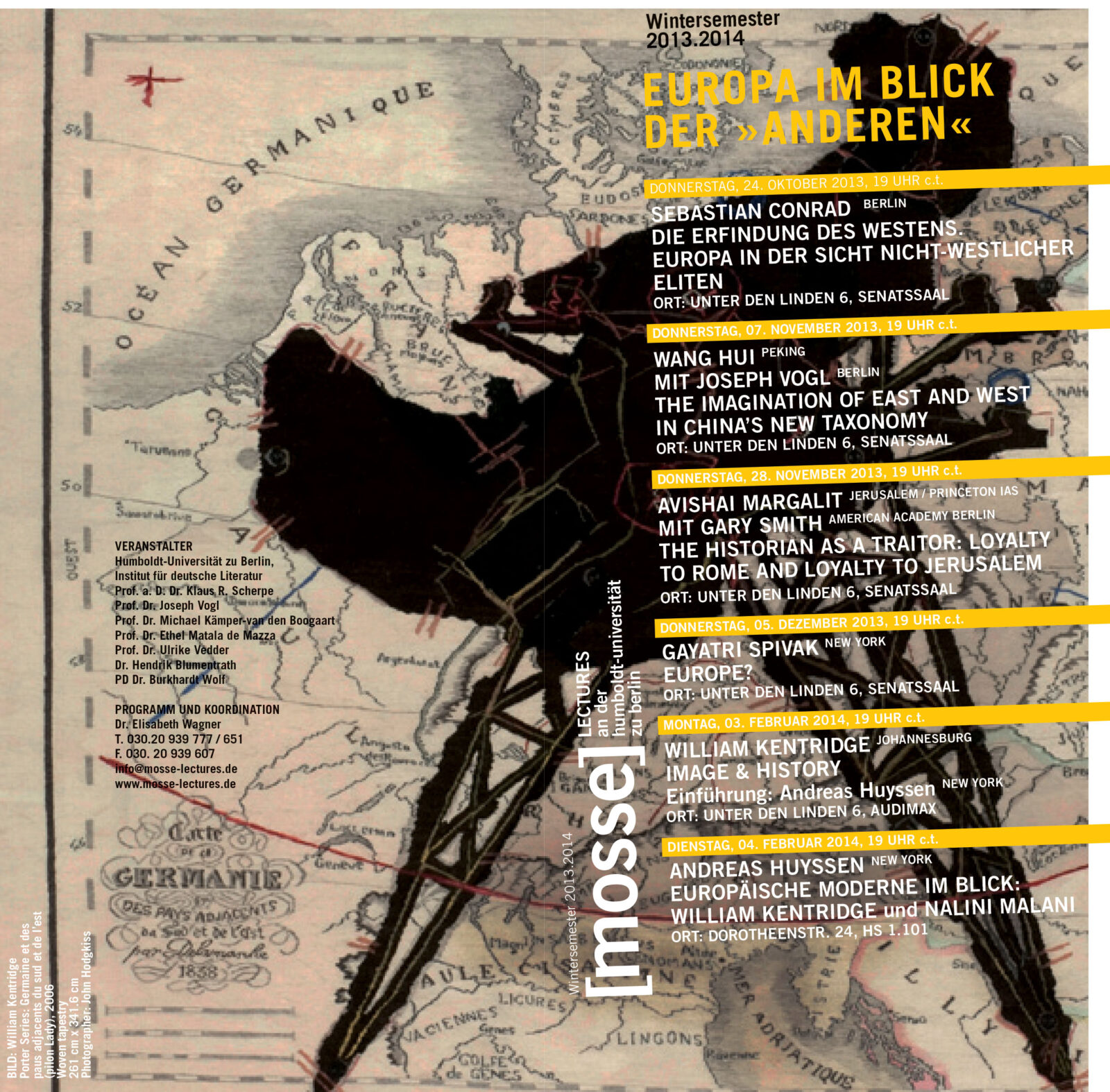
William Kentridge, “Image & History”
Berlin Mosse Lecture
https://mosselectures.wisc.edu/berlin/
Monday, 3 February 2014, 19:15 CET
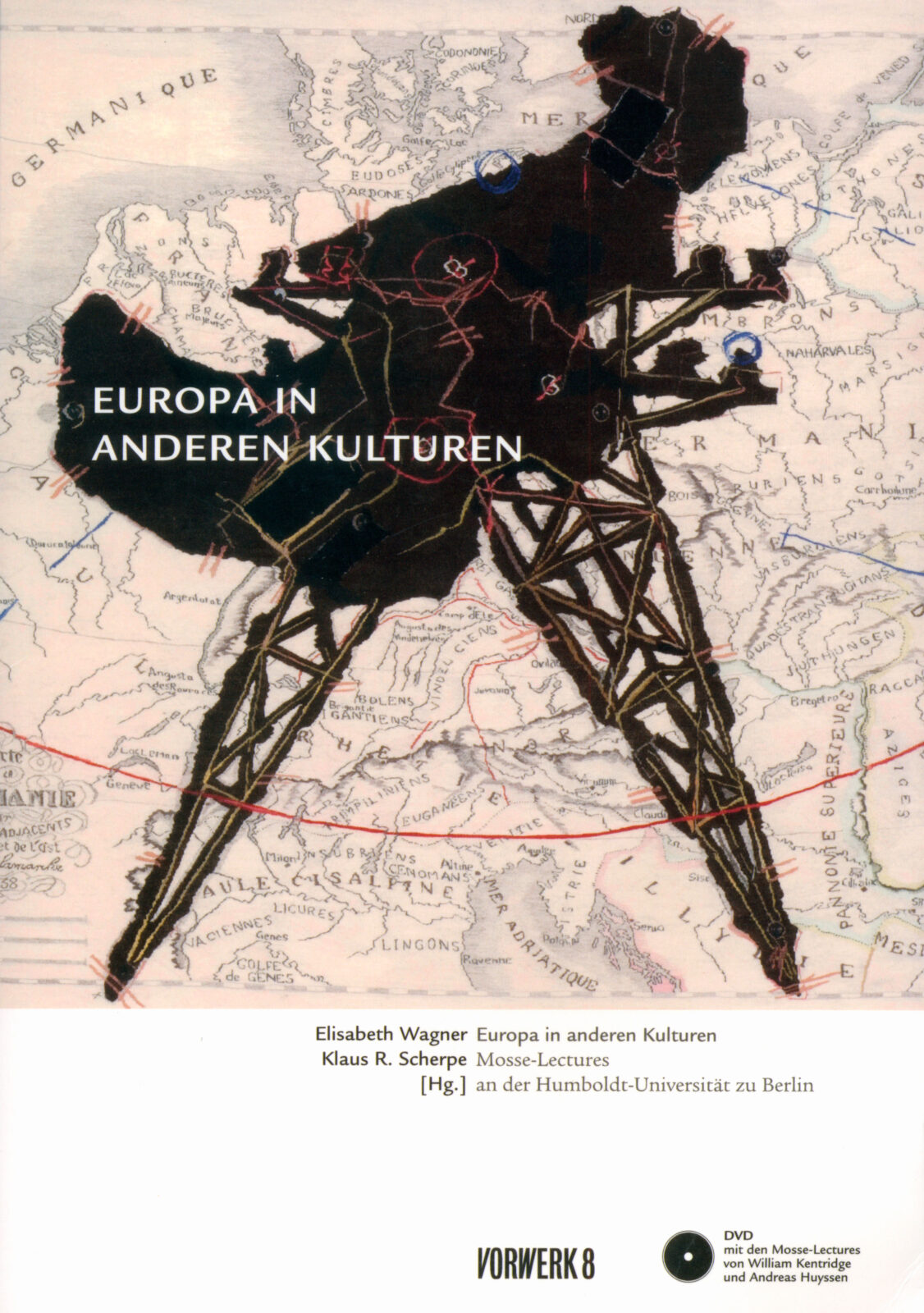
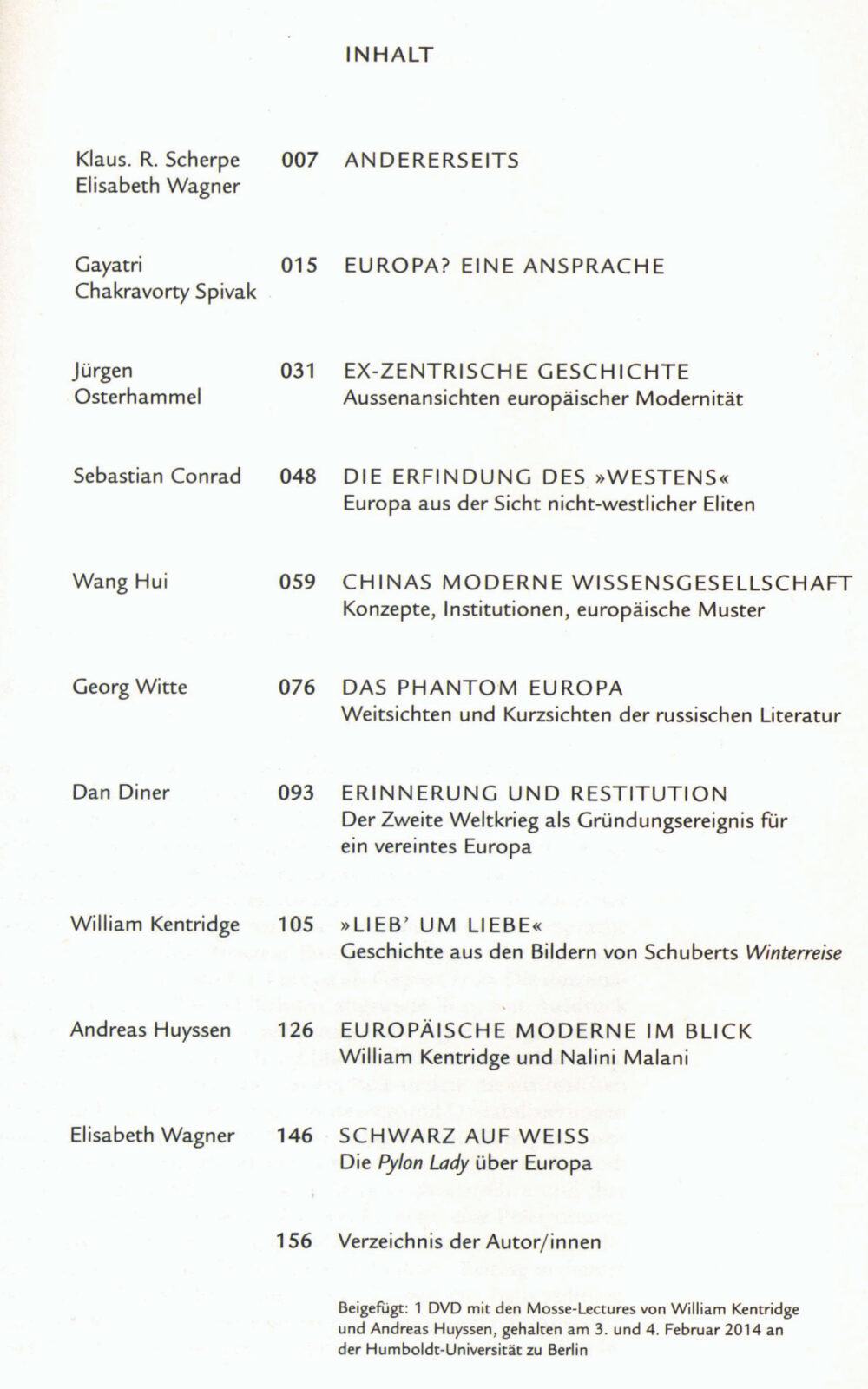
A version of this lecture was published in Elisabeth Wagner, Klaus R. Scherpe, ed. Europa in Anderen Kulturen. Mosse-Lectures an der Humboldt-Universität zu Berlin (Berlin: Vorwerk 8, 2015), 105-125. See table of contents below.
Audimax
Under den Linden 6
1. Stock
10117 Berlin
GERMANY
Sponsored by:
[mosse] LECTURES an der humboldt-universität zu berlin
The Mosse Foundation
Global Mosse Lecture Series
Fritz Thyssen Stiftung
Institut für deutsche Literatur
Humboldt University
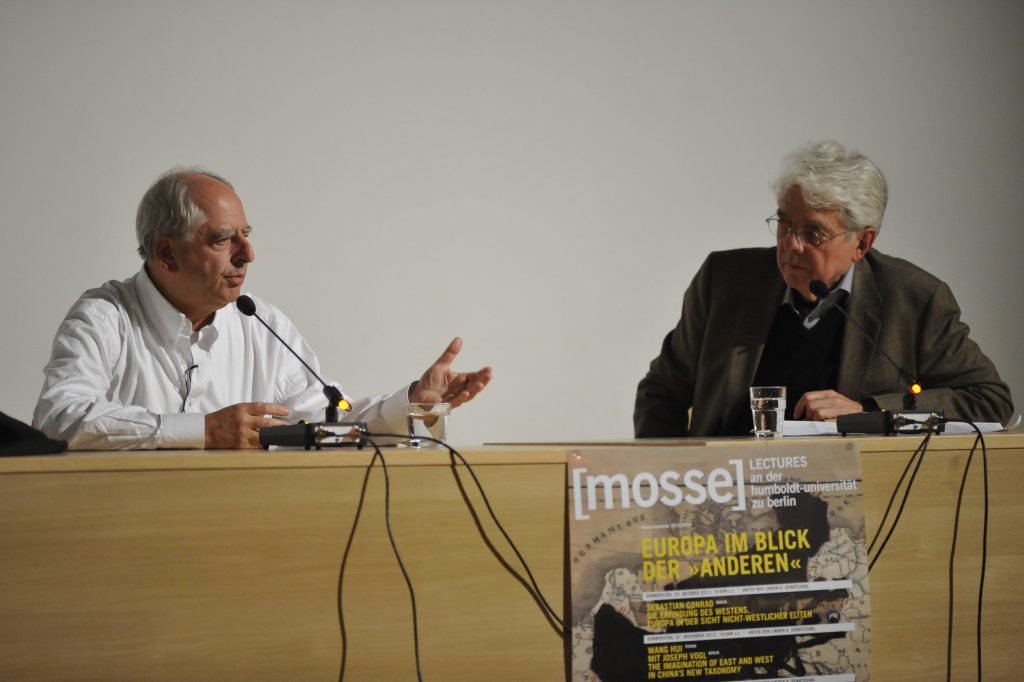
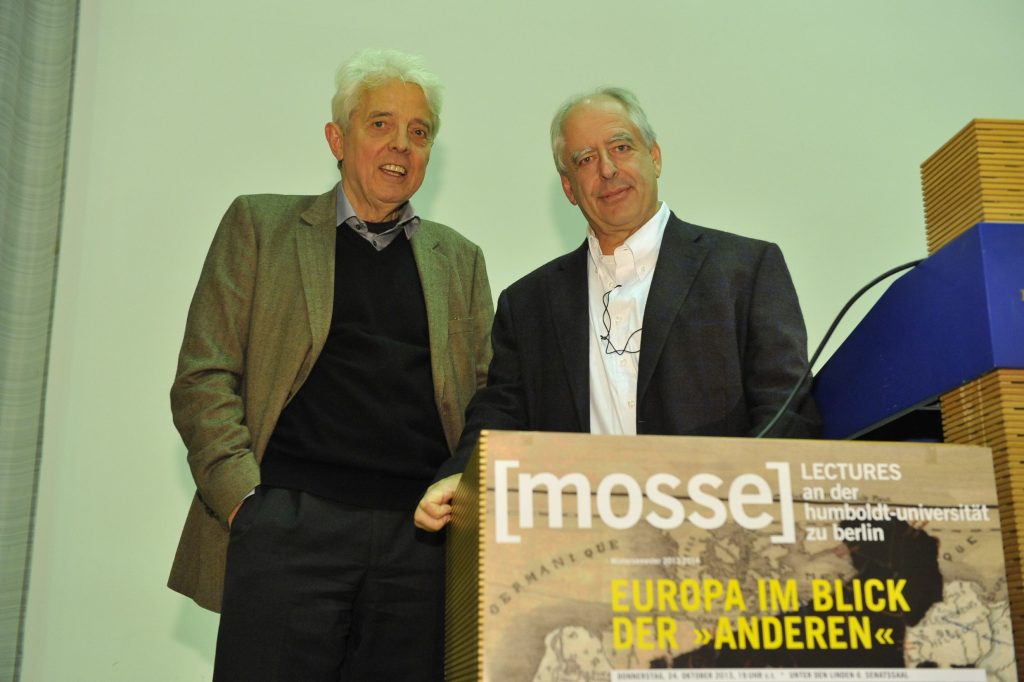
Introduction: Klaus Scherpe (Humboldt University)
Respondent: Andreas Huyssen (Columbia University)
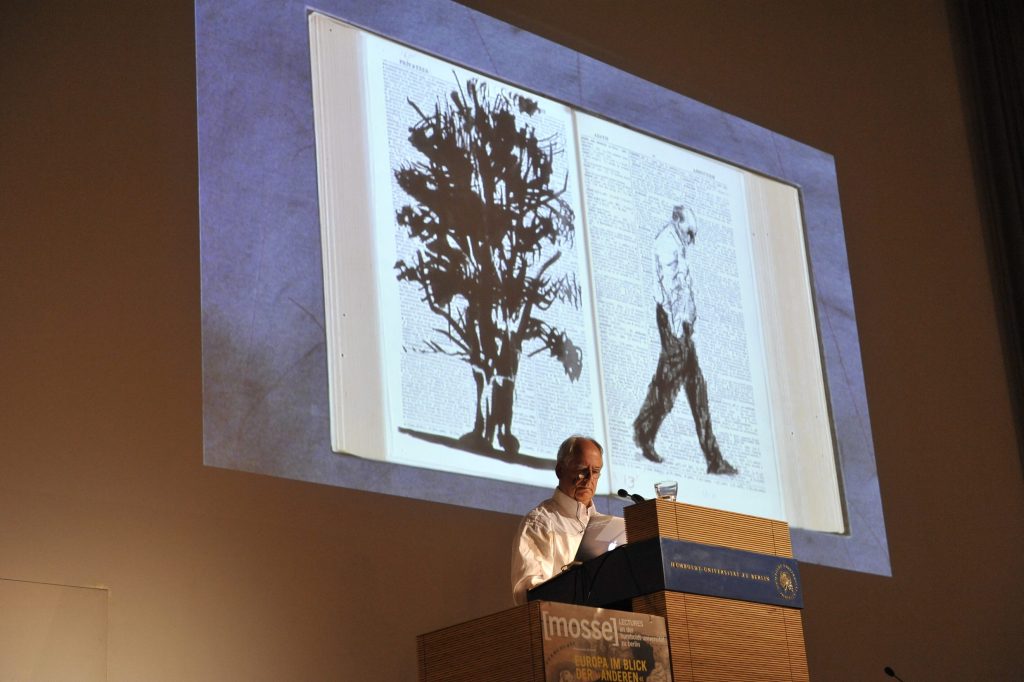
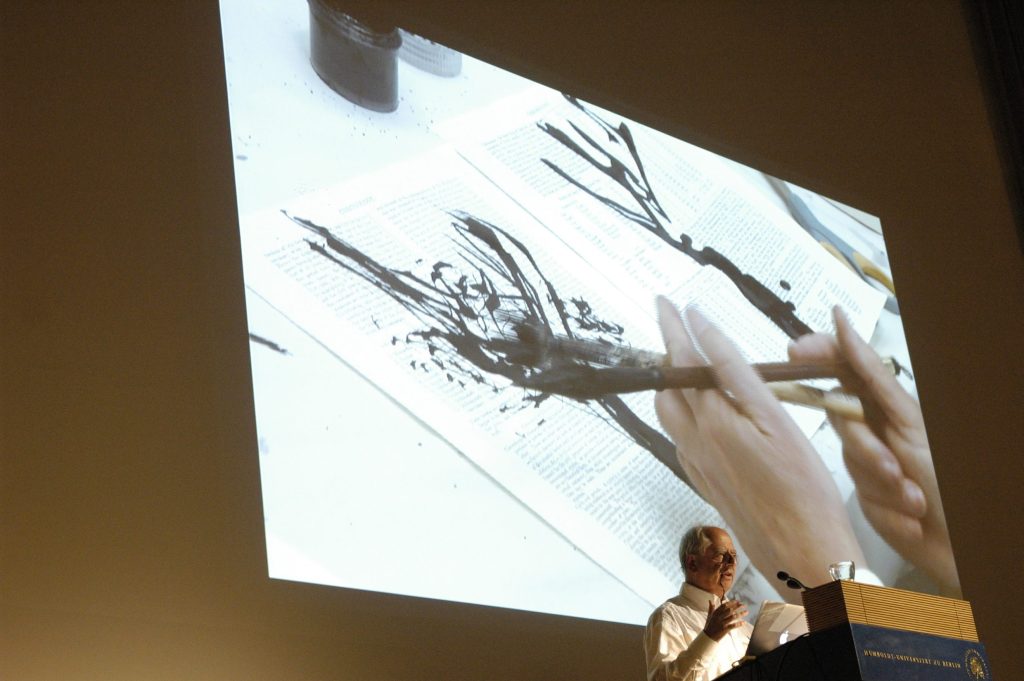
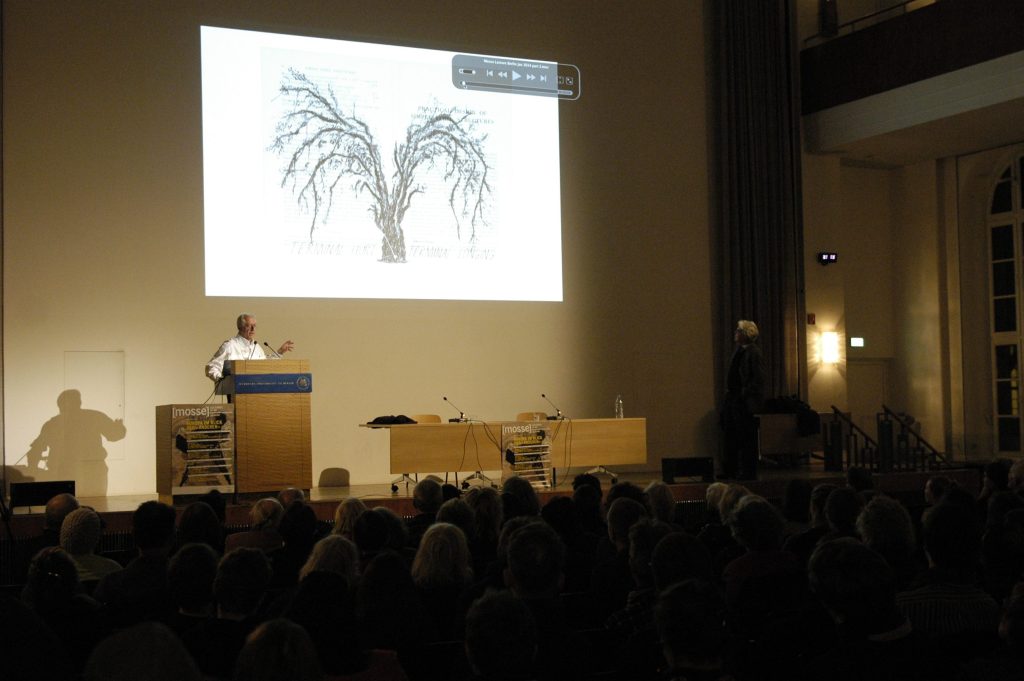
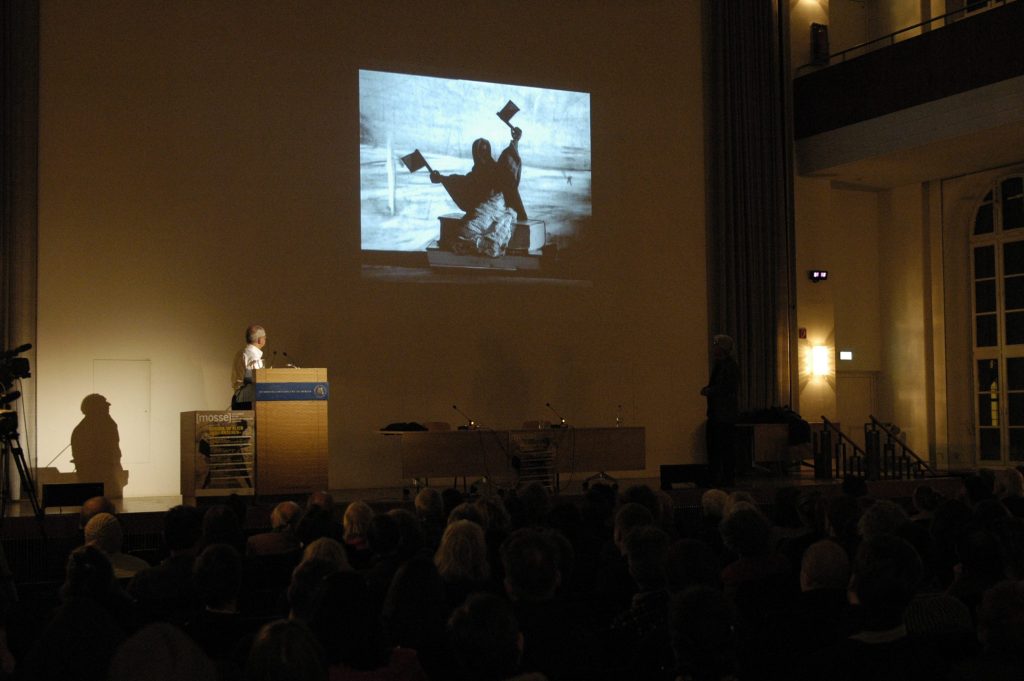
Lecture Description: Der Vortrag reflektiert die jüngste Arbeit mit der “ Winterreise“: eine Reihe von bildnerischen und filmischen Annäherungen an Franz Schuberts berühmten Liederzyklus nach den Gedichten von Wilhelm Müller. Der Vortrag nimmt dieses Material zum Ausgangspunkt, um beispielhaft zu zeigen, wie sich das Bildnerische, Historische und Gedankliche in unseren Vorstellungen ablagert und miteinander verbindet. Vom „Image of History“ ist in doppeltem Sinne zu sprechen. Zum einen im Blick auf die Außenwelt der Geschichte und ihrer Bilder, zum anderen im Rückgang auf deren Potenzial in uns, das nur darauf wartet aufgerufen und, auf halbem Wege sozusagen, in die Welt entlassen zu werden. Sind wir nicht immer auf bestimmte Art und Weise, so ist zu fragen, Komplizen unserer Erkenntnisse: einer angenommenen Anschauung der Welt, abhängig von unseren Konstruktionen dieser Welt?
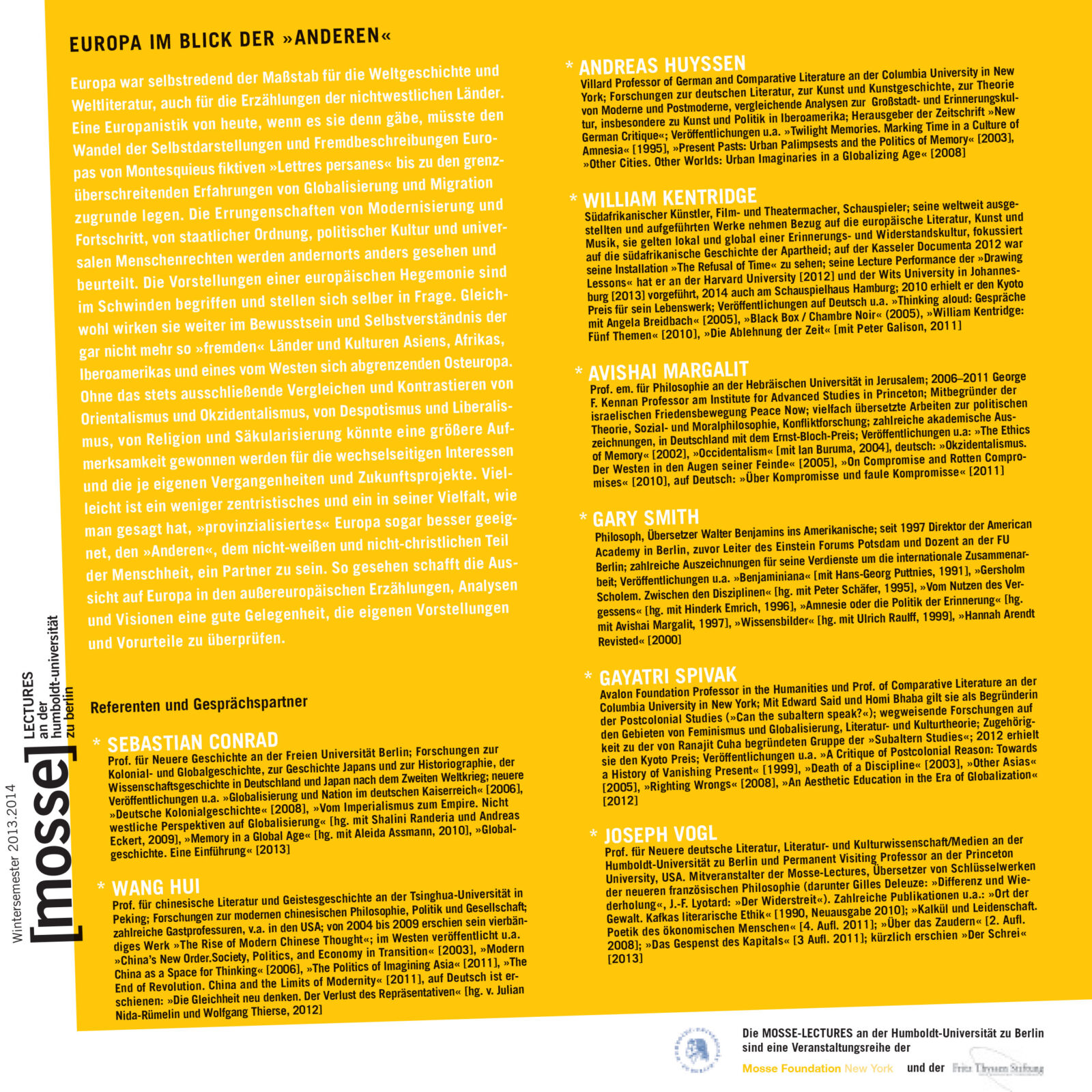
Lecture Series Description: It is taken for granted that Europe has been the measure of world history and world literature. It even appears as such in the narratives of non-Western countries. Any comprehensive study of Europe today would have to ground itself in the transformations of Europe’s self-representations and descriptions in the eyes of the “others” from Montesquieu’s fiction of the “Lettres persanes” up to the present day realities of border crossing globalization and migration. Key European ideas such as modernization and progress, democratic institutions, nation state regimes, political culture and human rights are viewed differently in other places. An overpowering European hegemony has waned in the wake of self-doubt and criticism, but it continues to have an effect on the consciousness and self-conception of other, nowadays perhaps less “alien” countries and cultures in Asia, Africa, Latin America, and an Eastern Europe that insists on its differences from the West. If we could avoid the usual exclusionary comparisons and hostile characterizations – orientalism versus occidentalism, despotism versus liberalism, religion versus secularization – a greater respect for mutual interests and for the very different understandings of the past and the divergent prospects of the future could be gained. Maybe a less Eurocentric and “provincialized” Europe would be more inclined to cooperate with the “others”, the non-white and non- Christian part of mankind. Thus the view of Europe in non-European narratives, analyses and visions will give us ample opportunities to revise our own beliefs and prejudices.
William Kentridge: einer der bedeutendsten Vertreter der zeitgenössischen Kunst; seine weltweit ausgestellten und aufgeführten Werke nehmen Bezug auf die europäische Literatur, Kunst und Musik, sie gelten lokal und global einer Erinnerungs- und Widerstandskultur, fokussiert auf die südafrikanische Geschichte der Apartheid; auf der Kasseler Documenta 2012 war seine Installation The Refusal of Time zu sehen, seitdem als Theaterperformance u.a. in Paris, New York. Seine Lecture Performance der Drawing Lessons hat er an der Harvard University (2012) und der Wits University in Johannesburg (2013) vorgeführt, 2014 in neuer Fassung auch am Schauspielhaus Hamburg; 2010 erhielt er den Kyoto Preis für sein Lebenswerk; Veröffentlichungen auf Deutsch u.a. Thinking aloud: Gespräche mit Angela Breidbach (2005), Black Box / Chambre Noir (2005), William Kentridge: Fünf Themen (2010), Die Ablehnung der Zeit (mit Peter Gallison, 2011).
Klaus Scherpe served as professor of modern German literature at Humboldt University Berlin starting in 1993, where he also directed the Institute for German Literature between 1996 and 1998 and co-founded the Mosse Lectures in 1997. He is the author of How German Is It, and How American? Ironic Replays in Literature (2005) and Die rekonstruierte Moderne. Studien zur deutschen Literatur nach 1945 (1992), among numerous other works. From 1973-1993 he served as professor of modern German literature at the Free University of Berlin. He has been active as a guest professor at numerous universities around the world, including in the US, Japan, Australia, and Argentina.
Andreas Huyssen is the Villard Professor Emeritus of German and Comparative Literature at Columbia University, where he served as founding director of the Center for Comparative Literature and Society (1998-2003). He chaired the Department of Germanic Languages from 1986-1992 and again from 2005-2008. He is one of the founding editors of New German Critique (1974-), and he serves on the editorial boards of October, Constellations, and Germanic Review. In 2005, he won Columbia’s coveted Mark van Doren teaching award. His research and teaching focus on eighteenth to twentieth-century German literature and culture, international modernism in literature and the visual arts, Frankfurt School Critical Theory, postmodernism, and cultural memory of historical trauma in transnational contexts. His work has been translated into Spanish, Portuguese, French, Swedish, Danish, Slovenian, Hungarian, Polish, Turkish, Japanese, and Chinese.