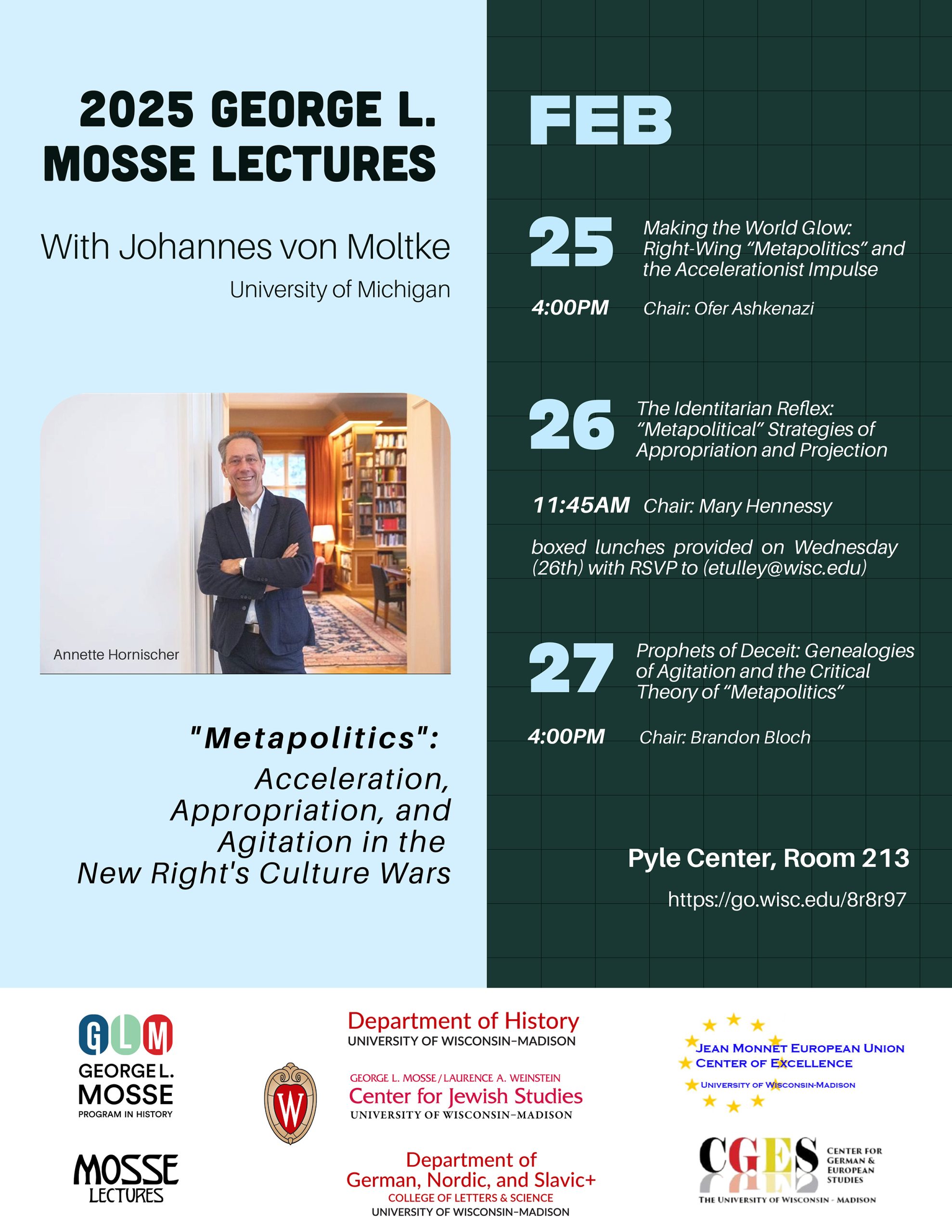
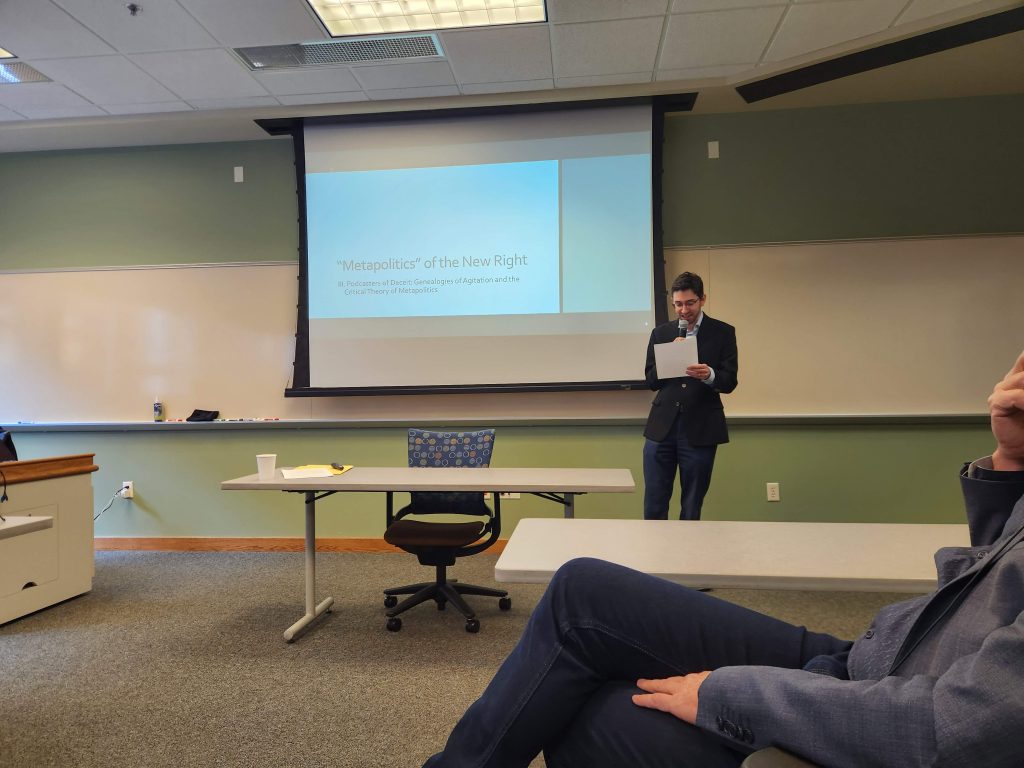
2025: Johannes von Moltke, Metapolitics 03: “Podcasters of Deceit- Genealogies of Agitation and the Critical Theory of ‘Metapolitics’”
Johannes von Moltke, “Podcasters of Deceit- Genealogies of Agitation and the Critical Theory of ‘Metapolitics'”
George L. Mosse Distinguished Lectures
https://mosselectures.wisc.edu/program/
Thursday, 27 February 2025, 16:00 CST
University of Wisconsin–Madison
Pyle Center, Room 213
702 Langdon Street
Madison, WI 53706
Chair: Brandon Bloch (University of Wisconsin–Madison)
Sponsored by:
Global Mosse Lecture Series
George L. Mosse Program in History
UW–Madison Department of History
UW–Madison Mosse/Weinstein Center for Jewish Studies
UW–Madison Department of German, Nordic, and Slavic+
UW–Madison Jean Monnet European Union Center of Excellence
UW–Madison Center for German & European Studies
Lecture Series Description: In this series of talks, Johannes von Moltke sheds light on the New Right’s mobilization of arts and ideas in today’s culture wars: its media strategies, identity politics, conspiracy theories, and efforts to shift the very language of public discourse to the right – or what the New Right calls its “metapolitics.” Situated outside the socio-political institutions and structures typically analyzed by the social sciences, the cultural formations of “metapolitics” call for humanities-based approaches that can supplement the important insights gleaned in political science and sociology. Drawing his guiding questions and methods from Critical Theory and Cultural Studies, von Moltke analyzes the New Right’s “metapolitical” maneuvers on both sides of the Atlantic to better understand the antidemocratic appeals made in the name of ethnonationalist, “identitarian” visions of the future. To this end, he defines the Right-Wing project of “metapolitics” and identifies its “accelerationist” dimensions (Lecture I); he analyzes the New Right’s conceptual poaching, or “appropriation” of progressive vocabularies (Lecture II); and he traces the antecedents of right-wing “agitation” in earlier forms of fascist propaganda, drawing on its theorization by the Frankfurt School (Lecture III): Taking a cue from Theodor W. Adorno, who described fascism as the “wounds, or scars, of a democracy that until today fails to live up to its concept,” von Moltke hopes to contribute to our understanding of right-wing cultural politics as the scar tissue of an unfinished democratic project.
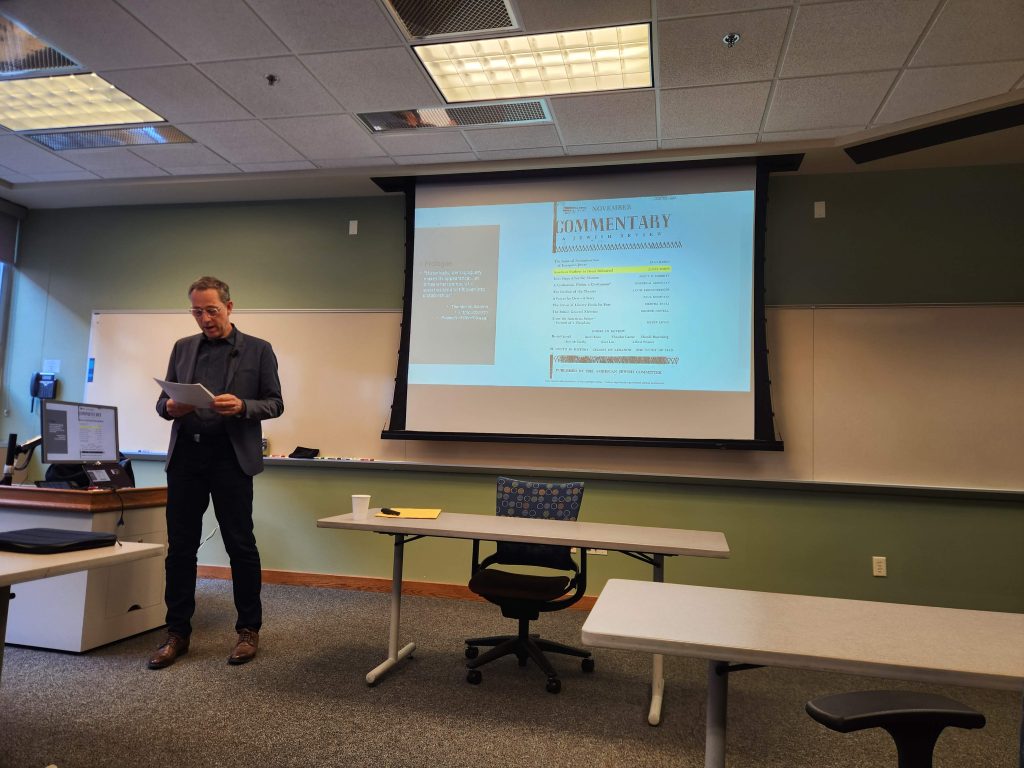
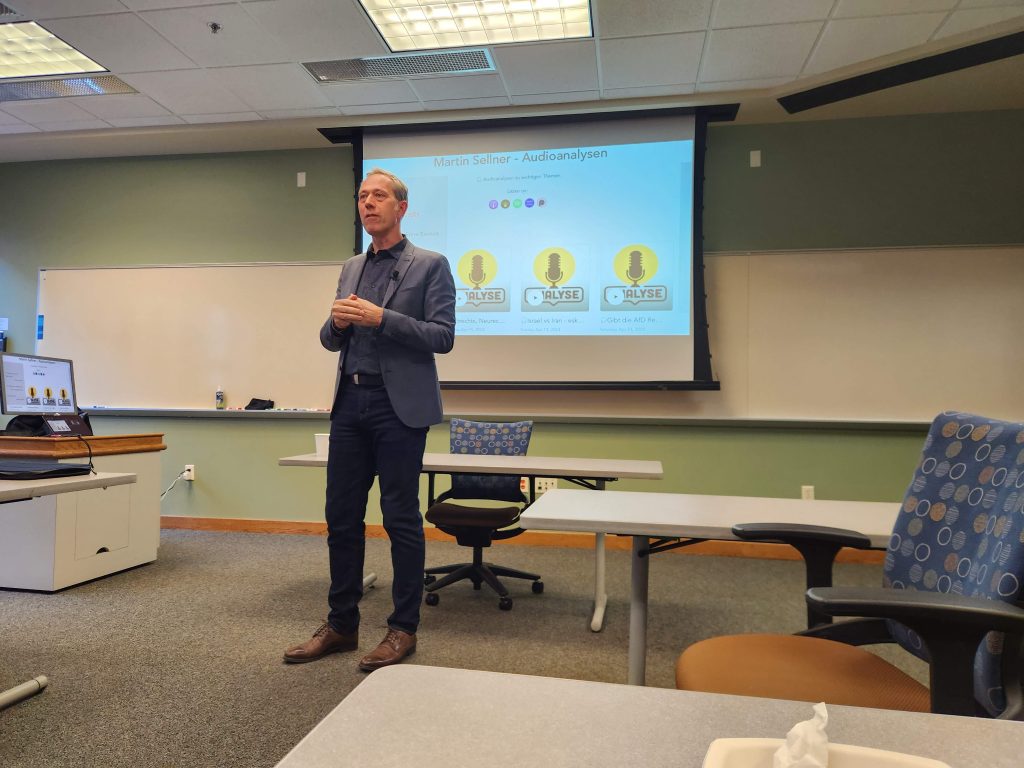

Johannes von Moltke‘s research and teaching focus on film and German cultural history of the 20th and 21st centuries. Professor von Moltke studied in Germany, France, and the US, and has previously taught at the University of Hildesheim in Germany. He is the author of The Curious Humanist: Siegfried Kracauer in America (2015), a Choice Outstanding Academic Title; and No Place Like Home: Locations of Heimat in German Cinema (2005), winner of the MLA Scaglione Prize for Best Book in German Studies. Combining his interests in German, Film, and Cultural Studies, he has published articles in New German Critique, October, Screen, Cultural Critique, Cinema Journal, Germanic Review and other journals, as well as in numerous edited volumes in the U.S. and Germany. Together with Gerd Gemünden Johannes is the series editor for Screen Cultures: German Film and the Visual at Camden House. Professor von Moltke is the President of the American Friends of Marbach, and he is a past president of the German Studies Association. At Michigan, he has been a member of the Society of Fellows, served as the organizer of the biannual German Film Institute. His research has been supported by the German Academic Exchange Service (DAAD), the Alexander von Humboldt Foundation, and the Freiburg Institute for Advanced Study (FRIAS) at the Albert-Ludwigs-Universität in Freiburg, where he was a senior fellow in 2018/19. He was recently awarded a Berlin Prize Fellowship by the American Academy in Berlin, where he was in residence during the 2024 Winter Semester.