
2023: Anna-Verena Nosthoff and Felix Maschewski, “Mars, Musk und Metaverse. Der Plattformkapitalismus und das All” / “Mars, Musk and Metaverse: Platform Capitalism and Space”
Anna-Verena Nosthoff and Felix Maschewski, “Mars, Musk und Metaverse. Der Plattformkapitalismus und das All” / “Mars, Musk and Metaverse: Platform Capitalism and Space”
Humboldt University Berlin Mosse Lecture
mosselectures.wisc.edu/berlin/
Thursday, 6 July 2023, 19:15 CET
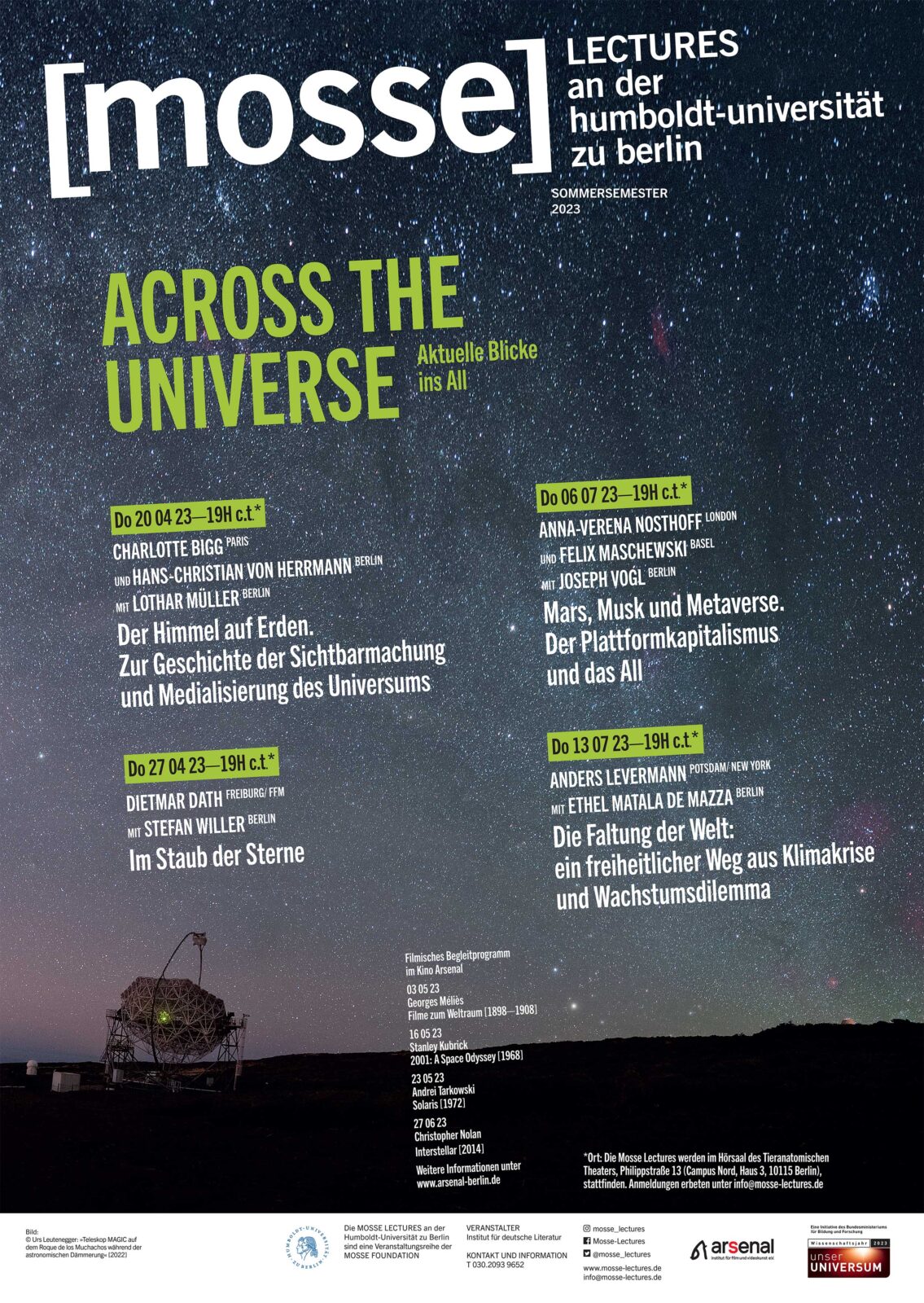
Auditorium of Tieranatomisches Theater
Philippstraße 13 (Campus Nord, House 3)
10115 Berlin
GERMANY
Moderator: Joseph Vogl (Humboldt University)
Sponsored by:
[mosse] LECTURES an der humboldt-universität zu berlin
The Mosse Foundation
Global Mosse Lecture Series
Institut für deutsche Literatur
Humboldt University
arsenal institute für film und videokunst e.V.
Bundesministeriums für Bildung und Forschung
Lecture Description: „If there aren’t enough people for Earth, then there definitely won’t be enough for Mars :(“, twitterte Elon Musk im Januar 2022. Der CEO von Tesla und SpaceX brachte damit nicht nur seine existenzielle Sorge um die Menschheit bzw. einen vermeintlichen „population collapse“ (Musk) zum Ausdruck, sondern deutete auch eine Perspektivverschiebung im Silicon Valley an. Nach Jahren der „smartification of everything“ geht es der Tech-Elite nicht mehr nur darum, innerweltliche Probleme – von Pandemien bis zur Klimakrise – mit digitaler Technik, allerlei Apps und Plattformen zu ‚lösen‘. Angesichts einer katastrophischen Gegenwart richtet sich der Blick nun stärker auf ferne, spekulative Zukünfte: etwa auf die extraterrestrische Kolonisierung des Uni- oder auf das (Über-)Leben im Metaversum. Anna-Verena Nosthoff und Felix Maschewski analysieren in ihrem Vortrag eben diesen (post-)solutionistischen Perspektivwechsel, zeigen dabei einerseits auf, dass die ‚neuen‘ Narrative und tech-eskapistischen Träume so neu gar nicht sind und erklären anderseits, welche digitalkapitalistischen und vor allem ideologischen Bedingungen (Longtermism) die Sichtachsen ins Anderswo prägen.
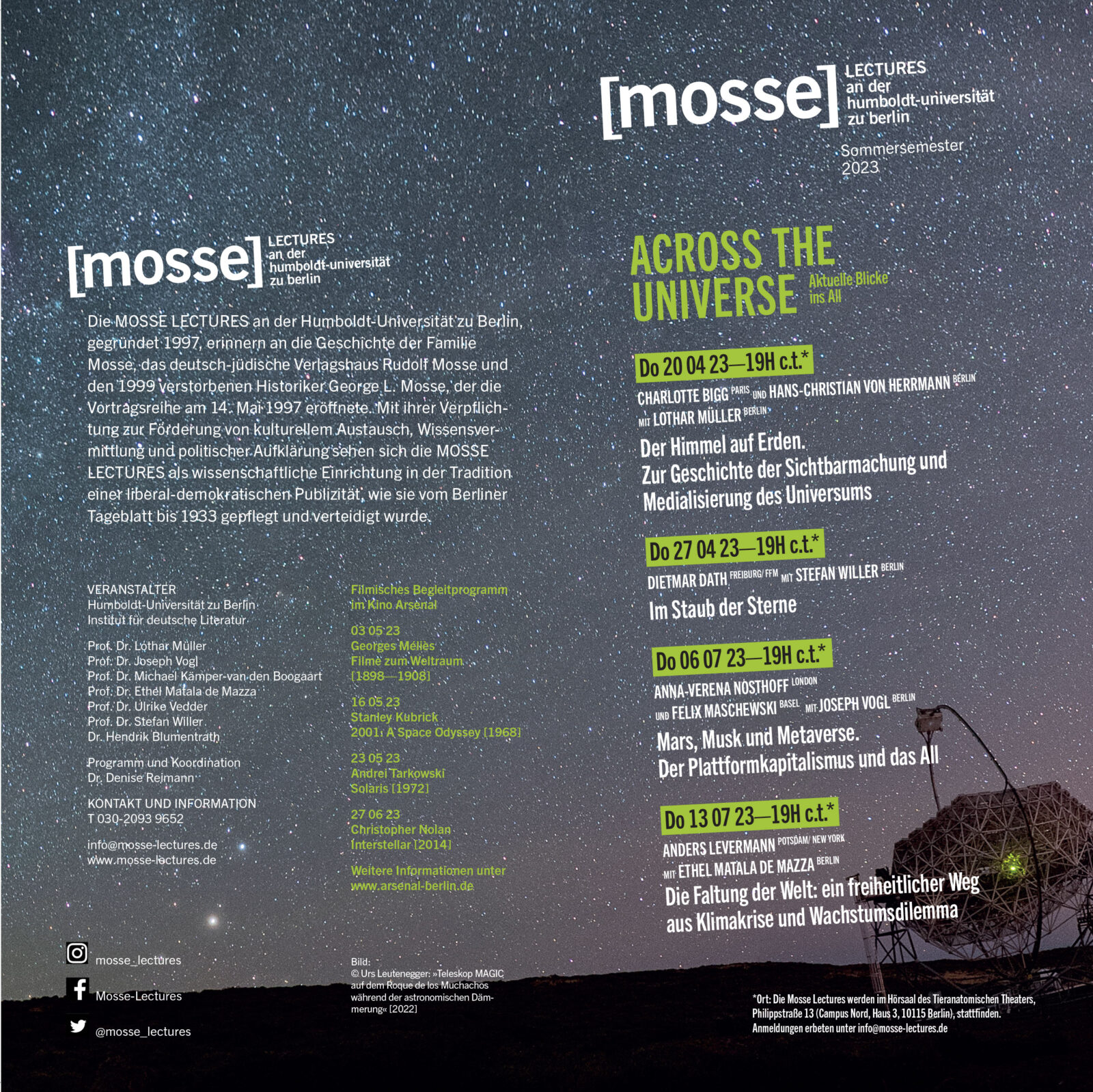
Lecture Series Theme: Across the Universe. Aktuelle Blicke ins All/Across the Universe: Current Views into Space
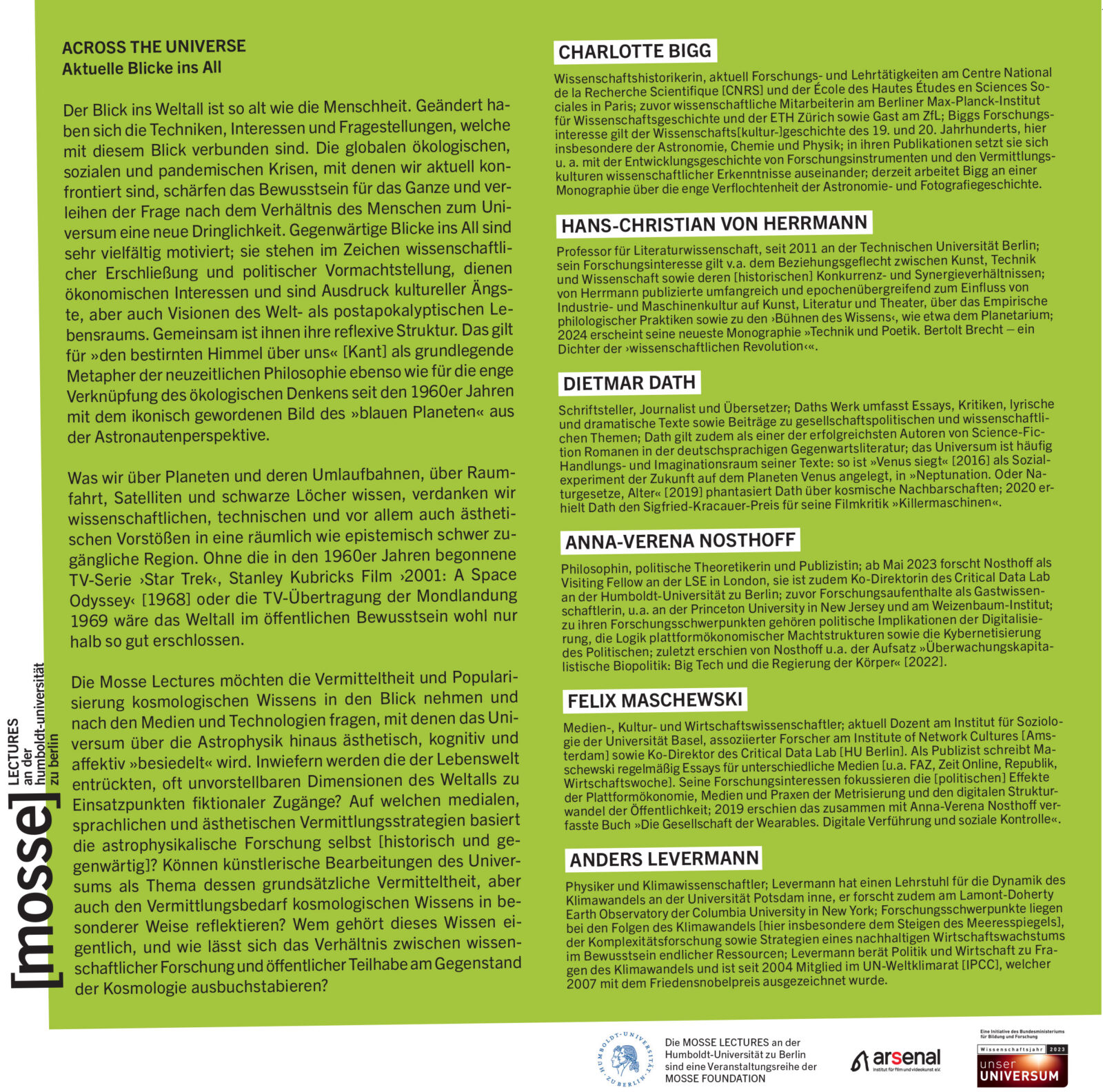
Lecture Series Description: Der Blick ins Weltall ist so alt wie die Menschheit. Geändert haben sich die Techniken, Interessen und Fragestellungen, welche mit diesem Blick verbunden sind. Die globalen ökologischen, sozialen und pandemischen Krisen, mit denen wir aktuell konfrontiert sind, schärfen das Bewusstsein für das Ganze und verleihen der Frage nach dem Verhältnis des Menschen zum Universum eine neue Dringlichkeit. Gegenwärtige Blicke ins All sind sehr vielfältig motiviert; sie stehen im Zeichen wissenschaftlicher Erschließung und politischer Vormachtstellung, dienen ökonomischen Interessen und sind Ausdruck kultureller Ängste, aber auch Visionen des Welt- als postapokalyptischen Lebensraums. Gemeinsam ist ihnen ihre reflexive Struktur. Das gilt für „den bestirnten Himmel über uns“ [Kant] als grundlegende Metapher der neuzeitlichen Philosophie ebenso wie für die enge Verknüpfung des ökologischen Denkens seit den 1960er Jahren mit dem ikonisch gewordenen Bild des „blauen Planeten“ aus der Astronautenperspektive.
Was wir über Planeten und deren Umlaufbahnen, über Raumfahrt, Satelliten und schwarze Löcher wissen, verdanken wir wissenschaftlichen, technischen und vor allem auch ästhetischen Vorstößen in eine nicht nur räumlich, sondern auch epistemisch schwer zugängliche Region. Ohne die in den 1960er Jahren begonnene TV-Serie ›Star Trek‹, Stanley Kubricks Film ›2001: A Space Odyssey‹ [1968] oder die TV-Übertragung der Mondlandung 1969 wäre das Weltall im öffentlichen Bewusstsein wohl nur halb so gut erschlossen.
Die Mosse Lectures möchten die Vermitteltheit und Popularisierung kosmologischen Wissens in den Blick nehmen und nach den Medien und Technologien fragen, mit denen das Universum über die Astrophysik hinaus ästhetisch, kognitiv und affektiv „besiedelt“ wird. Inwiefern werden die der Lebenswelt entrückten, oft unvorstellbaren Dimensionen des Weltalls zu Einsatzpunkten fiktionaler Zugänge? Auf welchen medialen, sprachlichen und ästhetischen Vermittlungsstrategien basiert die astrophysikalische Forschung selbst (historisch und gegenwärtig)? Können künstlerische Bearbeitungen des Universums als Thema dessen grundsätzliche Vermitteltheit, aber auch den Vermittlungsbedarf kosmologischen Wissens in besonderer Weise reflektieren? Wem gehört dieses Wissen eigentlich, und wie lässt sich das Verhältnis zwischen wissenschaftlicher Forschung und öffentlicher Teilhabe am Gegenstand der Kosmologie ausbuchstabieren?
The view into space is as old as mankind. What has changed are the techniques, interests and questions associated with this view. The global ecological, social and pandemic crises with which we are currently confronted sharpen our awareness of the whole and lend a new urgency to the question of our relationship towards the universe. Current glances into space are motivated in many different ways; they are driven by scientific exploration and political supremacy, serve economic interests and are an expression of cultural fears, but also visions of the world as a post-apocalyptic living space. What they have in common is their reflexive construction. This applies to »the starry sky above us« (Kant) as a fundamental metaphor of modern philosophy as well as to the close link between ecological thinking since the 1960s and the iconic image of the »blue planet« from an astronaut’s perspective.
What we know about planets and their orbits, about space travel, satellites and black holes, we owe to scientific, technical and above all aesthetic ventures into a space that is spatially and epistemically difficult to access. Without the TV series ›Star Trek‹, which began in the 1960s, Stanley Kubrick’s film ›2001: A Space Odyssey‹ [1968] or the TV broadcast of the moon landing in 1969, outer space would probably only be half as accessible in the public consciousness.
The Mosse Lectures would like to examine the mediatedness and popularisation of cosmological knowledge and ask about the media and technologies with which the universe is aesthetically, cognitively and affectively »colonised« beyond astrophysics. To what extent can fictional approaches help us imagine the often unimaginable dimensions of the universe? On which media, linguistic and aesthetic strategies of mediation is astrophysical research itself based (historically and currently)? Can artistic approaches to the universe reflect its fundamental mediated nature, but also the need to mediate cosmological knowledge in a special way? To whom does this knowledge actually belong, and how can the relationship between scientific research and public participation in the matter of cosmology be spelled out?

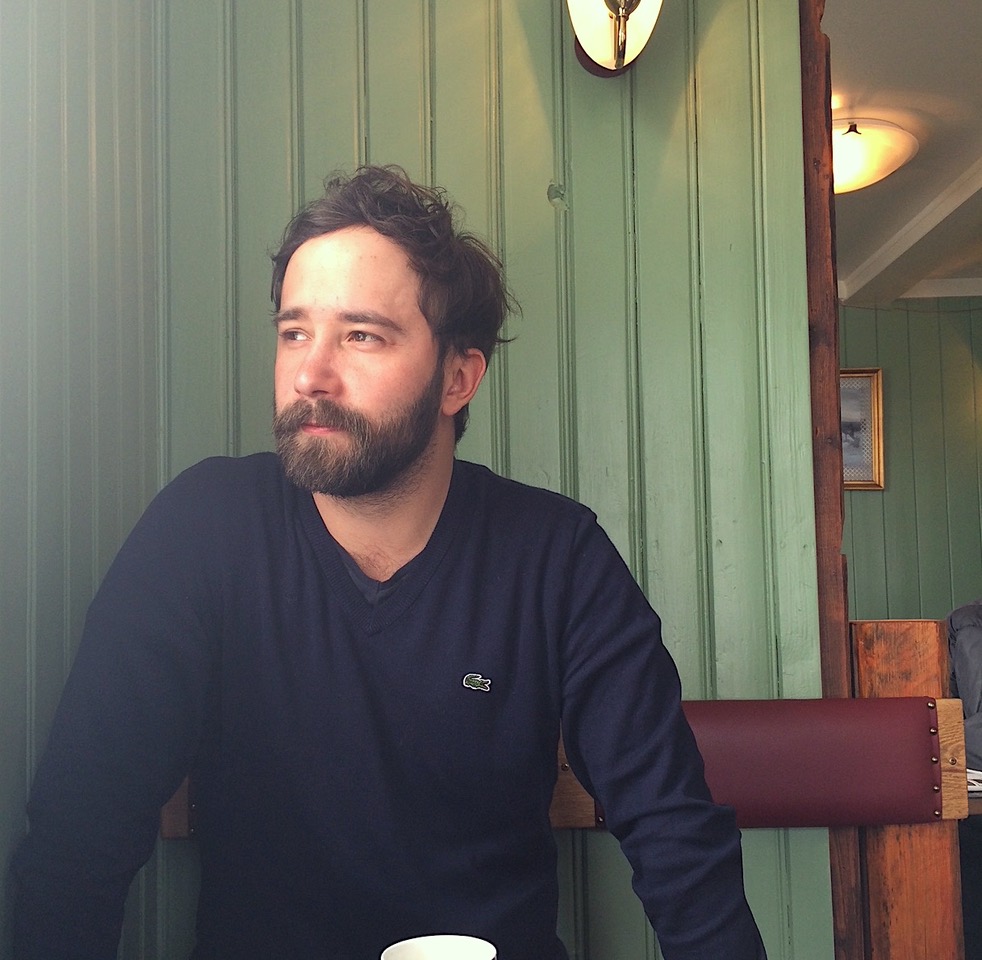
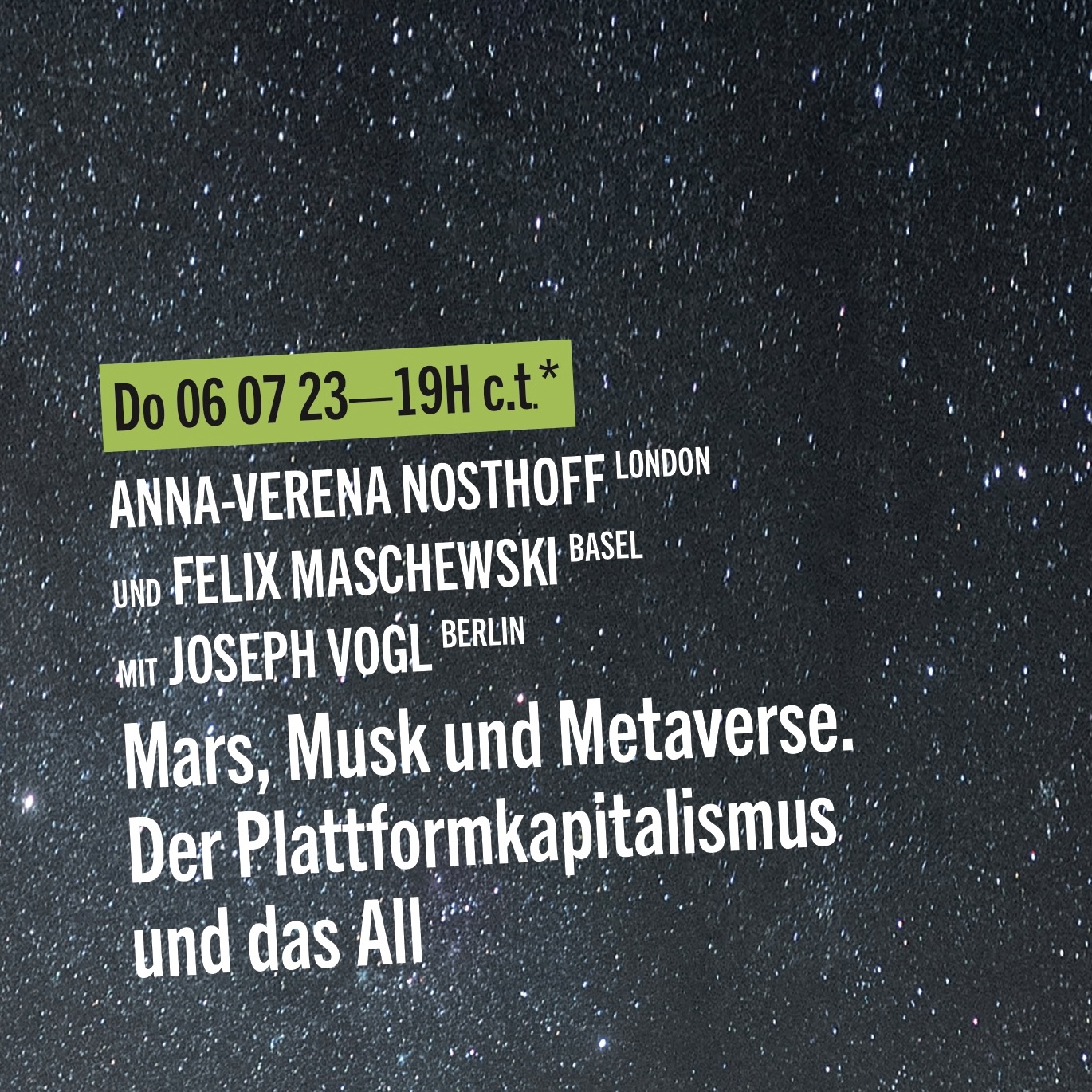
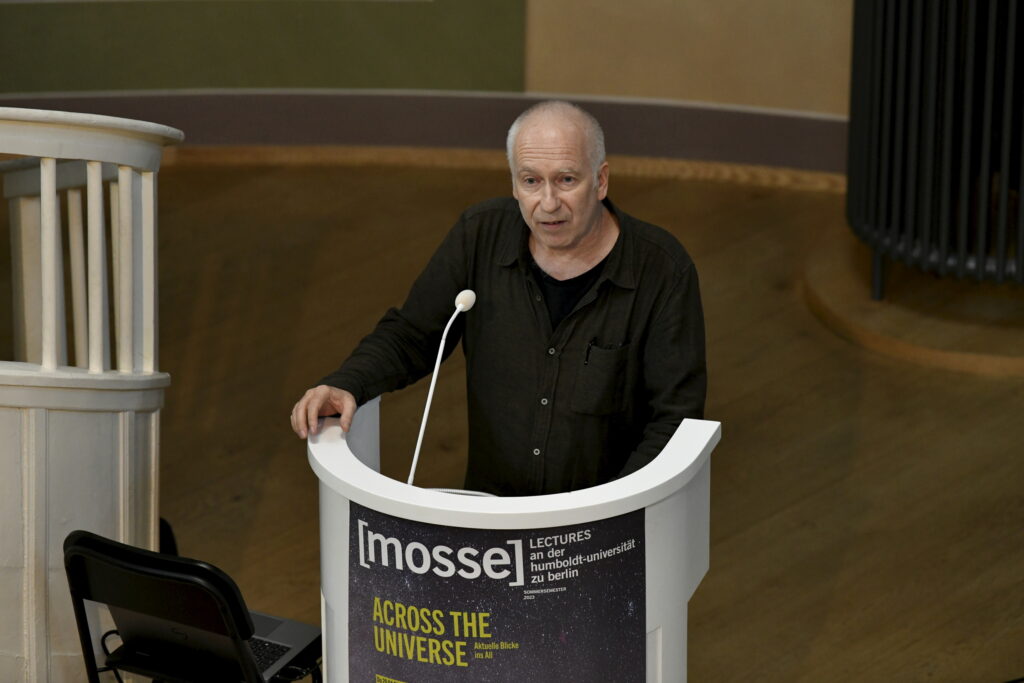
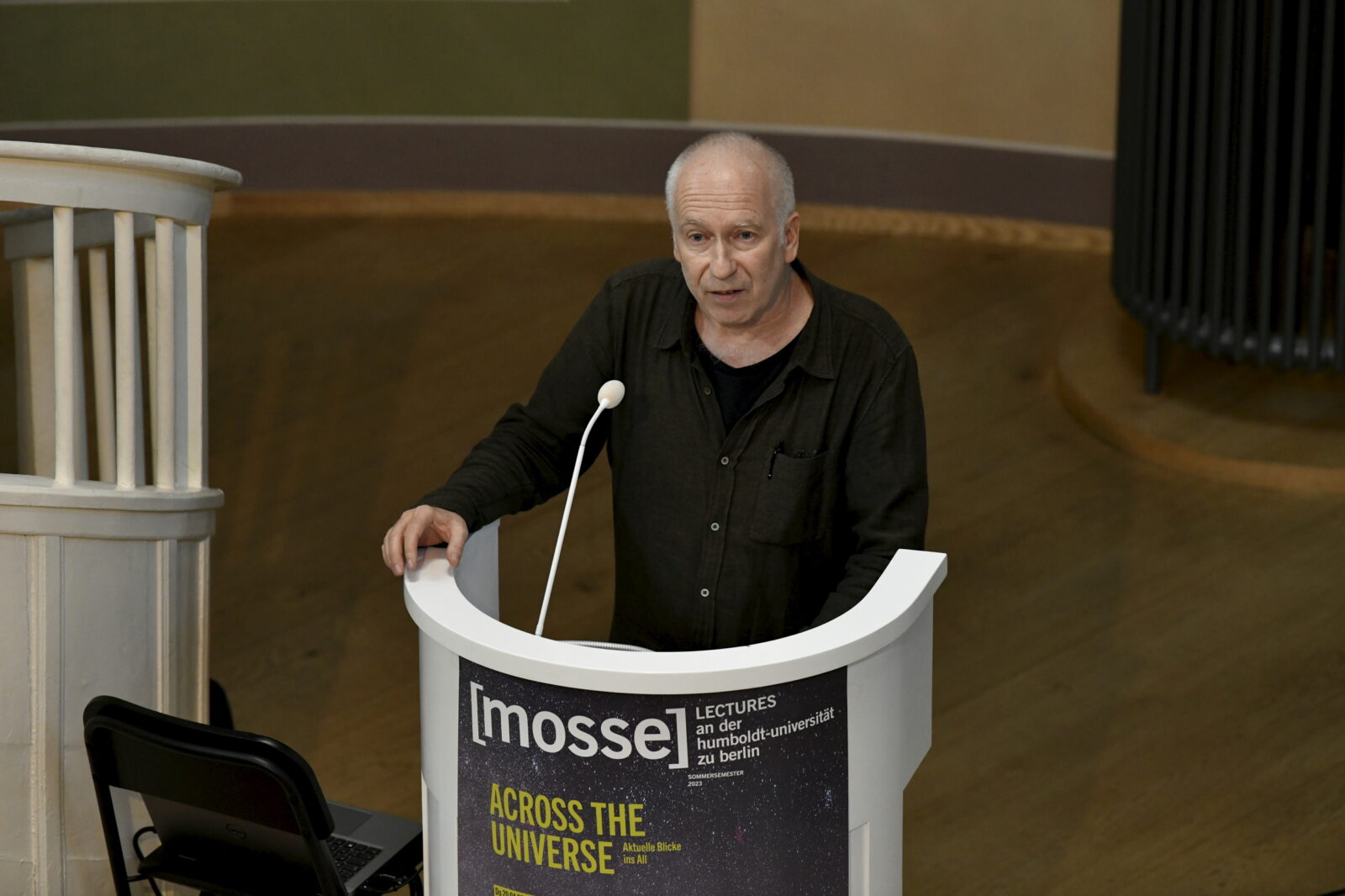
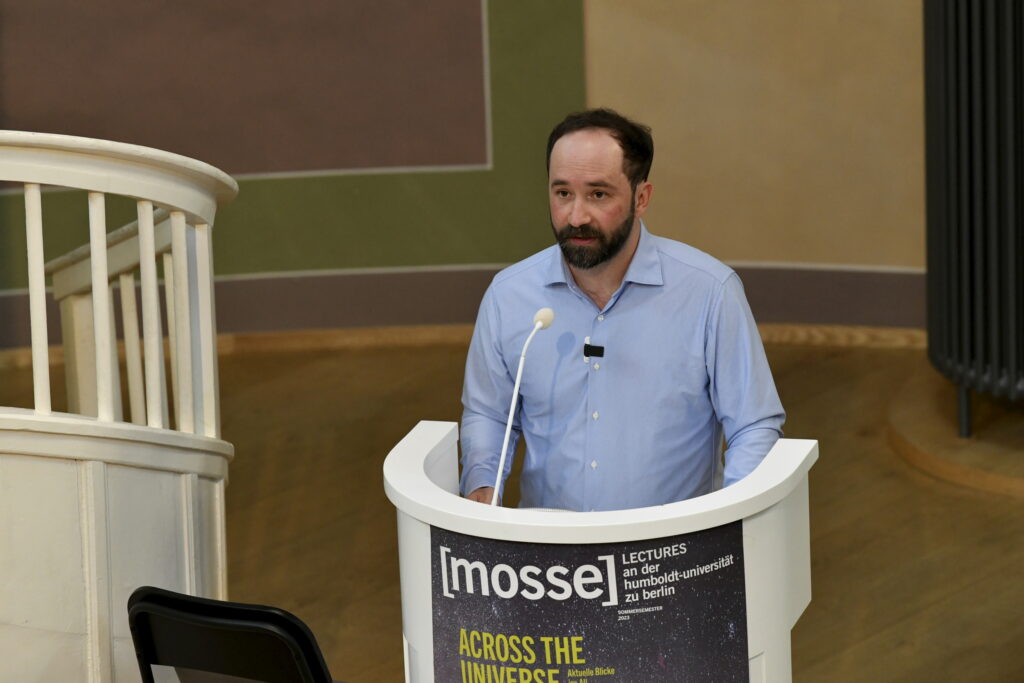
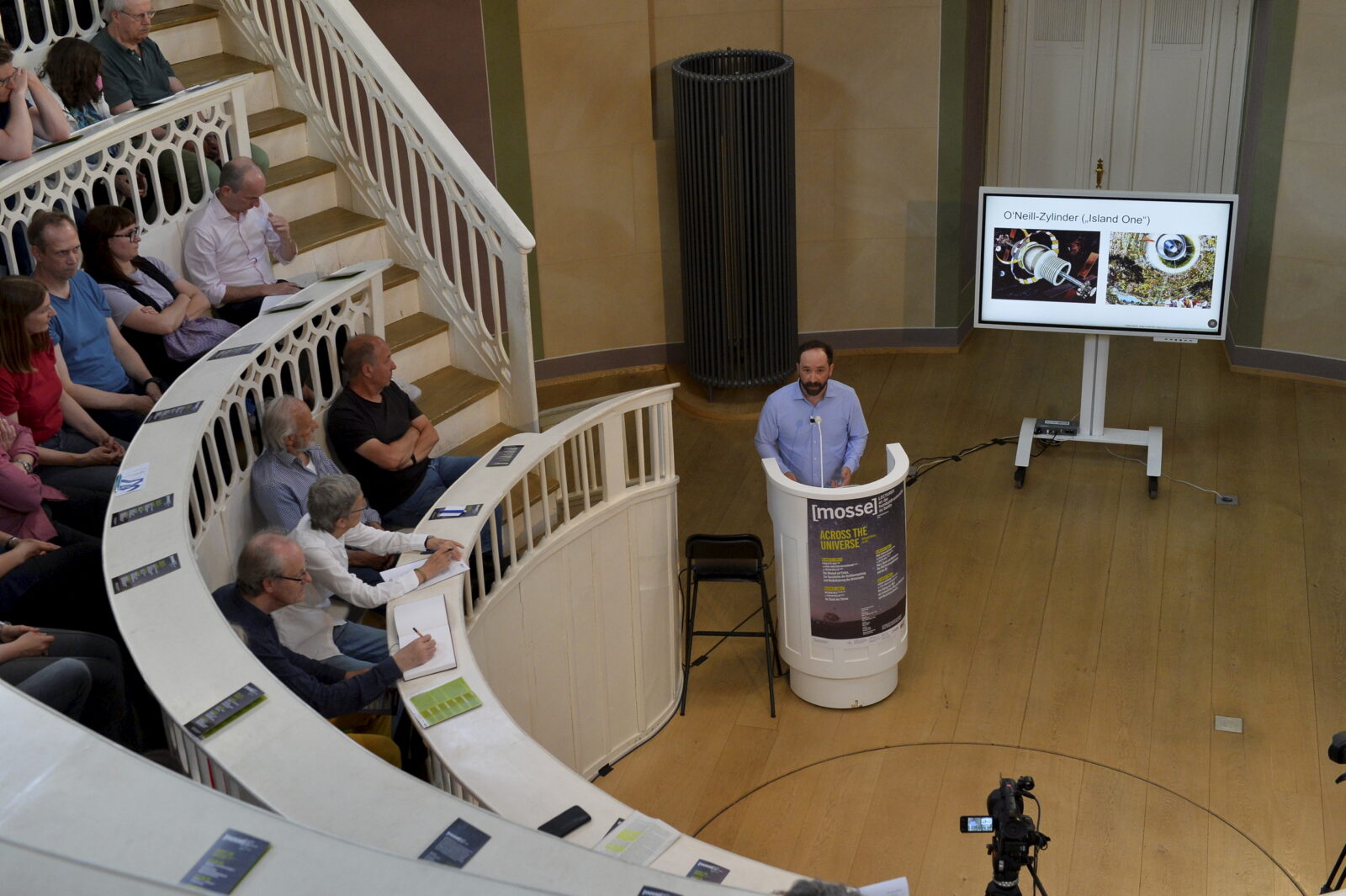
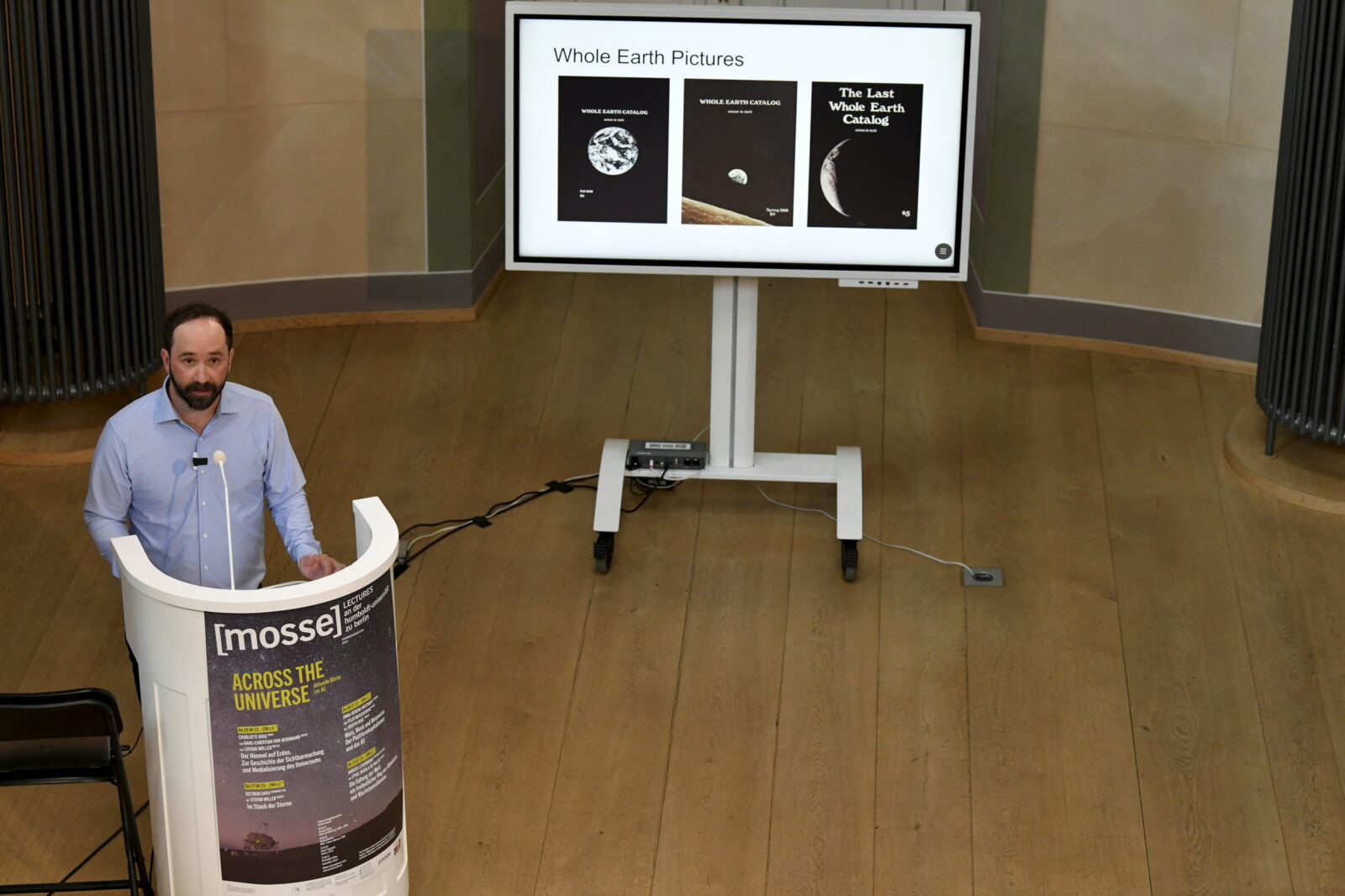
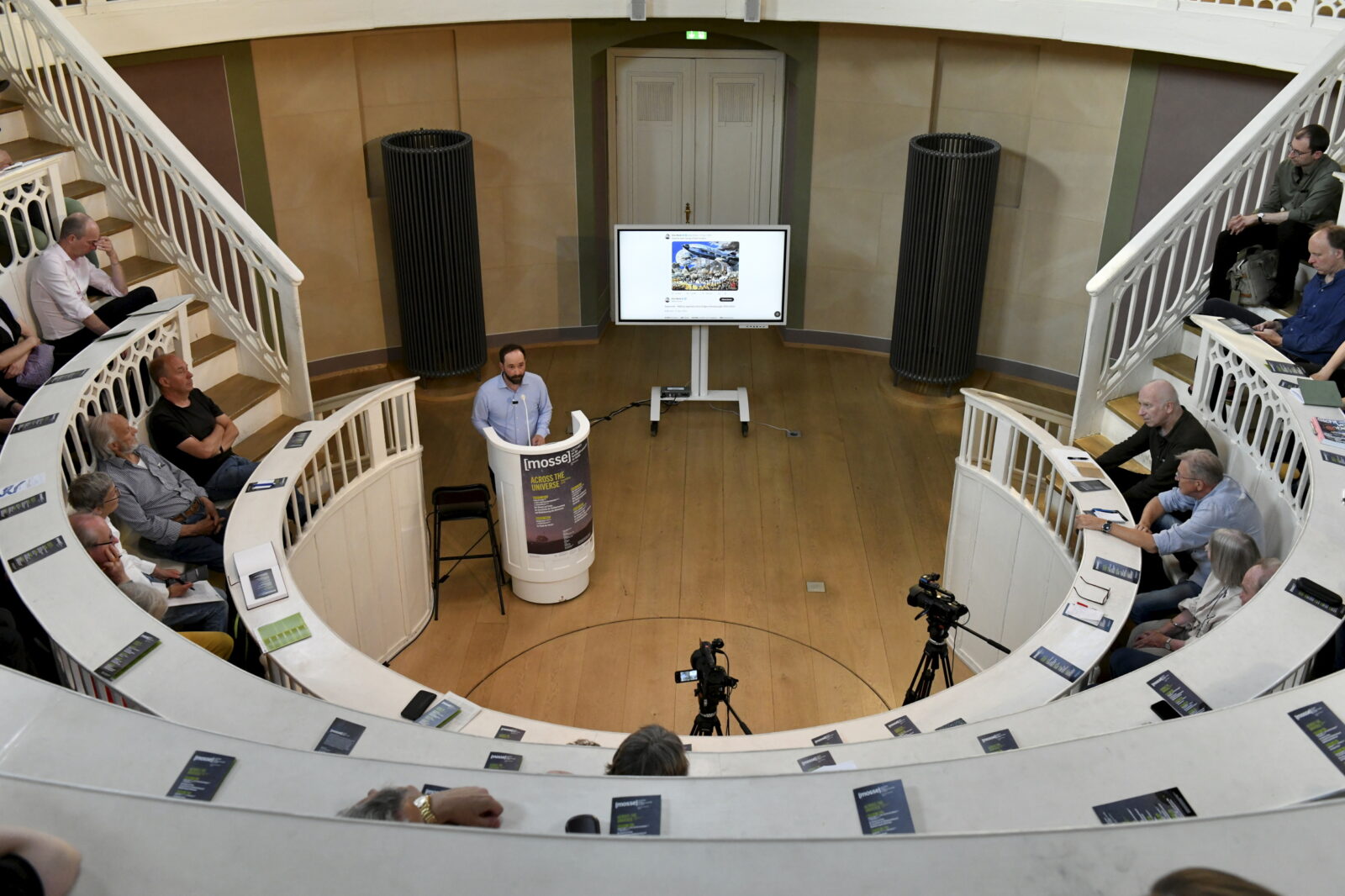
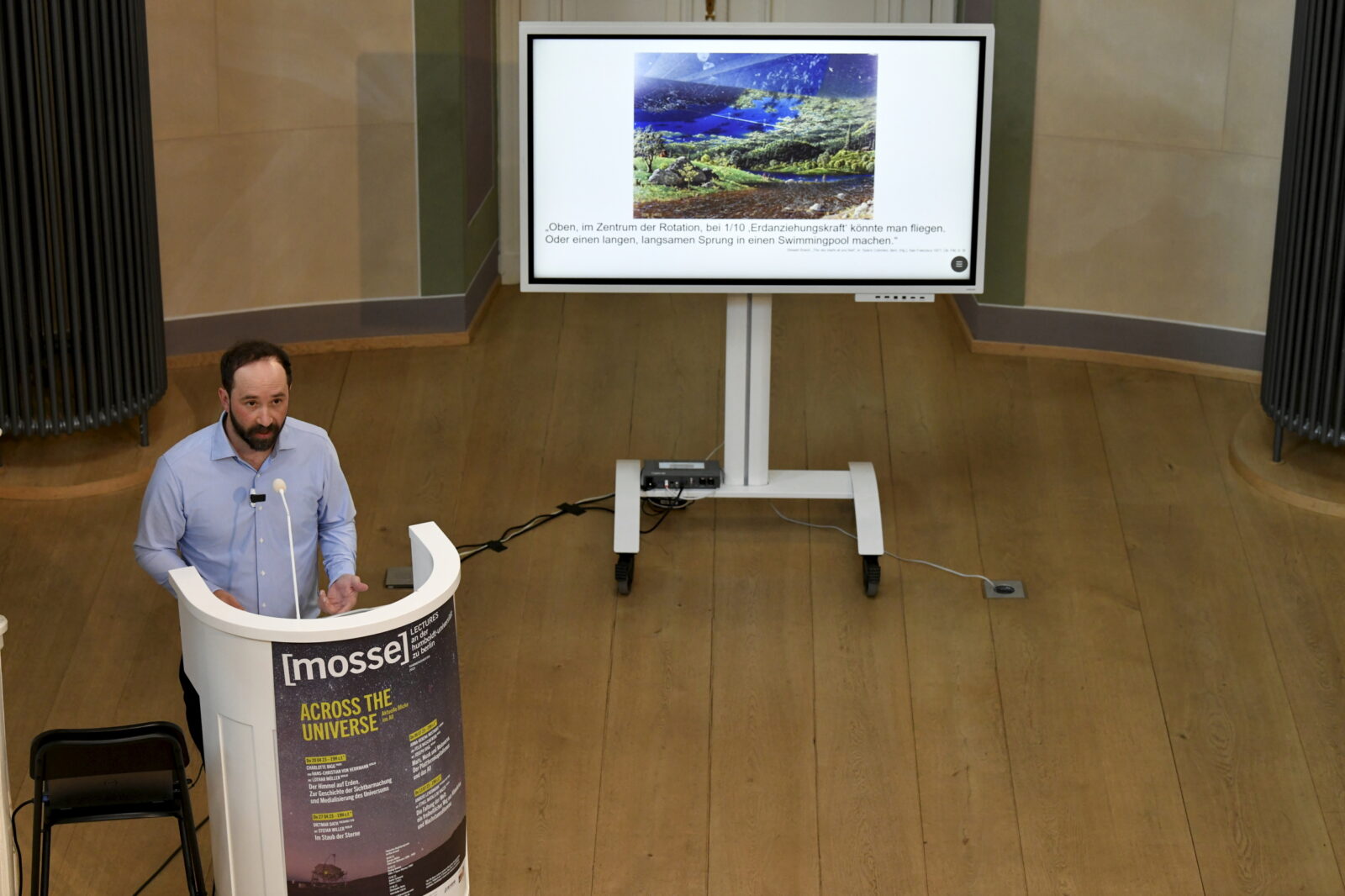
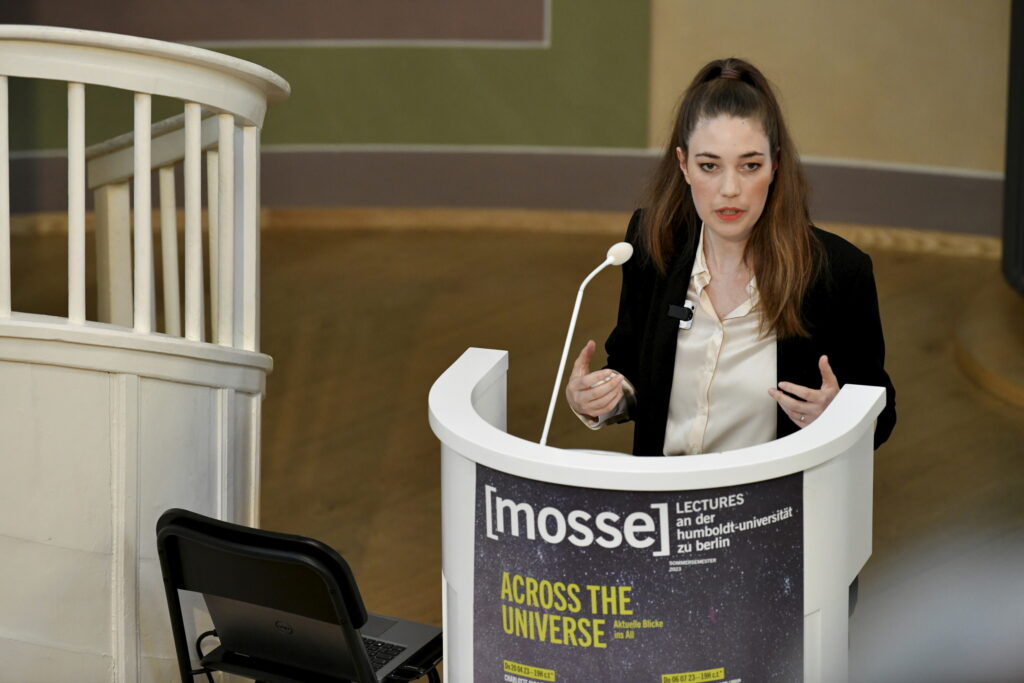
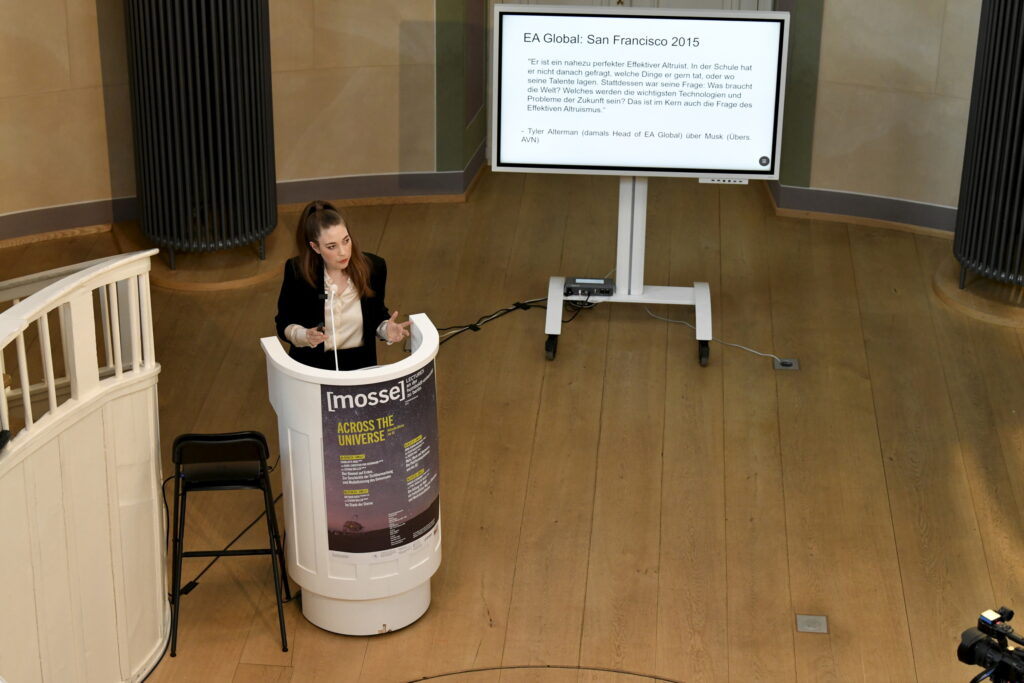
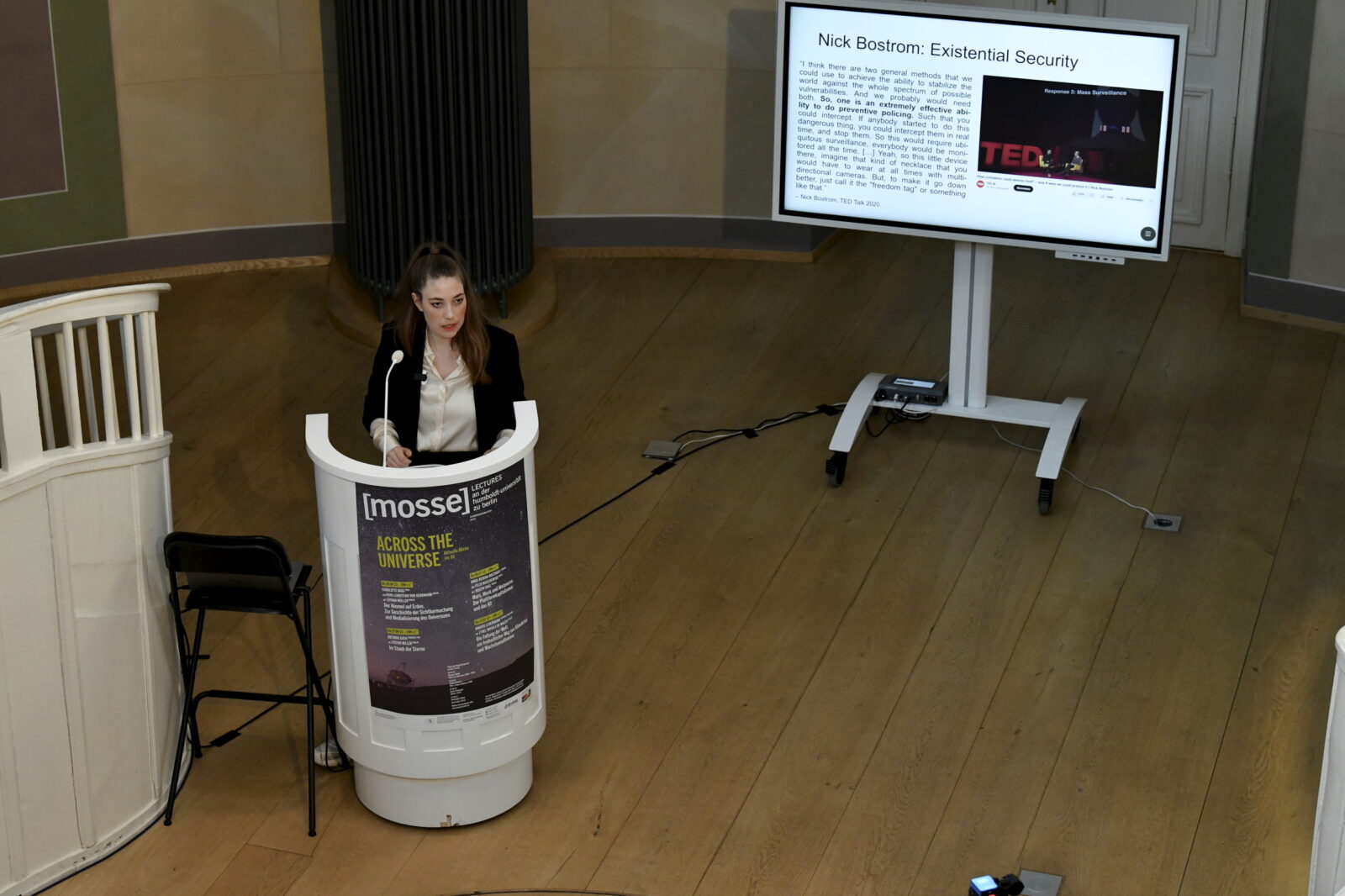
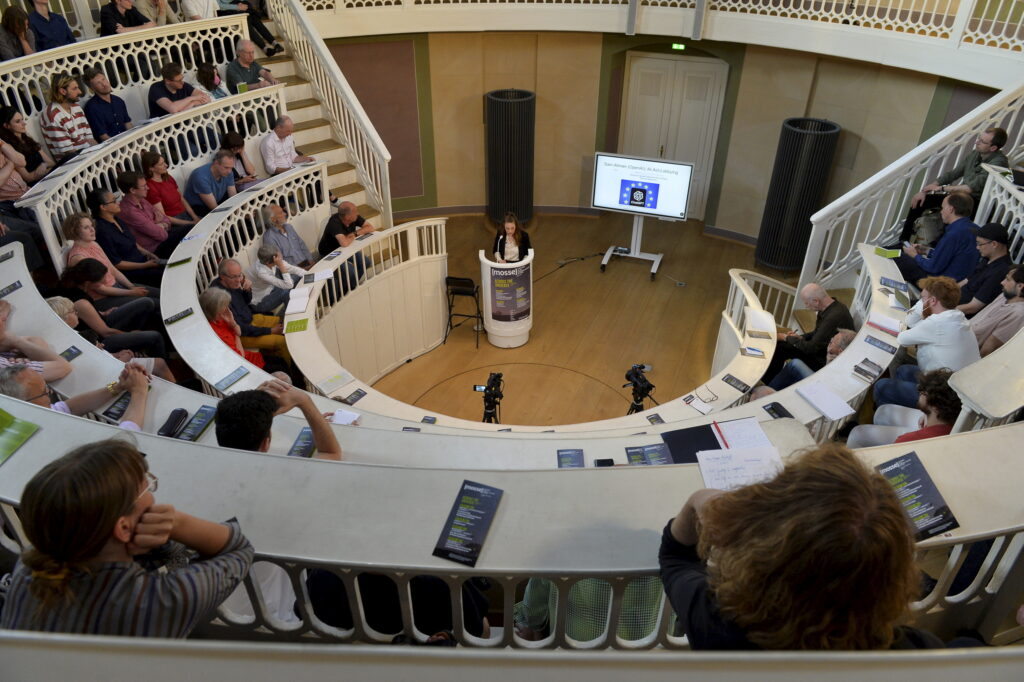
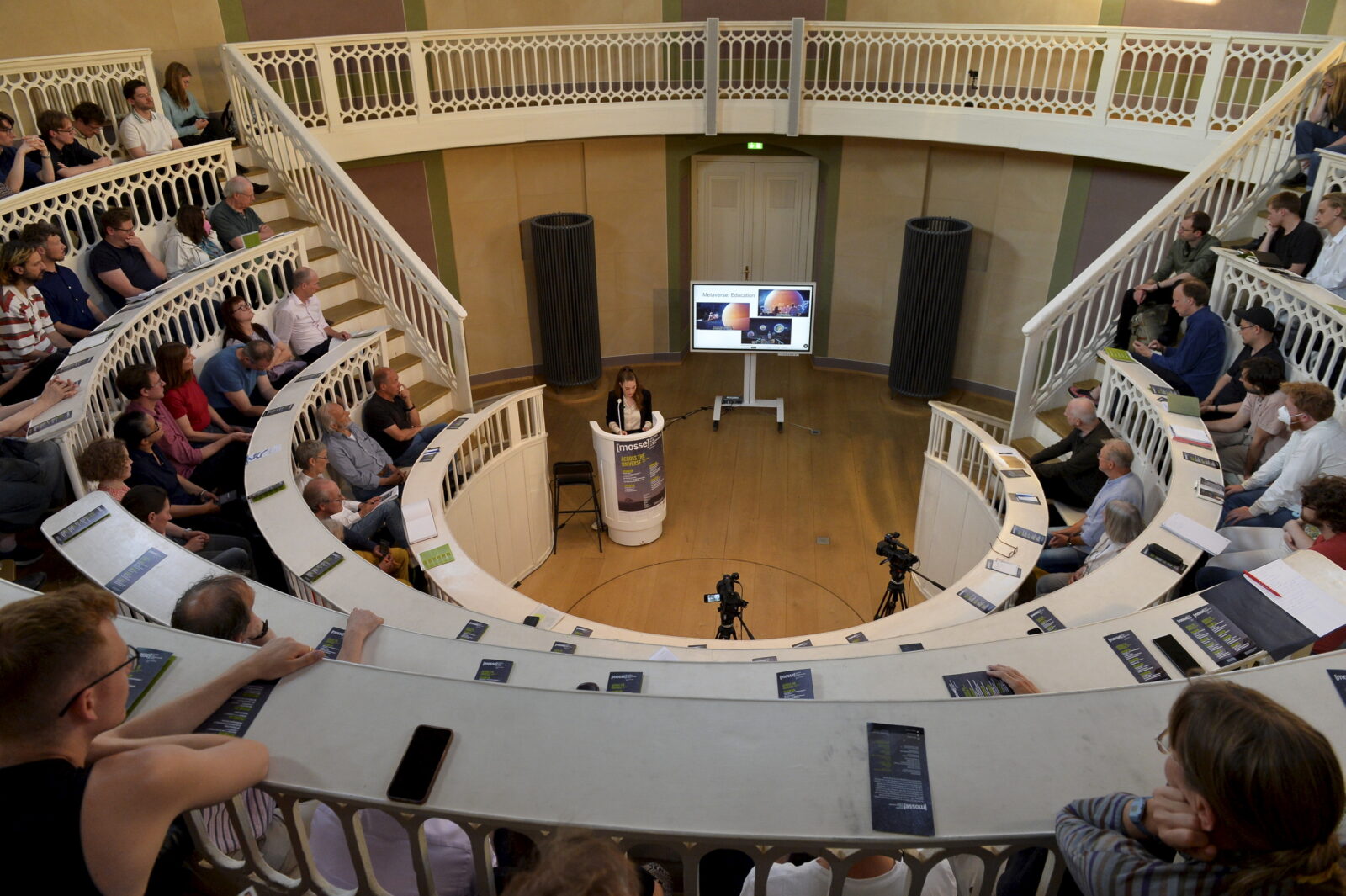
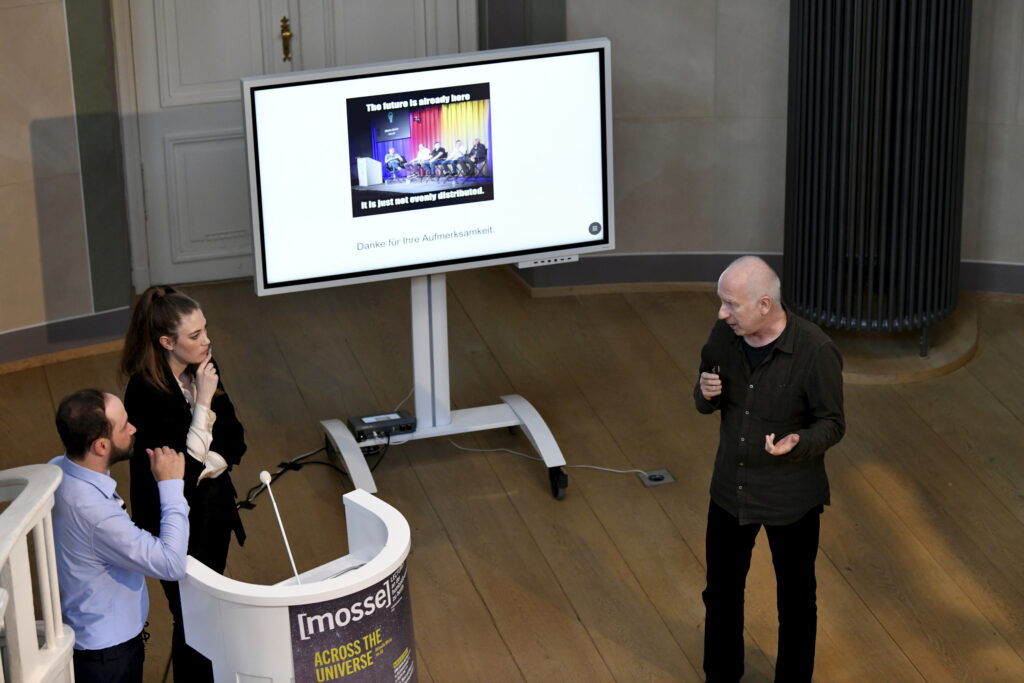
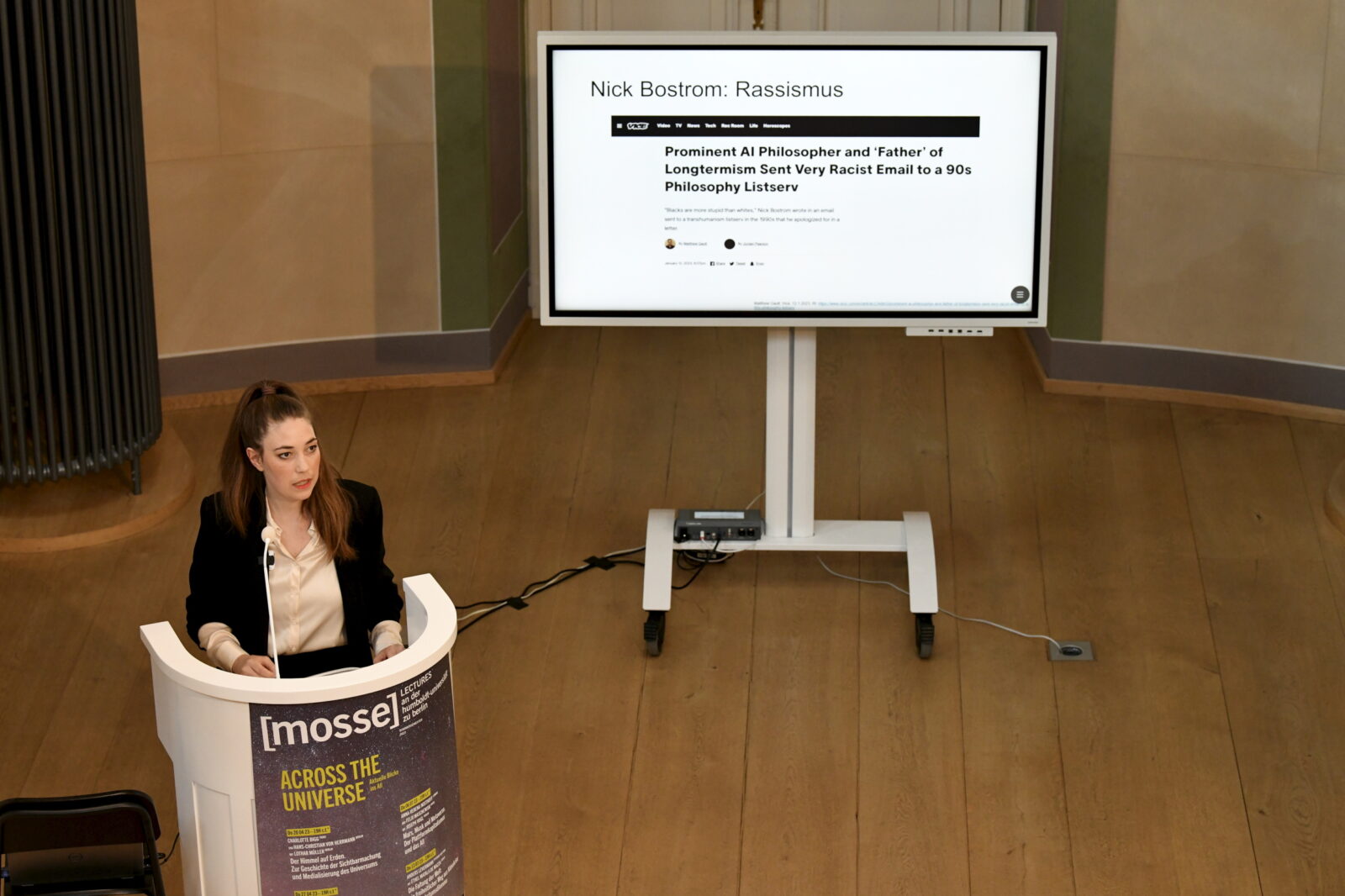
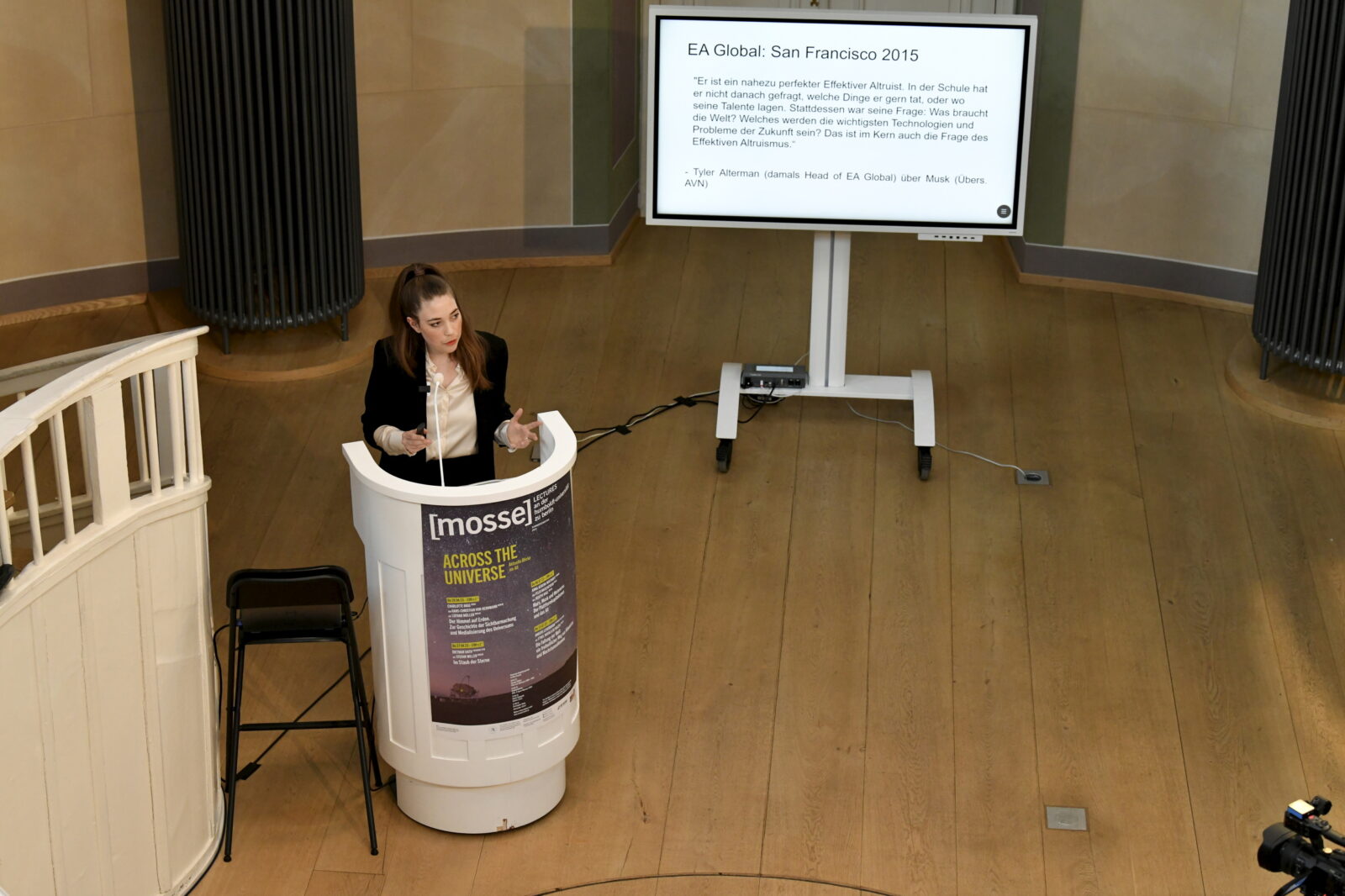
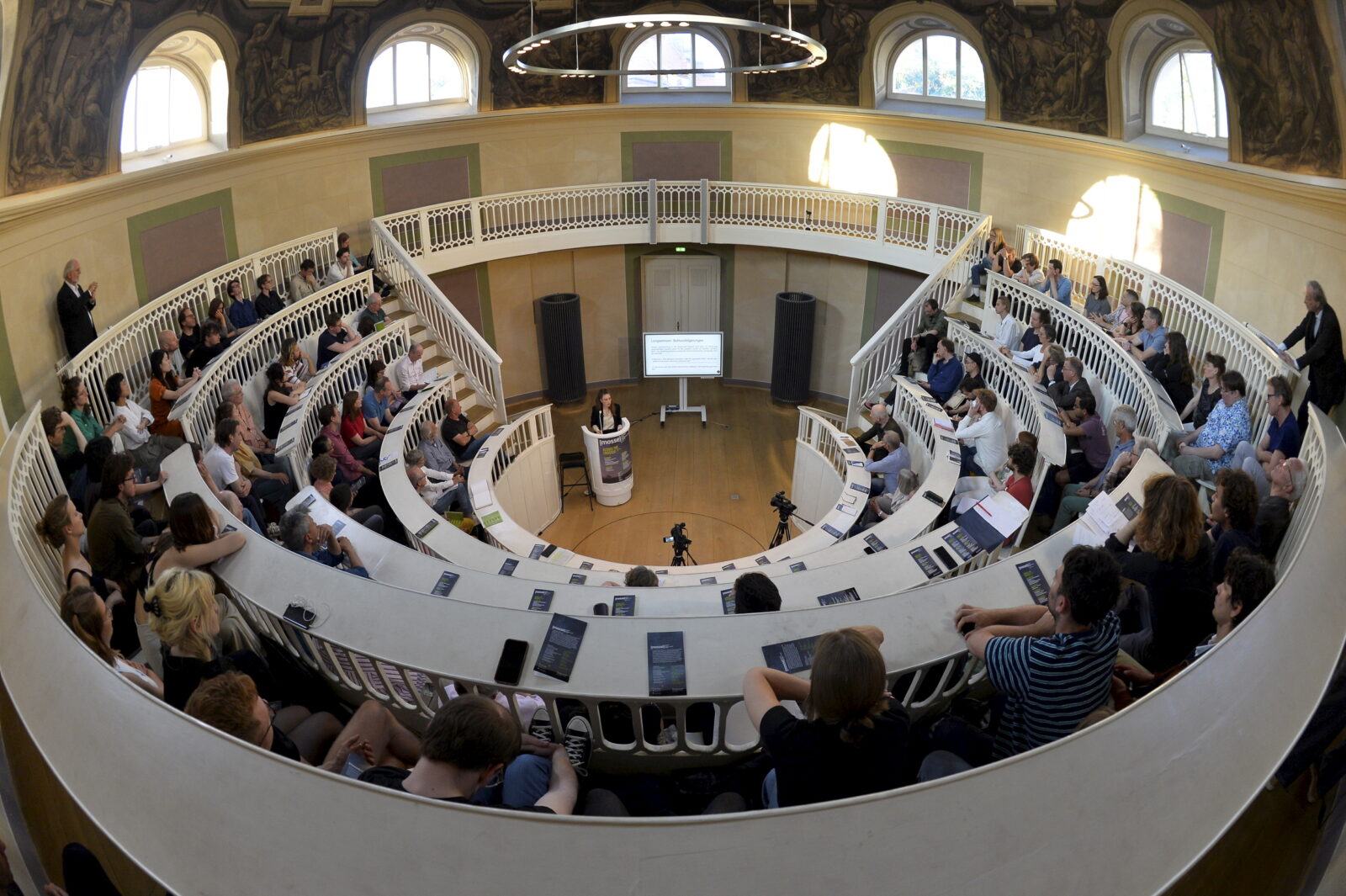
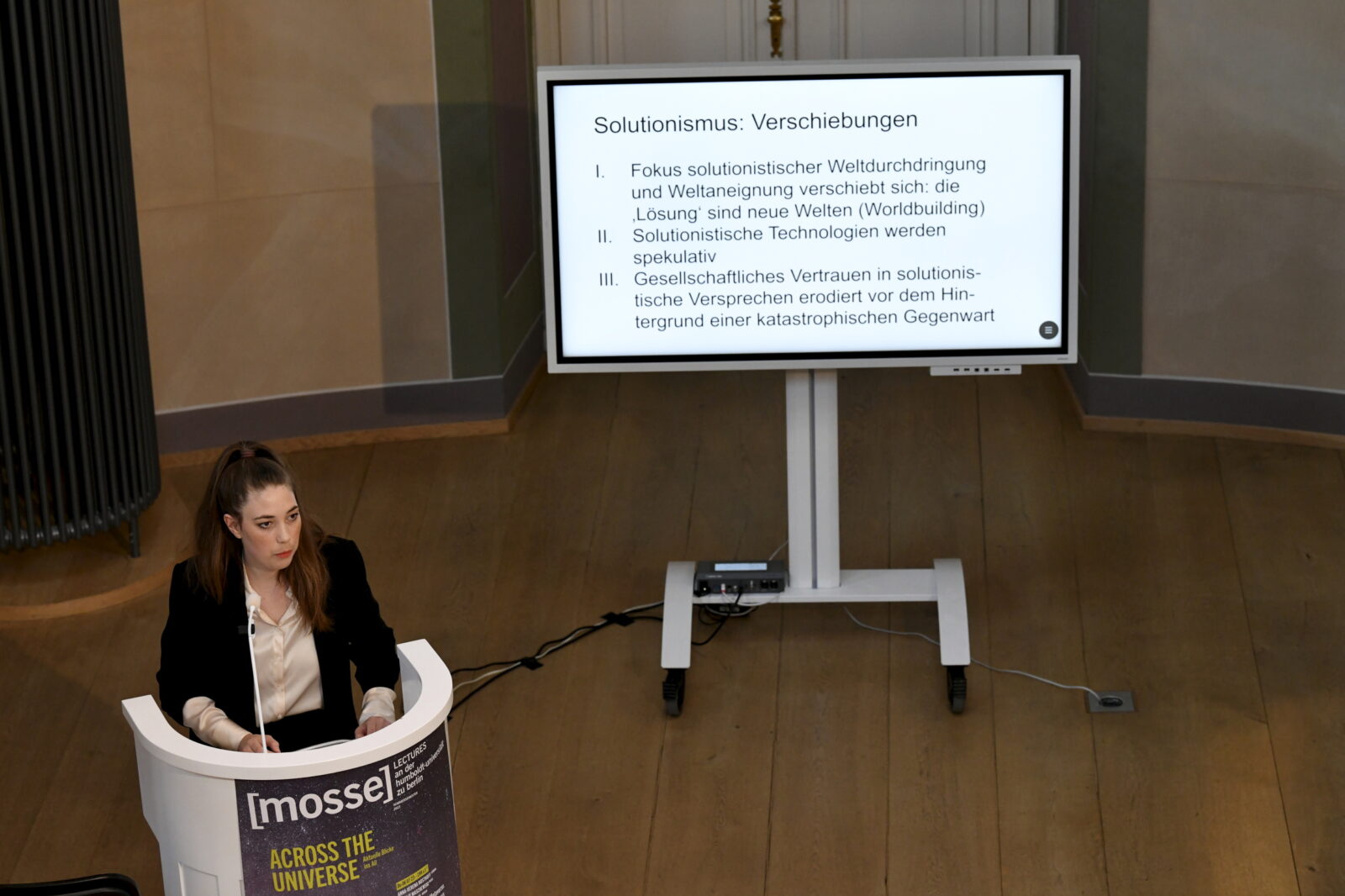
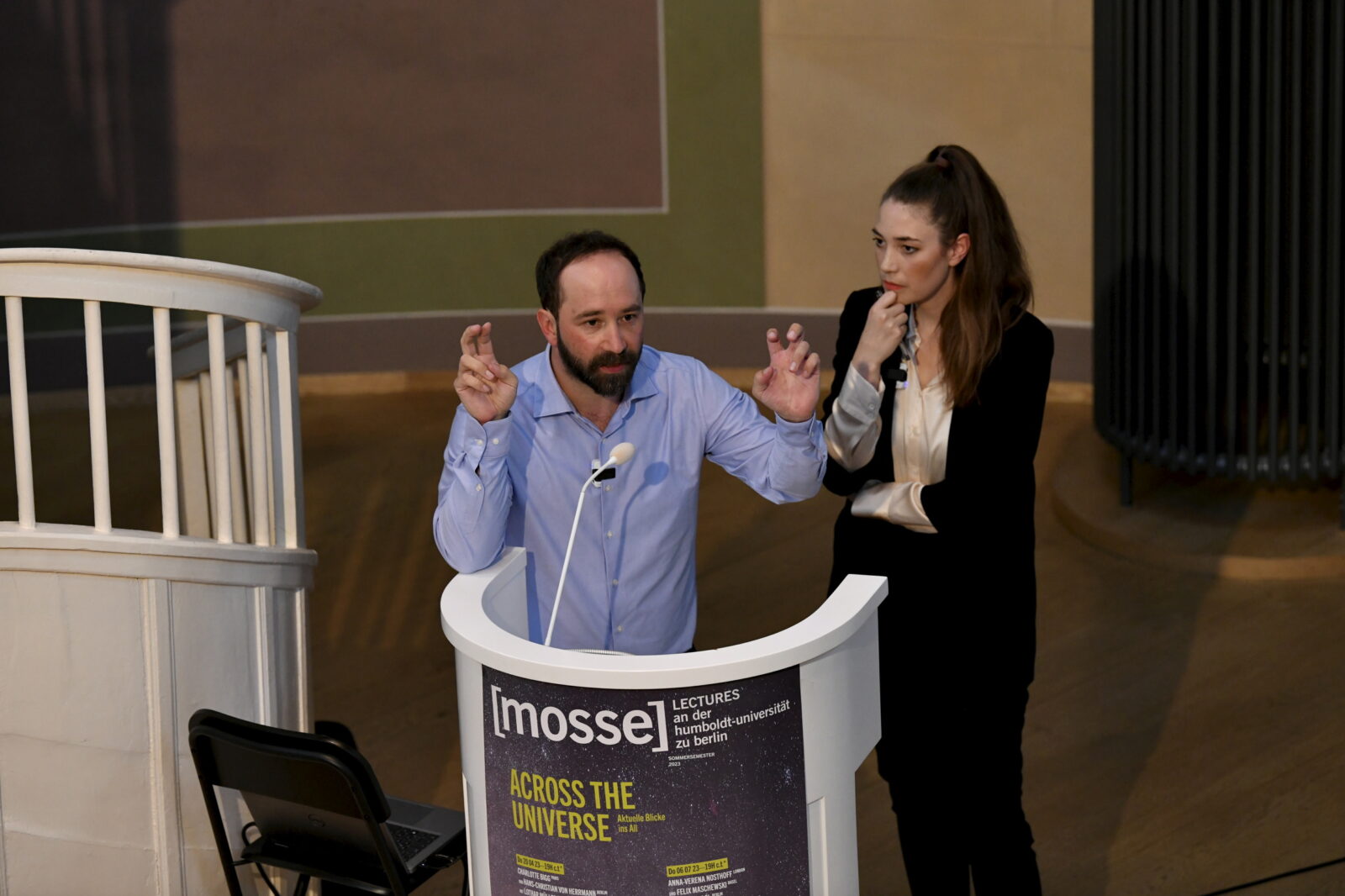
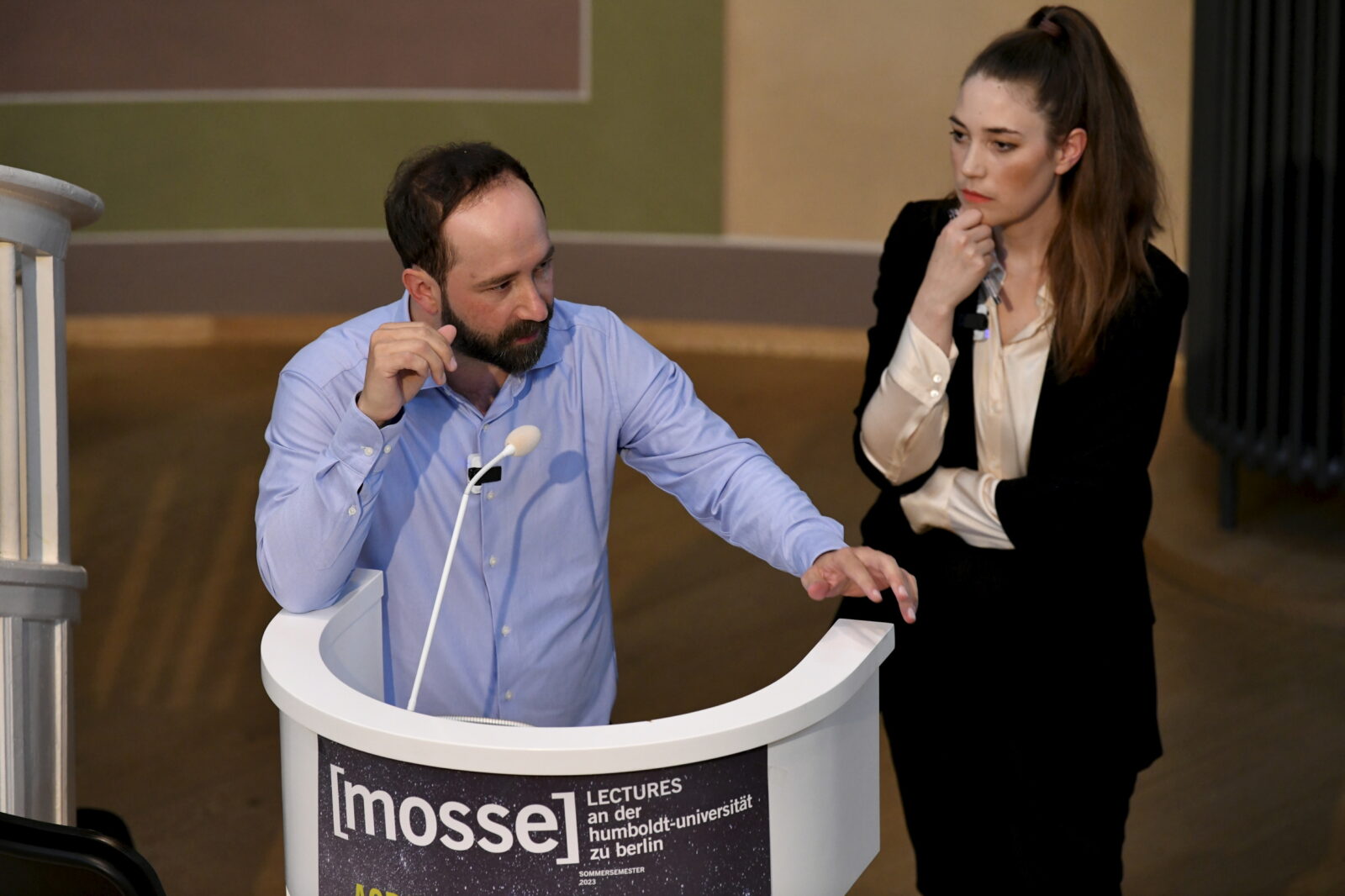
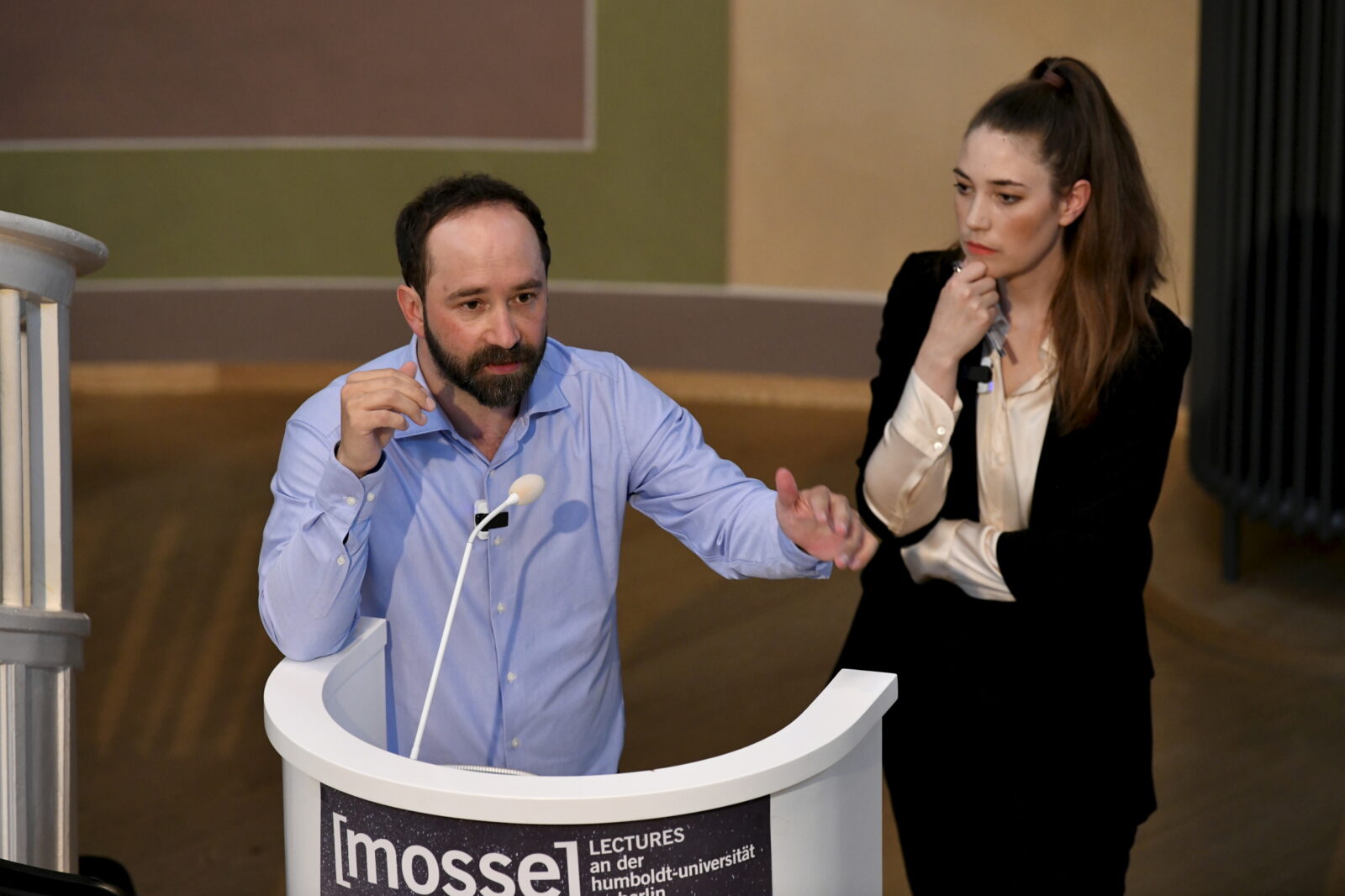
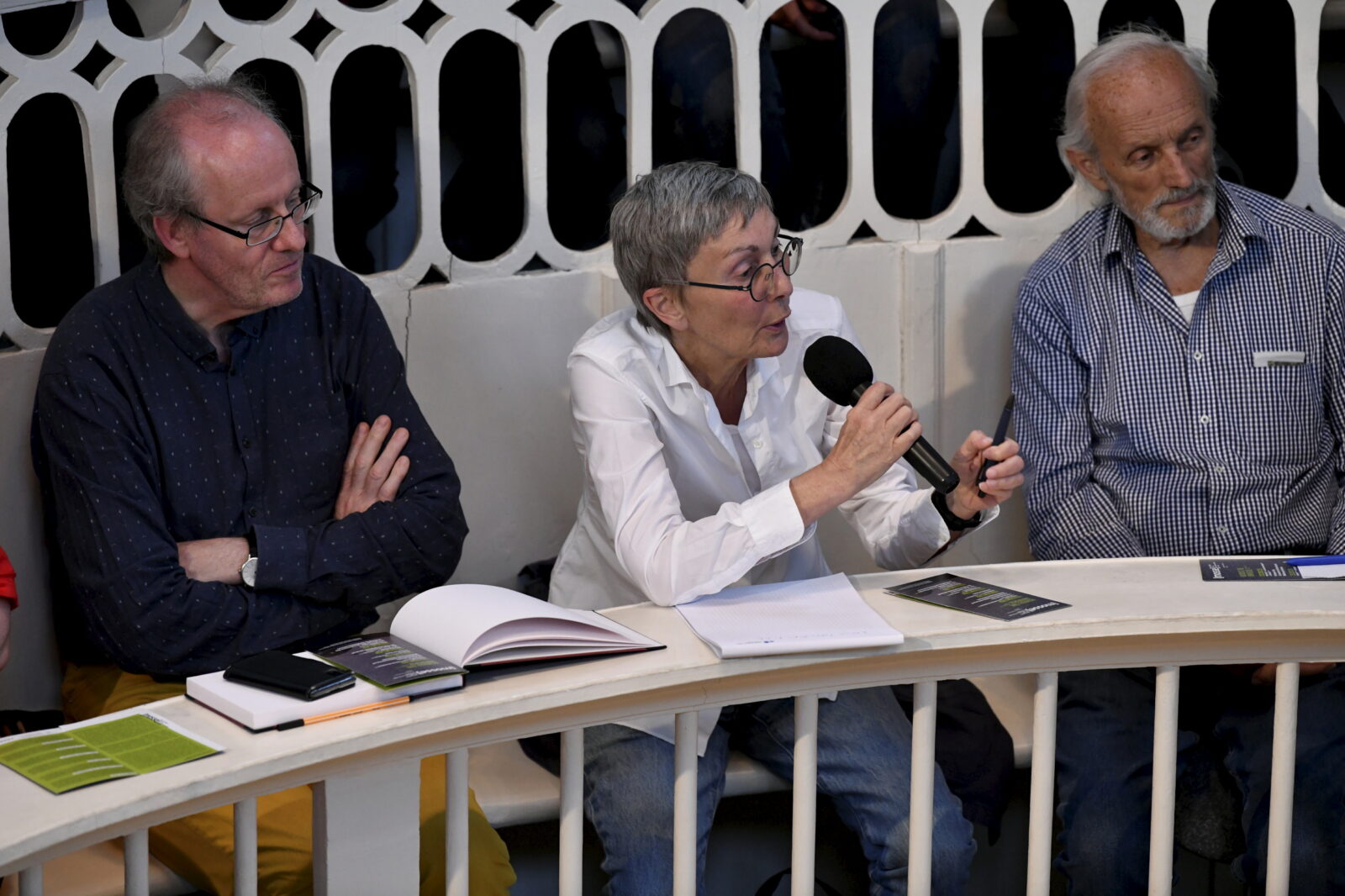
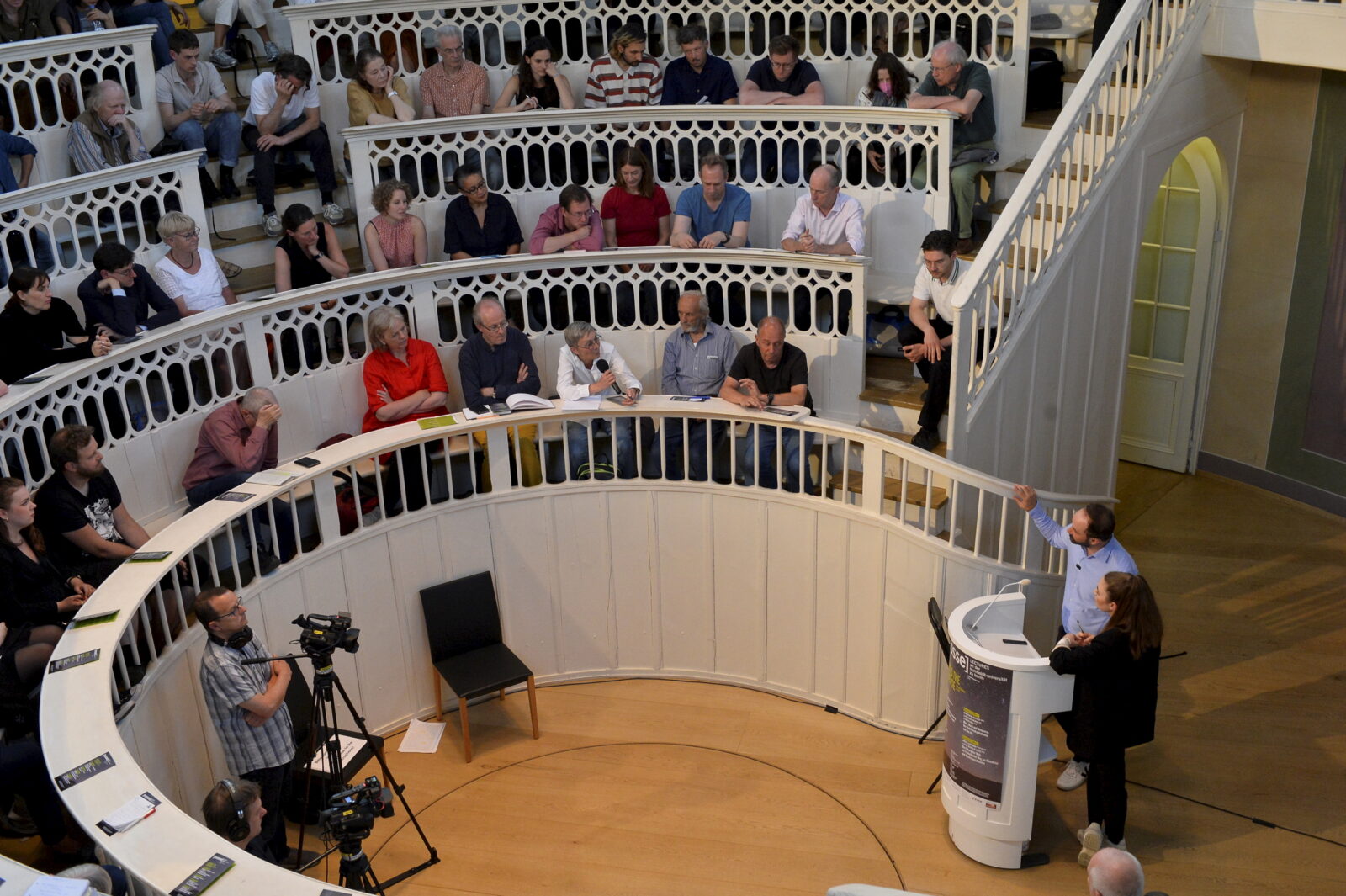
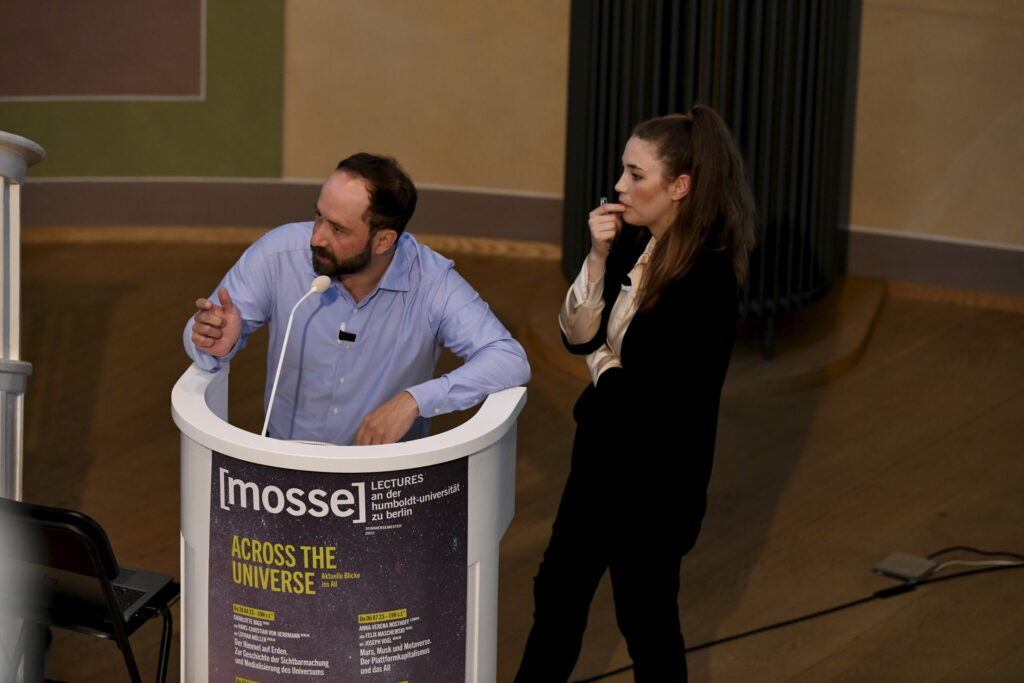
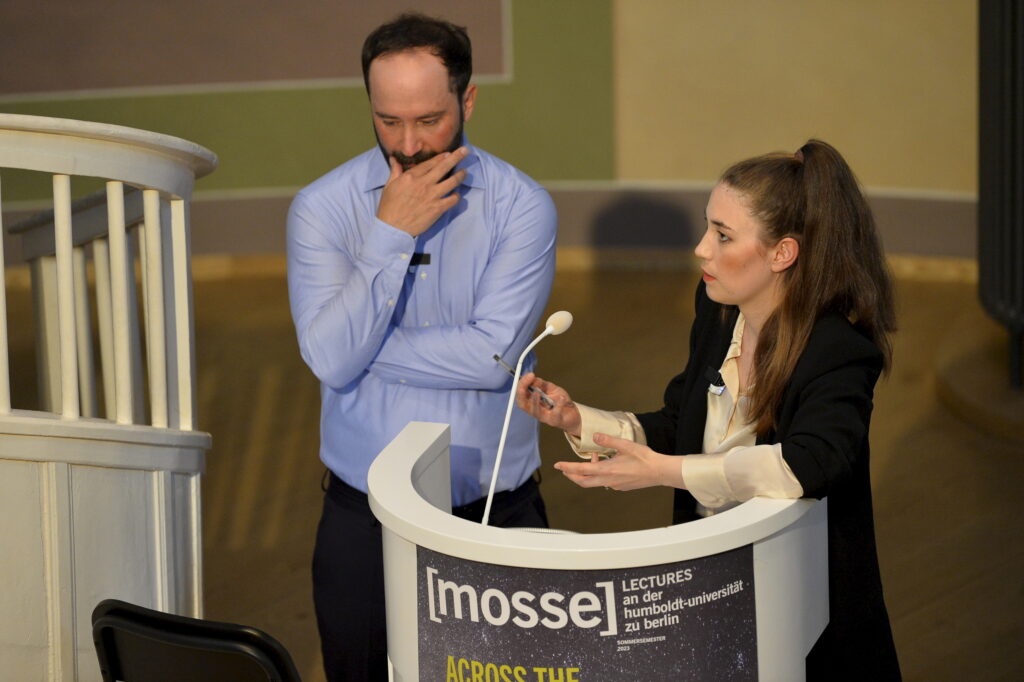
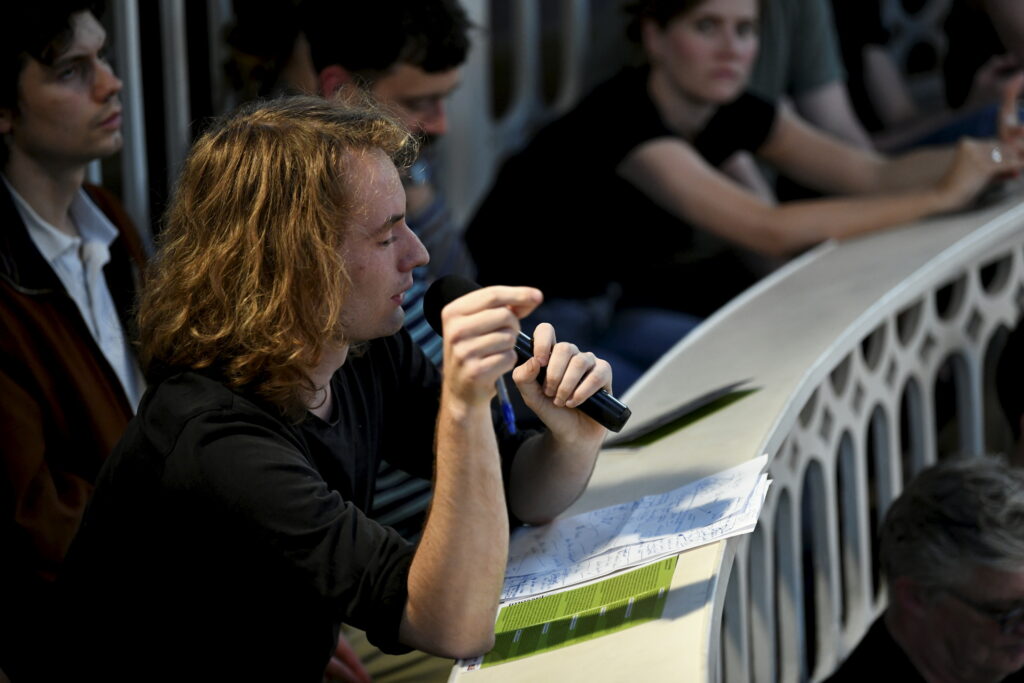
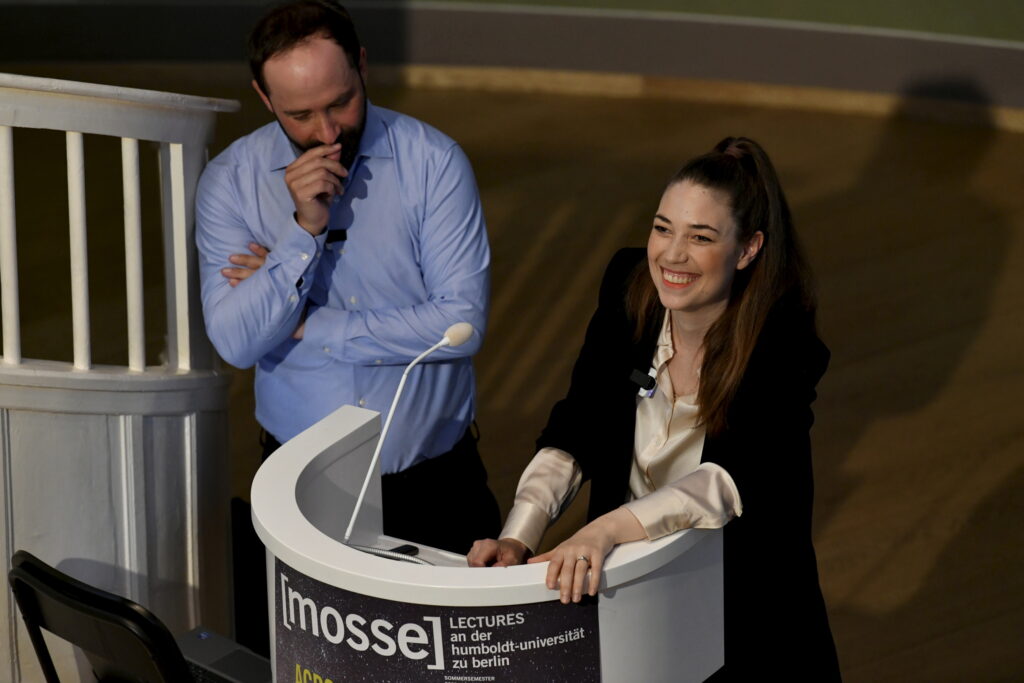
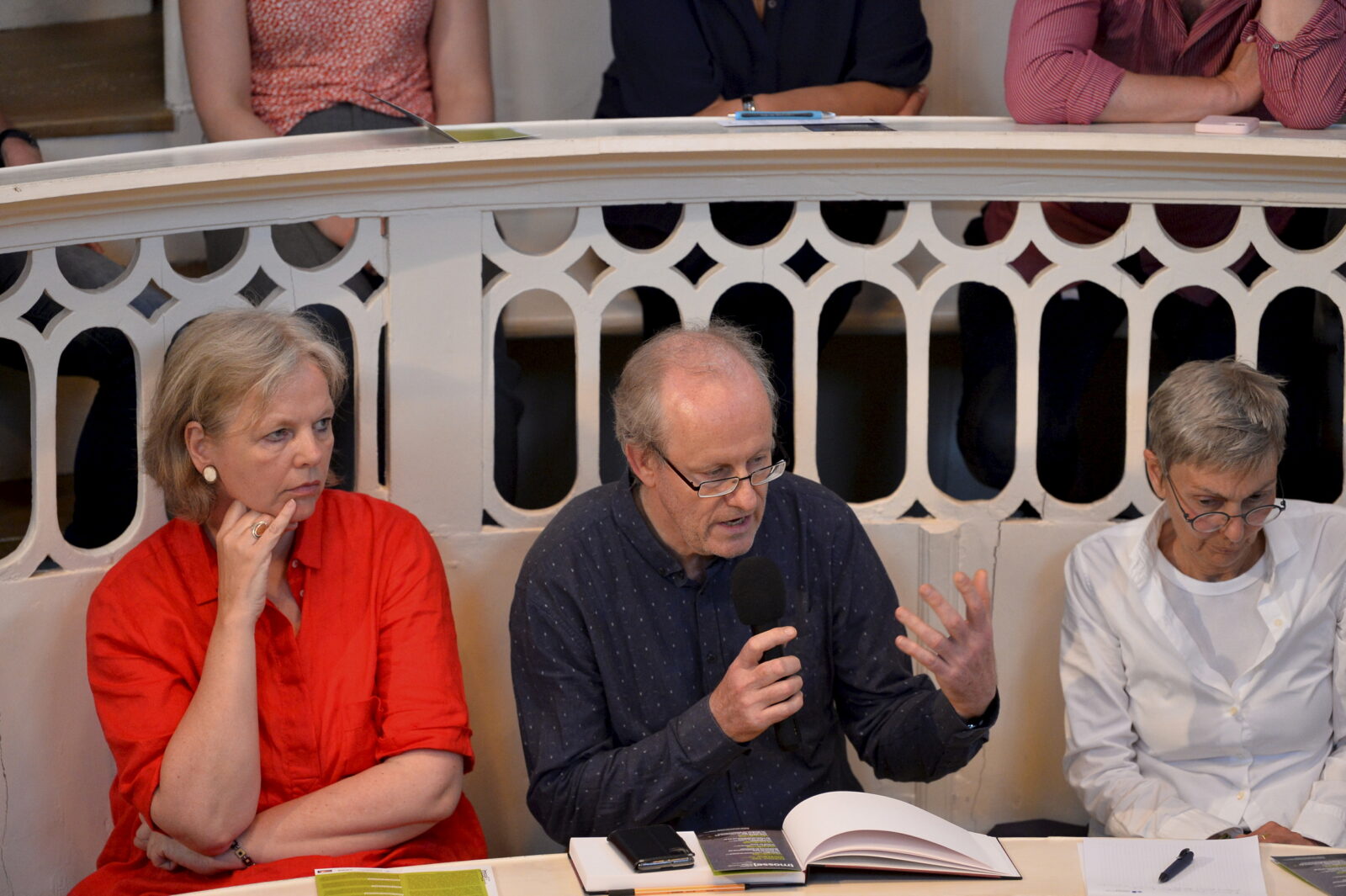
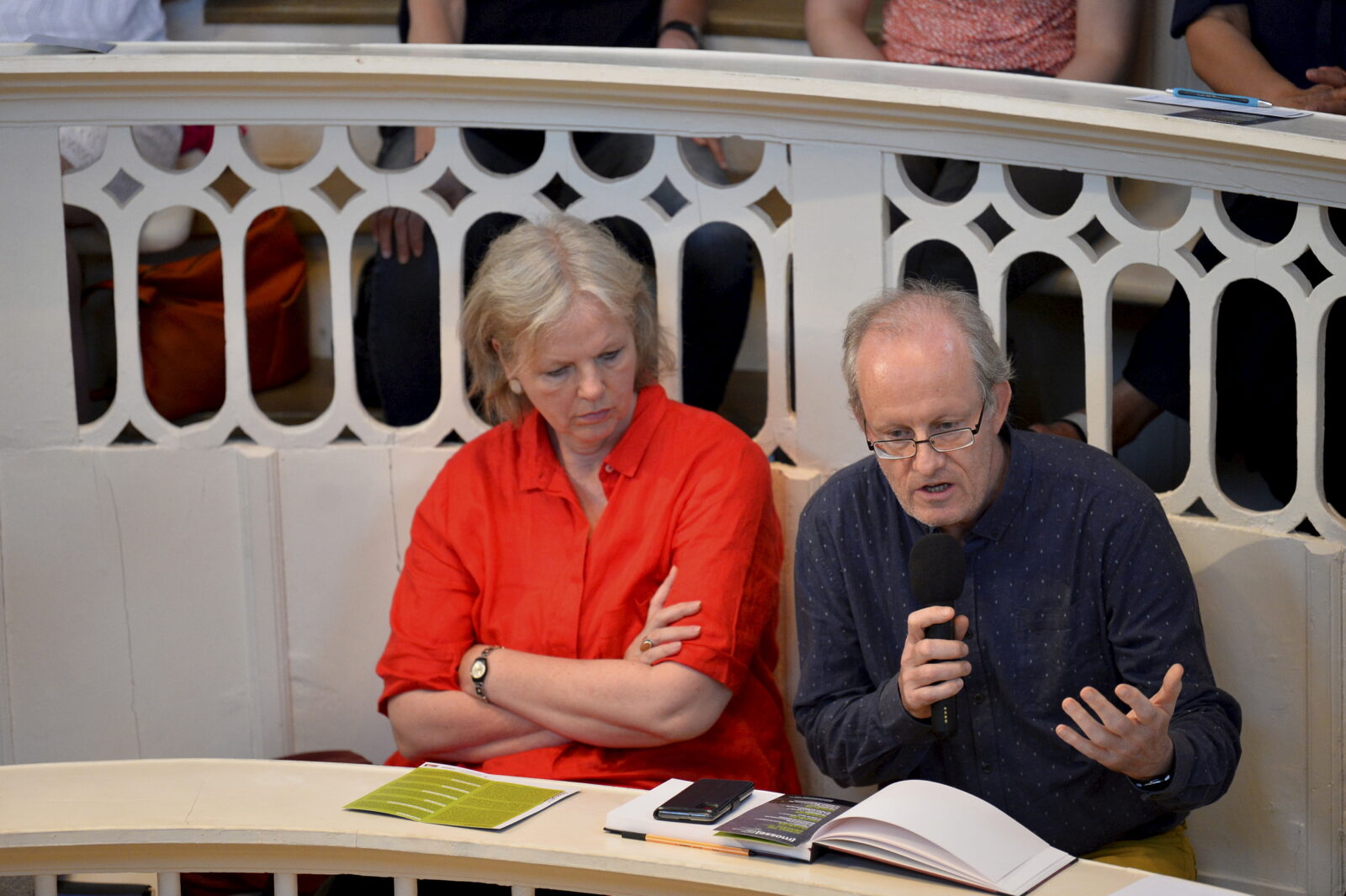
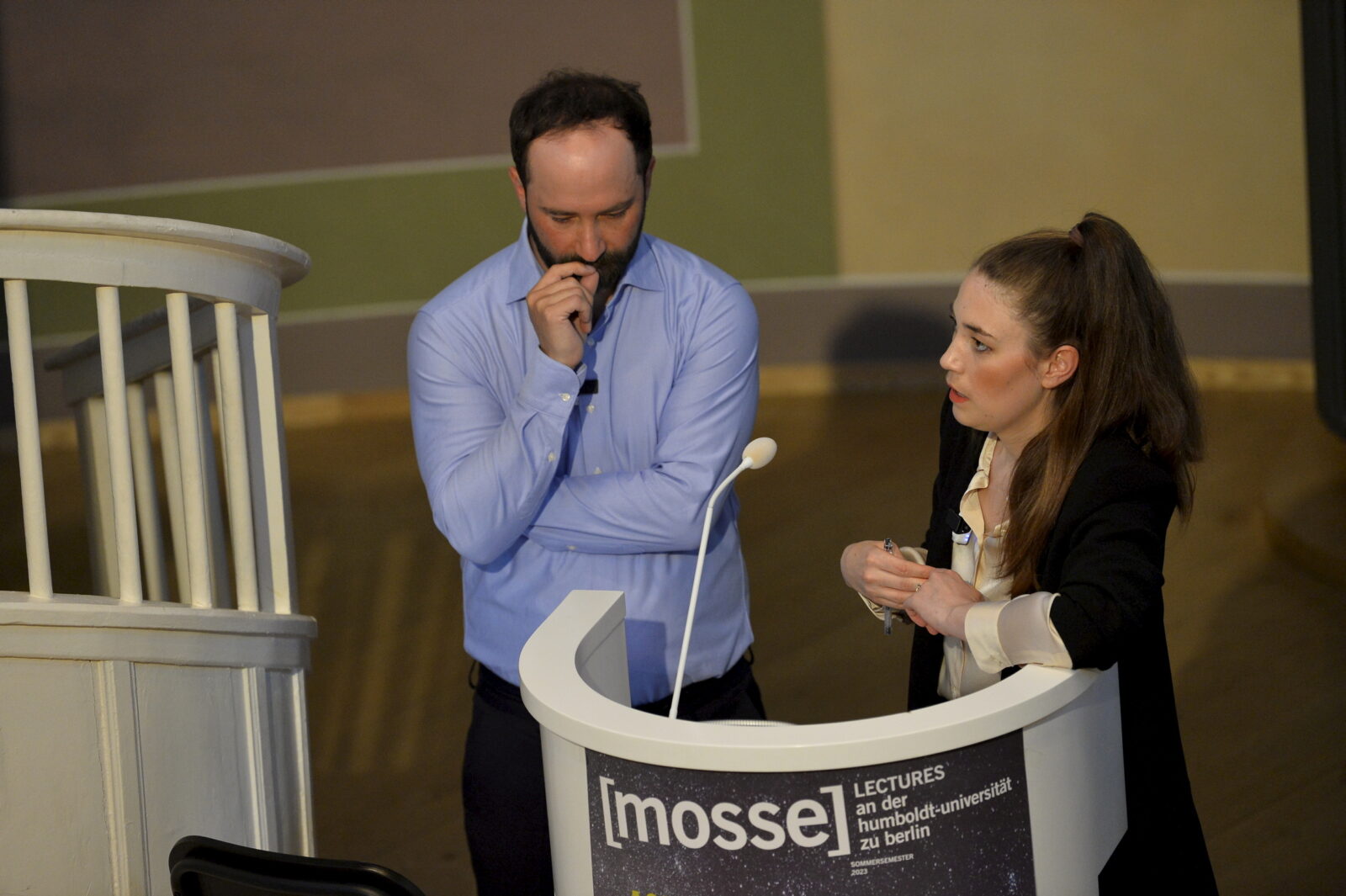
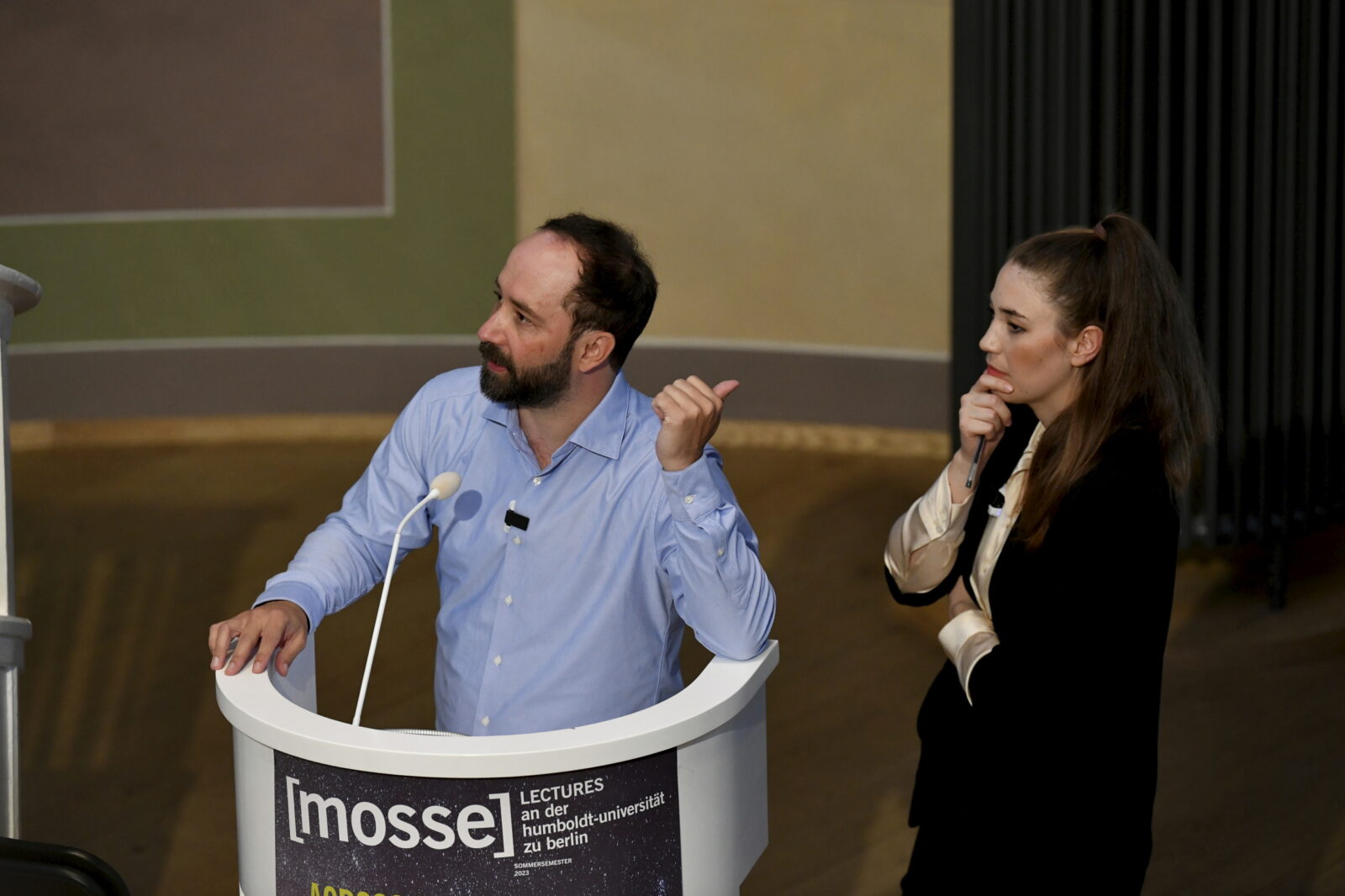
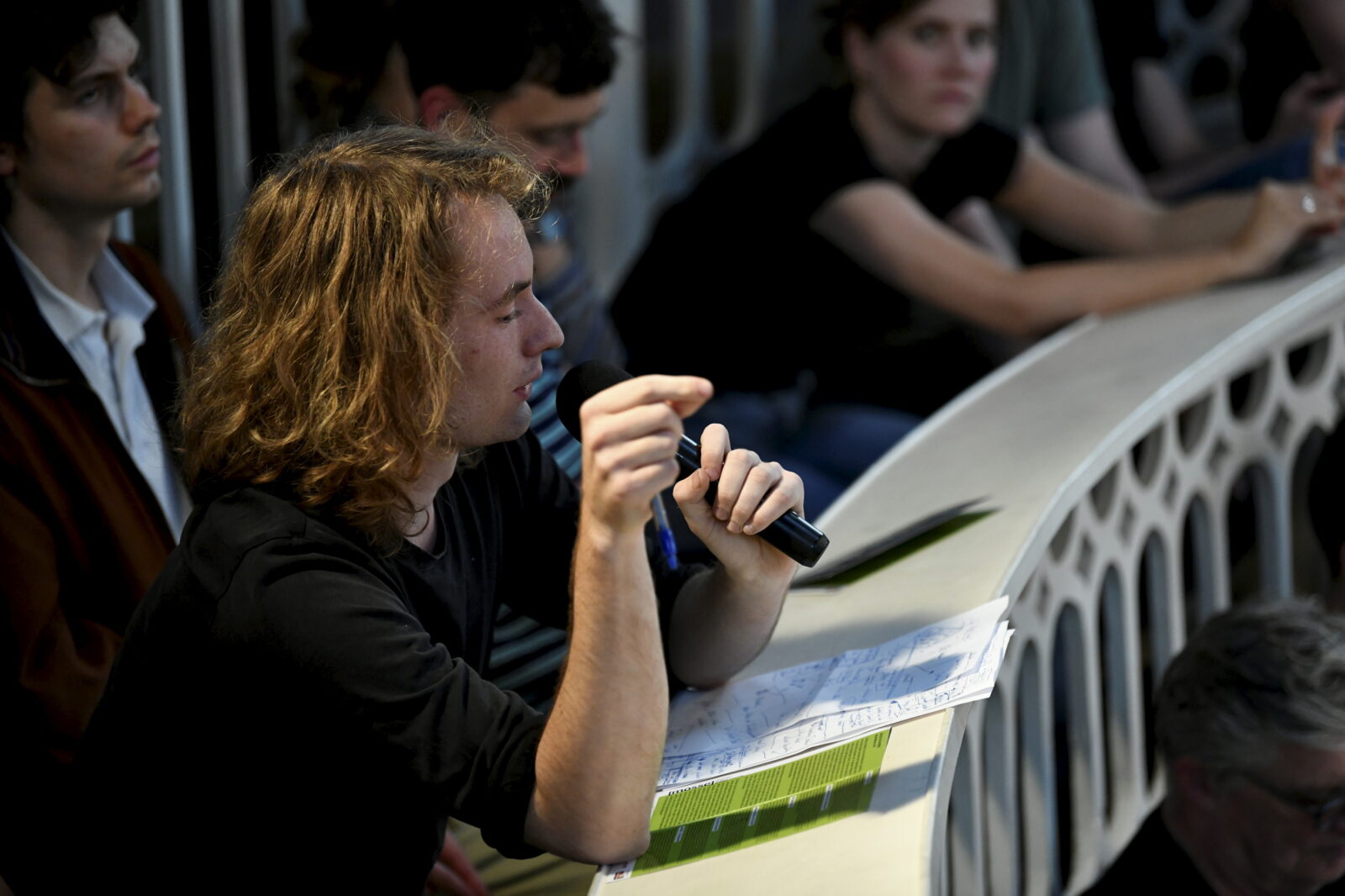
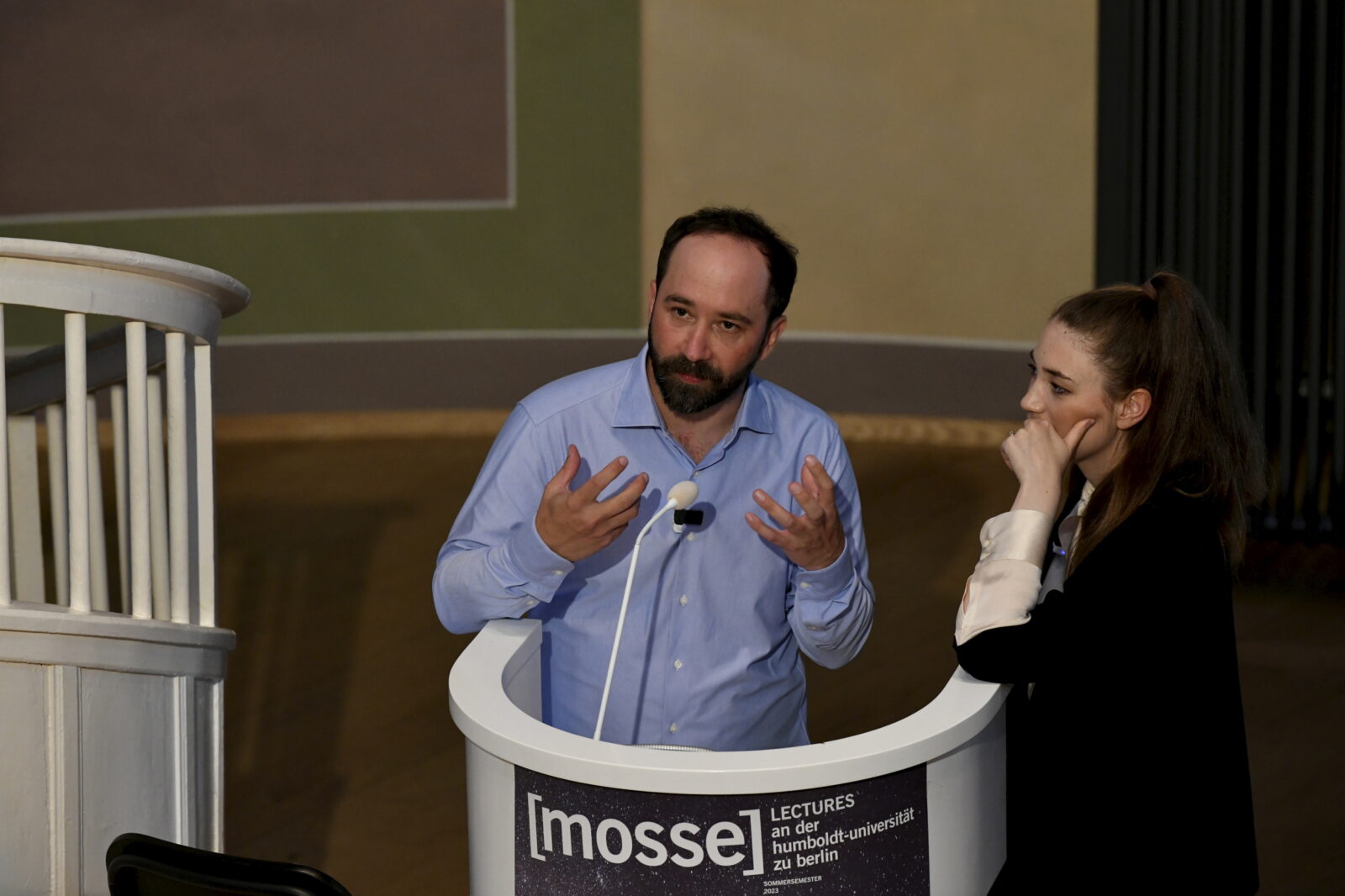
Photo credit: Niels Leiser for the Mosse Lectures
Anna-Verena Nosthoff and Felix Maschewski: Nosthoff is a philosopher, political theorist, and publicist who currently serves as Junior Professor of Philosophy and Digital Ethics at Carl von Ossietzky University Oldenburg. She is co-Director of the Critical Data Lab at Humboldt University and has held research and teaching positions at the London School of Economics, the University of Basel, Princeton Universtiy, and several other institutions. Maschewski is a literary, media, and cultural theorist and Co-Director of the Critical Data Lab at the Humboldt University. He is a teaching fellow at the University of Basel and has researched and taught at the Free University of Berlin and Princeton University. Together, they authored the book “Die Gesellschaft der Wearables” (The Society of Wearables).
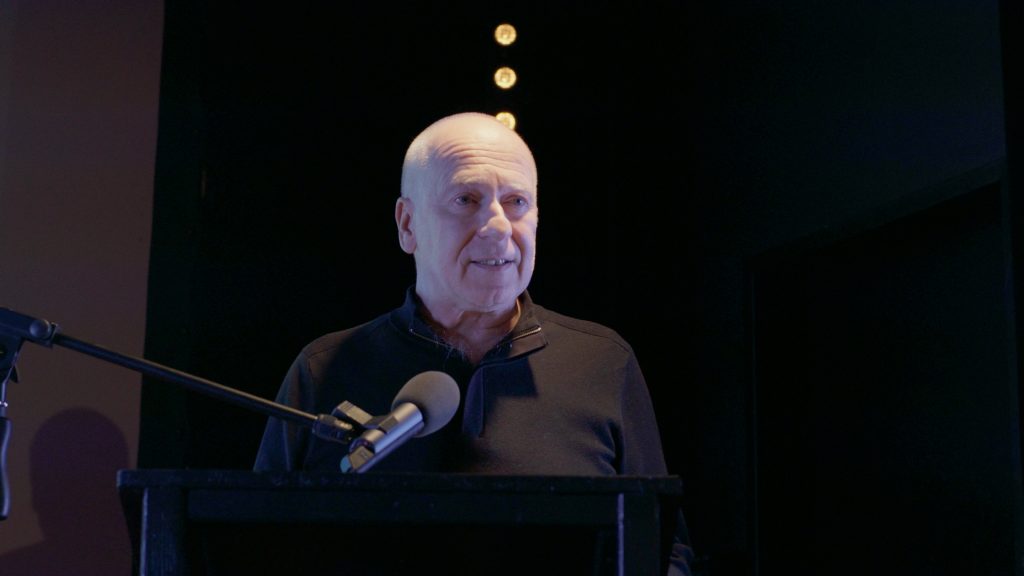
His research and teaching comprises literature from the eighteenth to the twentieth century, media and aesthetics, cultural and political theory. Recent research focuses on the history of financial economy, literature and economics, and the “poetics of knowledge” – the study of the relationships and interactions between forms of knowledge and poetic or aesthetic figures. He is the director or principal investigator of a range of research projects including “The Knowledge of Literature” (PhD-Net), “Small Forms in the History of Literature and Sciences” (Research Training Group), and “Matters of Activity: Image Space Material” (Cluster of Excellence).
Joseph Vogl published more than a hundred articles and book chapters, as well as numerous books and monographs. Among his most important written works are the monographs Ort der Gewalt. Kafkas literarische Ethik (1990); Kalkül und Leidenschaft. Poetik des ökonomischen Menschen (2002); Über das Zaudern (2007; On Tarrying, 2011). Besides his research in literature, cultural and media studies, he is well known for his intensive work on modern and present-day finance and economics, analyzing finance theories from the perspective of cultural history. This work culminated in his books Das Gespenst des Kapitals (2010; The Specter of Capital, 2014), Der Souveränitätseffekt (2015; The Ascendancy of Finance, 2017) and Kapital und Ressentiment. Eine kurze Theorie der Gegenwart (2021; Capital and Ressentiment: A Brief Theory of the Present, 2022), which received wide recognition in the fields of cultural studies as well as economics, and initiated a public debate. Further workings include translations from French to German (Deleuze, Lévi-Strauss, Lyotard) and numerous interviews on TV with Alexander Kluge (see Soll und Haben. Fernsehgespräche, 2009; Senkblei der Geschichten. Gespräche, 2020).
He was awarded the Günther Anders Prize for Critical Thinking (2022). For his book Der Souveränitätseffekt (The Ascendancy of Finance) Vogl was on the shortlist for the Leipzig Book Fair Prize 2015 in the category of non-fiction. In 1988 he received the Translation Prize for the Promotion of Franco-German Relations (DVA Foundation) for his translations of key works of modern French philosophy.
