
2024: Barbara Stollberg-Rilinger, “Entscheiden als Kulturtechnik” / “Decision-Making as a Cultural Technique”
Barbara Stollberg-Rilinger, “Entscheiden als Kulturtechnik” / “Decision-Making as a Cultural Technique”
Humboldt University Berlin Mosse Lecture
mosselectures.wisc.edu/berlin/
Thursday, 2 May 2024, 19:15 CET
In the Media:
Guest article by Barbara Stollber-Rilinger in Tagesspiegel: “Ja, nein, ich meine: jein! Entscheiden als Kulturtechnik”
Senatssaal of Humboldt University
Unter den Linden 6
10117 Berlin
GERMANY
Sponsored by:
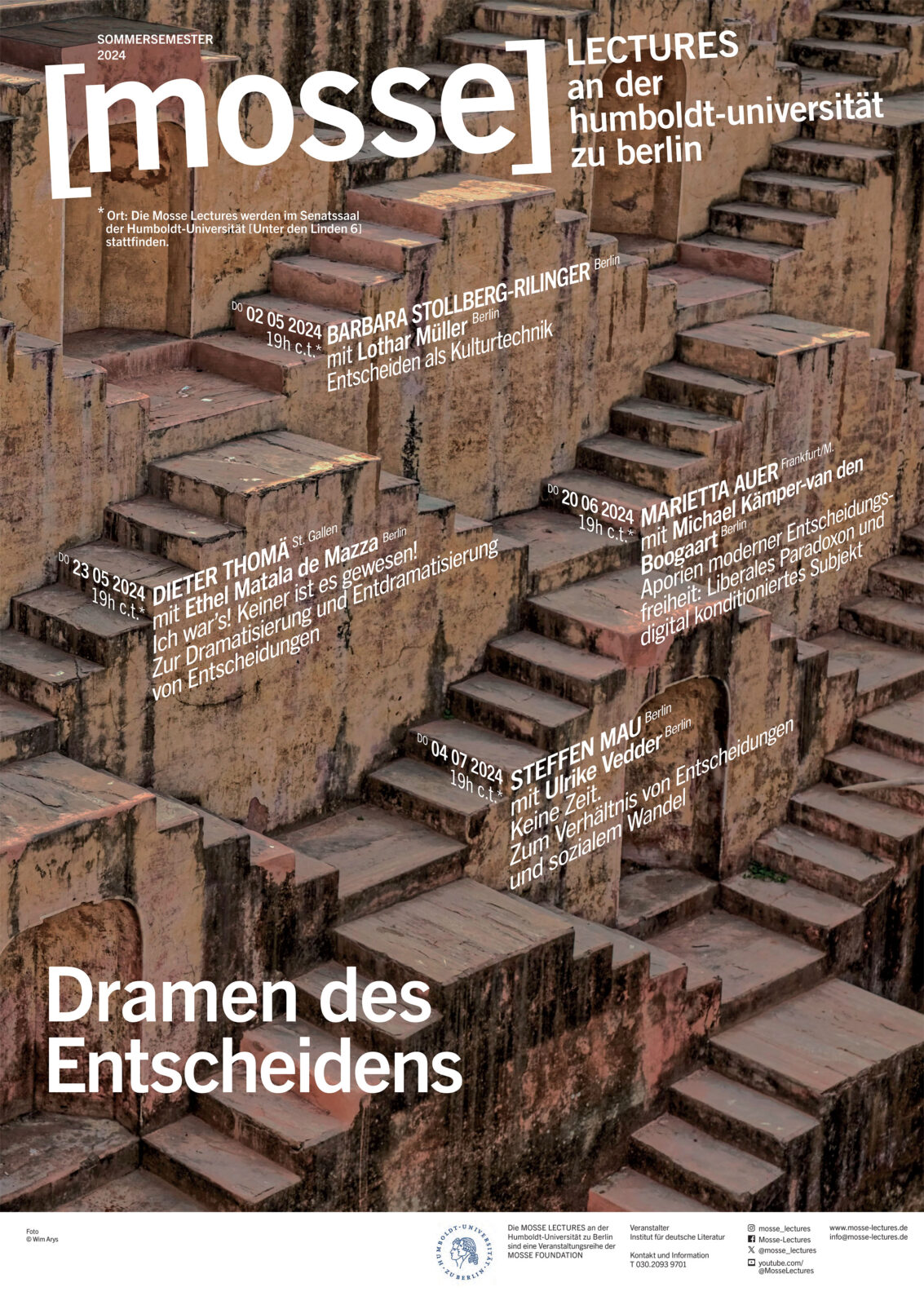
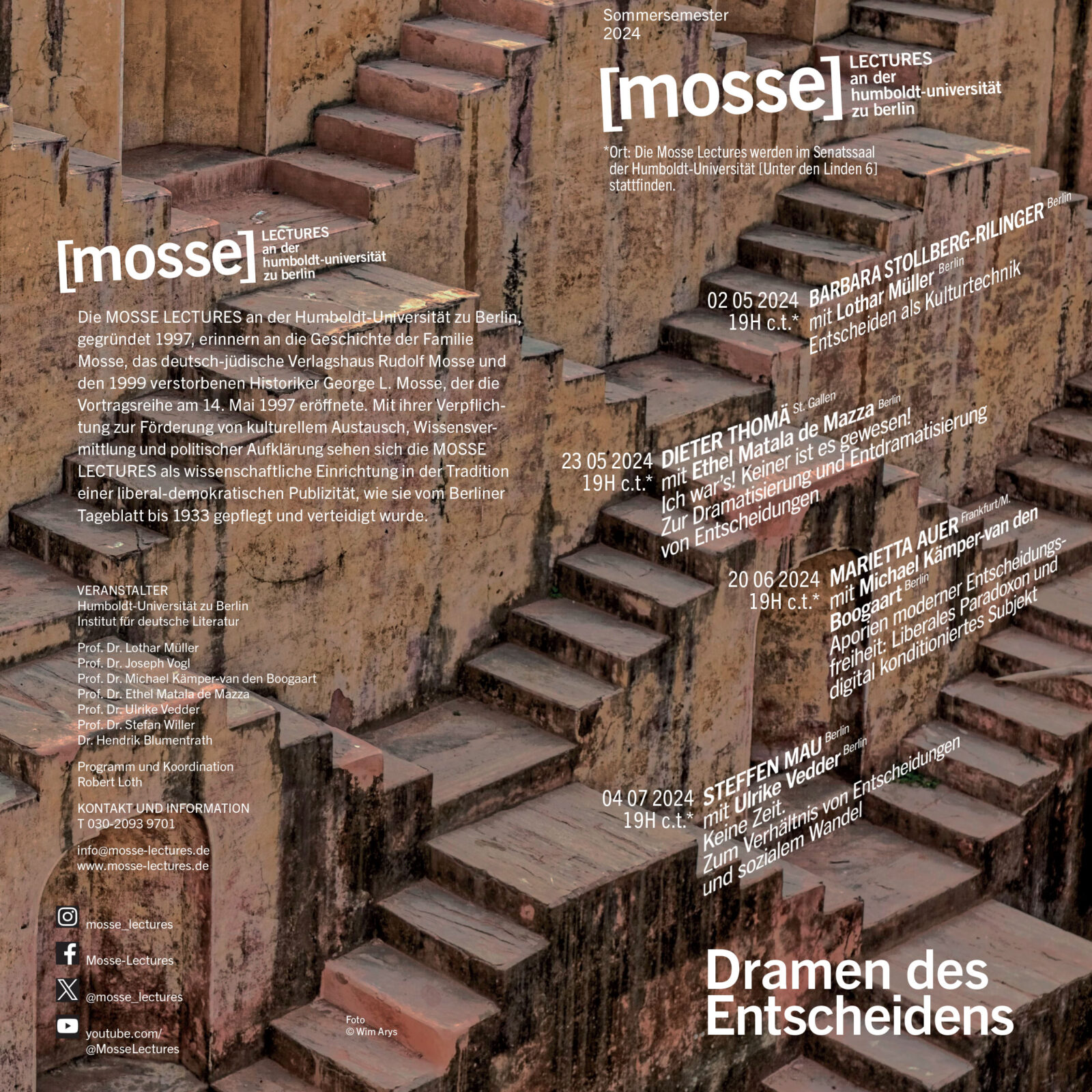
[mosse] LECTURES an der humboldt-universität zu berlin
The Mosse Foundation
Global Mosse Lecture Series
Institut für deutsche Literatur
Humboldt University
Moderator: Lothar Müller (Humboldt University)
Lecture Description: Deciding is not a matter of course, it is not even probable. A look at the early modern period makes something visible through the contrast that seems so self-evident to us today that we hardly notice it anymore, namely the assumption that all actions are normally based on decisions. In contrast, the thesis of the lecture is that whether and to what extent a situation is framed, modeled, staged, perceived and interpreted as a decision-making situation is variable and culturally dependent. In other words, decision-making has a history. It is a cultural technique that has been shaped and practiced in different ways throughout history.
Entscheiden ist nicht selbstverständlich, ja es ist nicht einmal wahrscheinlich. Ein Blick in die Frühe Neuzeit macht durch den Kontrast etwas sichtbar, was uns heute so selbstverständlich erscheint, dass wir es kaum noch wahrnehmen, nämlich die Annahme, alles Handeln beruhe im Normalfall auf Entscheidungen. Dagegen lautet die These des Vortrags: Ob und inwiefern eine Situation als Entscheidungssituation gerahmt, modelliert, inszeniert, wahrgenommen und gedeutet wird, ist variabel und kulturabhängig. Mit anderen Worten: Das Entscheiden hat eine Geschichte. Es ist eine historisch unterschiedlich ausgeformte und gehandhabte Kulturtechnik.
Lecture Series Theme: Drama des Entscheidens/Dramas of Decision-Making
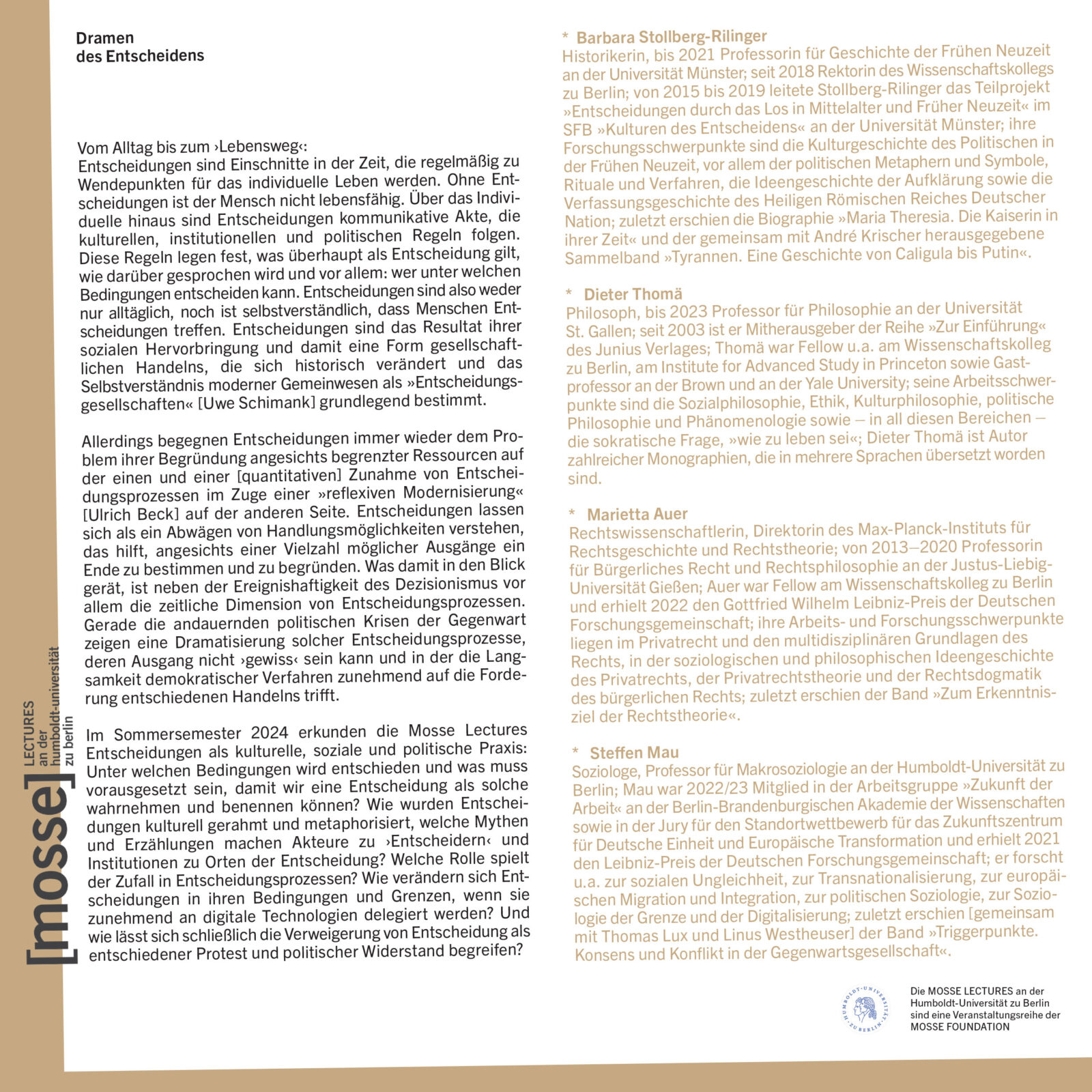
Lecture Series Description: From everyday life to the ›path of life‹: decisions are incisions in time that regularly become turning points in an individual’s life. Without decisions, people are not viable. Beyond the individual, decisions are communicative acts that follow cultural, institutional and political rules. These rules determine what is considered a decision, how it is discussed and, above all, who can make decisions and under what conditions. Decisions are therefore neither an everyday occurrence, nor is it self-evident that people make decisions. Decisions are the result of their social production and thus a form of social action that changes historically and fundamentally determines the self-image of modern communities as »Entscheidungsgesellschaften« (Uwe Schimank).
However, decisions repeatedly face the problem of their justification in the face of limited resources on the one hand and a (quantitative) increase in decision-making processes in the course of »reflexive modernization« (Ulrich Beck) on the other. Decisions can be understood as a weighing up of possible courses of action that helps to determine and justify an end in the face of a multitude of possible outcomes. In addition to the eventfulness of decisionism, the temporal dimension of decision-making processes is what comes into focus here. The ongoing political crises of the present day in particular show a dramatization of such decision-making processes, the outcome of which cannot be ›certain‹ and in which the slowness of democratic procedures increasingly encounters the demand for decisive action.
In the summer semester 2024, the Mosse Lectures will explore decisions as a cultural, social and political practice: Under what conditions are decisions made and what must be presupposed so that we can perceive and name a decision as such? How have decisions been culturally framed and metaphorized, which myths and narratives turn actors into ›decision-makers‹ and institutions into places of decision? What role does chance play in decision-making processes? How do decisions change in their conditions and limits when they are increasingly delegated to digital technologies? And finally, how can the refusal to make decisions be understood as decisive protest and political resistance?
Vom Alltag bis zum ›Lebensweg‹: Entscheidungen sind Einschnitte in der Zeit, die regelmäßig zu Wendepunkten für das individuelle Leben werden. Ohne Entscheidungen ist der Mensch nicht lebensfähig. Über das Individuelle hinaus sind Entscheidungen kommunikative Akte, die kulturellen, institutionellen und politischen Regeln folgen. Diese Regeln legen fest, was überhaupt als Entscheidung gilt, wie darüber gesprochen wird und vor allem: wer unter welchen Bedingungen entscheiden kann. Entscheidungen sind also weder nur alltäglich, noch ist selbstverständlich, dass Menschen Entscheidungen treffen. Entscheidungen sind das Resultat ihrer sozialen Hervorbringung und damit eine Form gesellschaftlichen Handelns, die sich historisch verändert und das Selbstverständnis moderner Gemeinwesen als »Entscheidungsgesellschaften« (Uwe Schimank) grundlegend bestimmt.
Allerdings begegnen Entscheidungen immer wieder dem Problem ihrer Begründung angesichts begrenzter Ressourcen auf der einen und einer (quantitativen) Zunahme von Entscheidungsprozessen im Zuge einer »reflexiven Modernisierung« (Ulrich Beck) auf der anderen Seite. Entscheidungen lassen sich als ein Abwägen von Handlungsmöglichkeiten verstehen, das hilft, angesichts einer Vielzahl möglicher Ausgänge ein Ende zu bestimmen und zu begründen. Was damit in den Blick gerät, ist neben der Ereignishaftigkeit des Dezisionismus vor allem die zeitliche Dimension von Entscheidungsprozessen. Gerade die andauernden politischen Krisen der Gegenwart zeigen eine Dramatisierung solcher Entscheidungsprozesse, deren Ausgang nicht ›gewiss‹ sein kann und in der die Langsamkeit demokratischer Verfahren zunehmend auf die Forderung entschiedenen Handelns trifft.
Im Sommersemester 2024 erkunden die Mosse Lectures Entscheidungen als kulturelle, soziale und politische Praxis: Unter welchen Bedingungen wird entschieden und was muss vorausgesetzt sein, damit wir eine Entscheidung als solche wahrnehmen und benennen können? Wie wurden Entscheidungen kulturell gerahmt und metaphorisiert, welche Mythen und Erzählungen machen Akteure zu ›Entscheidern‹ und Institutionen zu Orten der Entscheidung? Welche Rolle spielt der Zufall in Entscheidungsprozessen? Wie verändern sich Entscheidungen in ihren Bedingungen und Grenzen, wenn sie zunehmend an digitale Technologien delegiert werden? Und wie lässt sich schließlich die Verweigerung von Entscheidung als entschiedener Protest und politischer Widerstand begreifen?
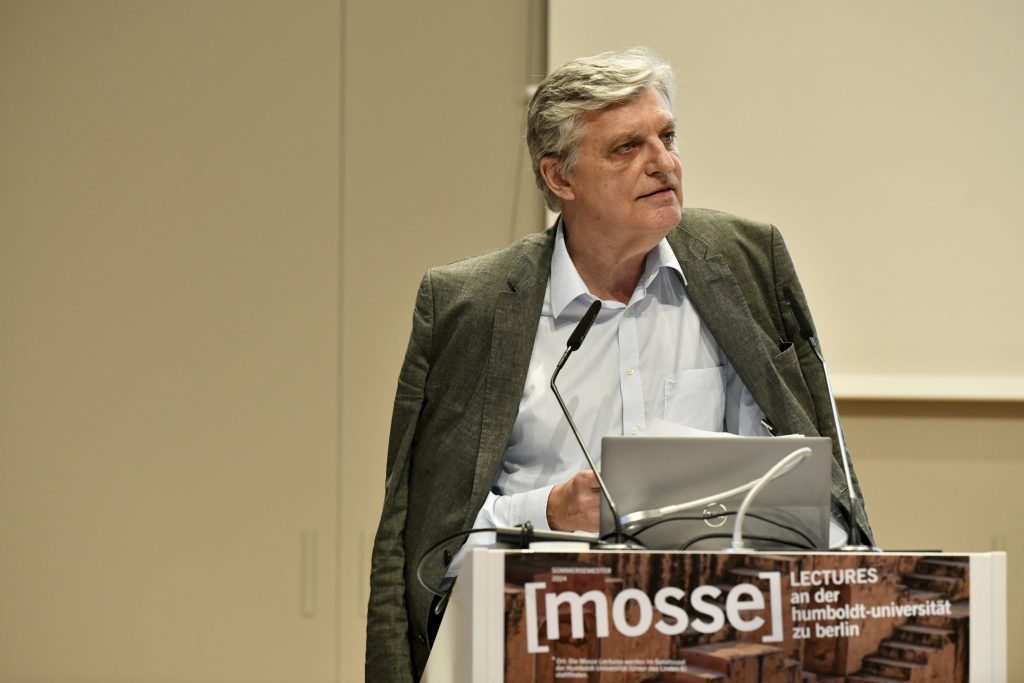
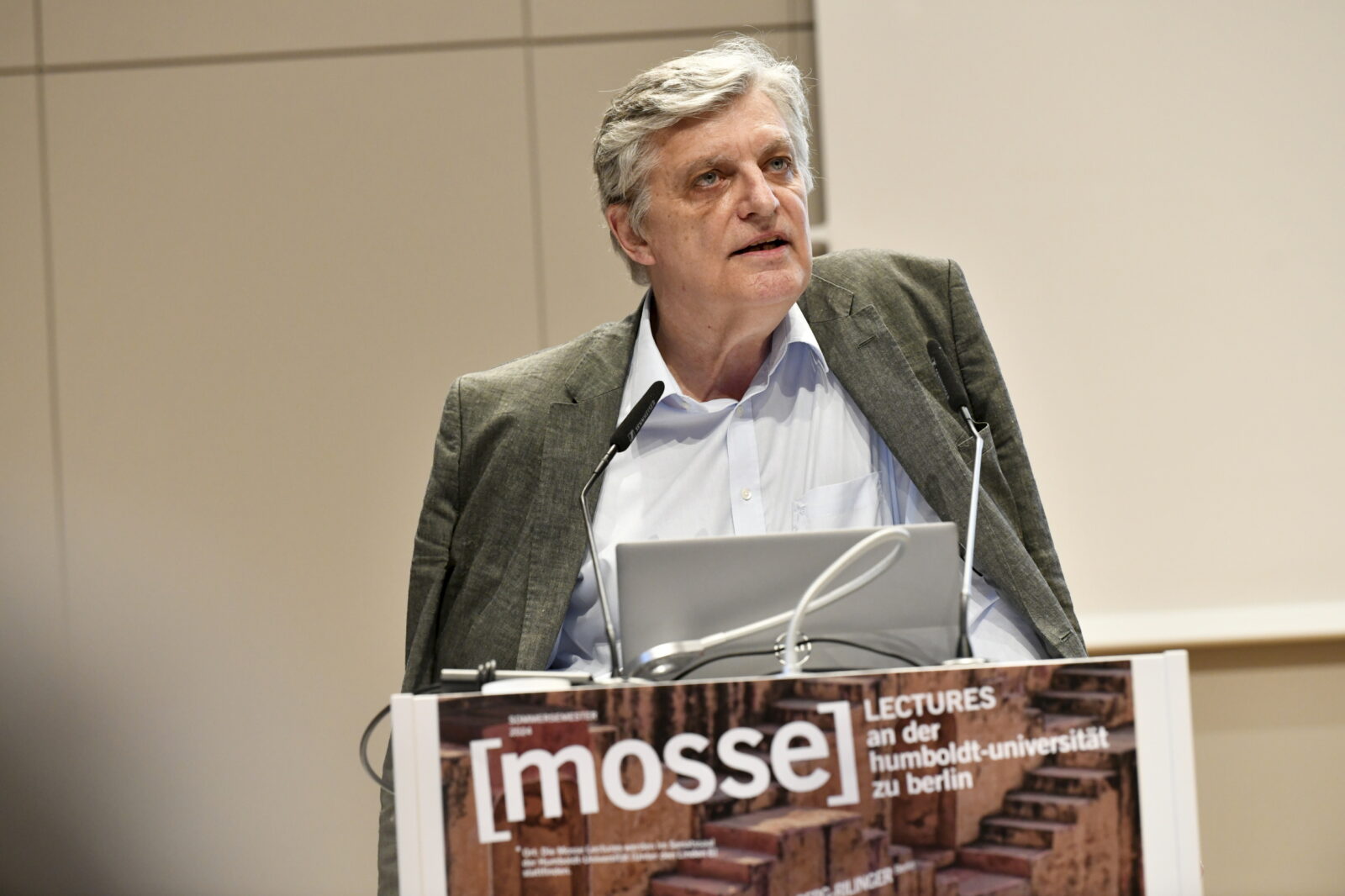
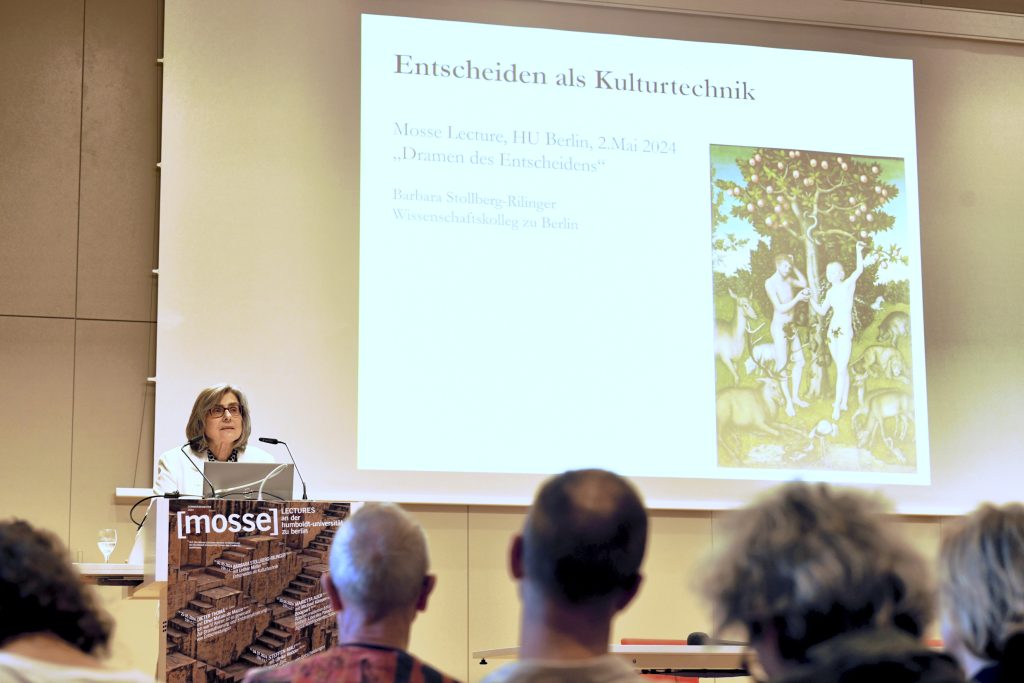
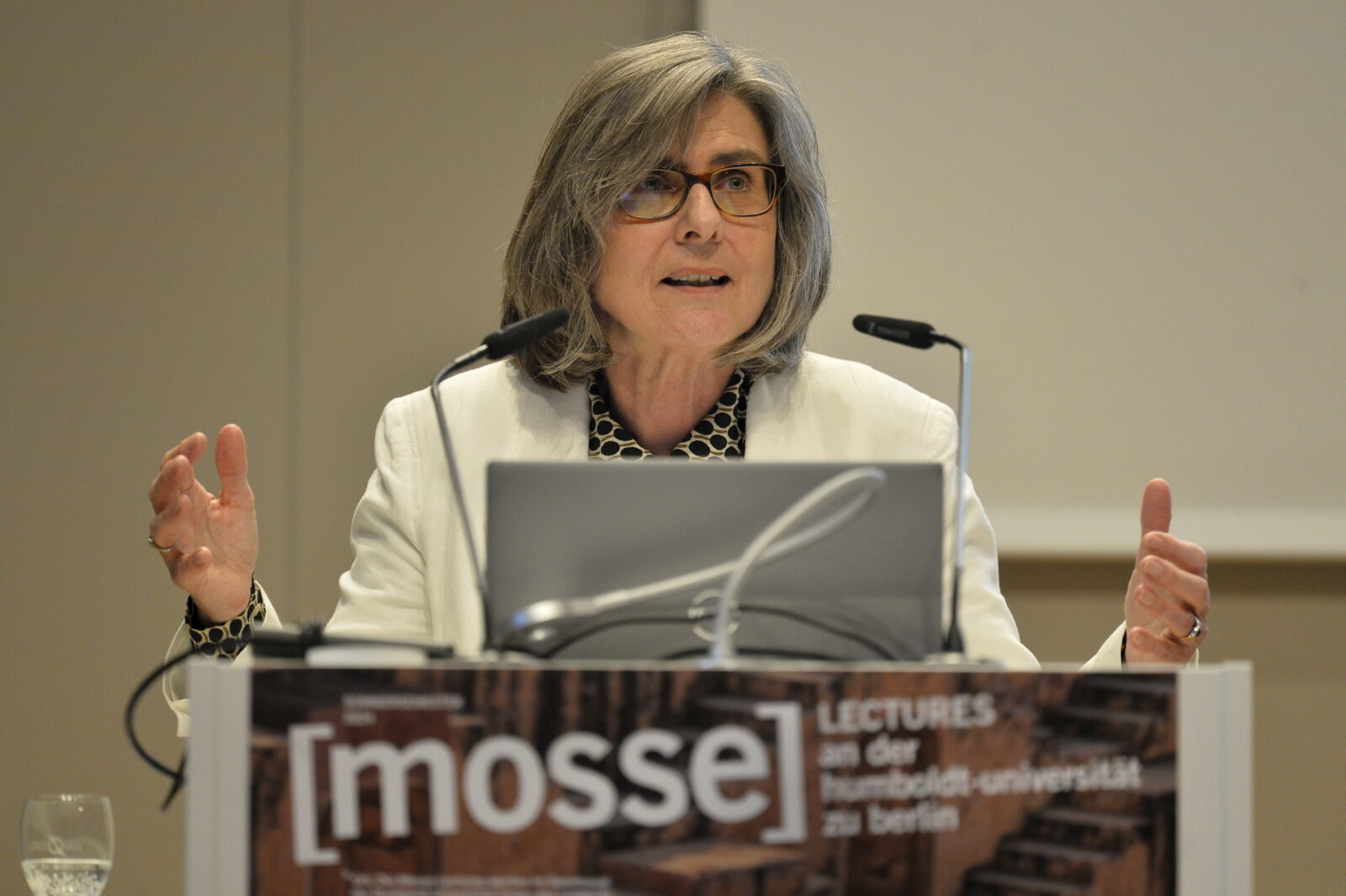
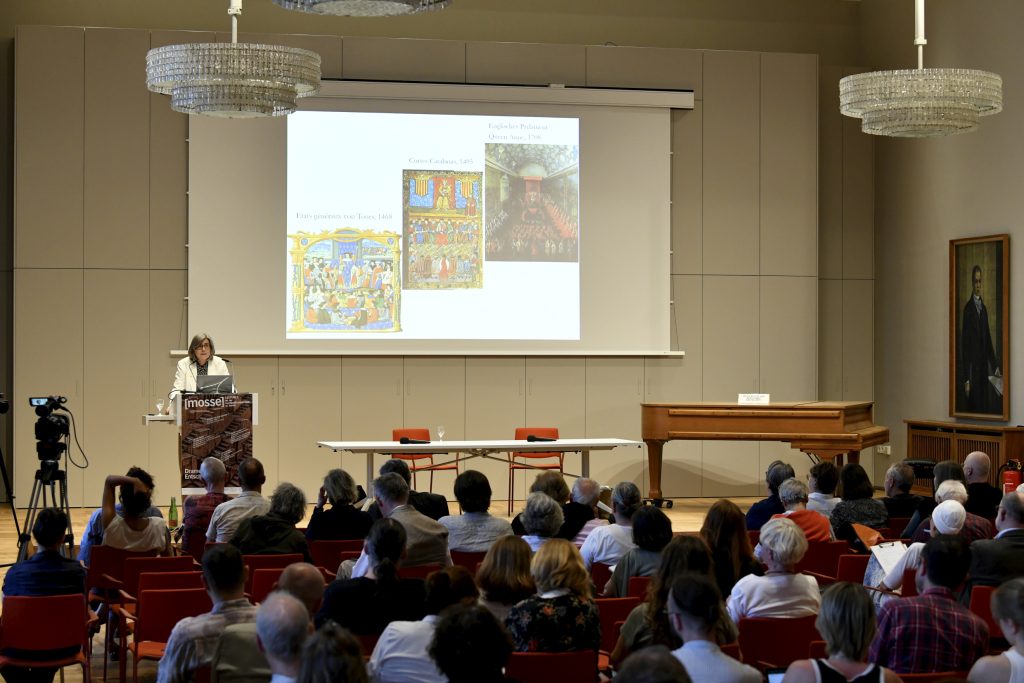
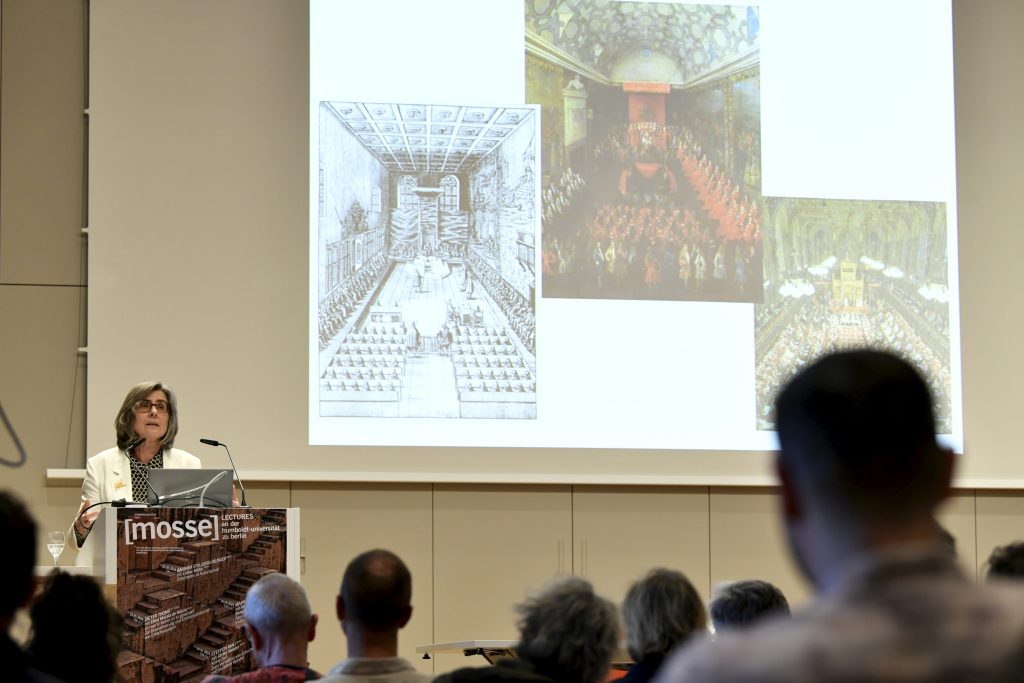
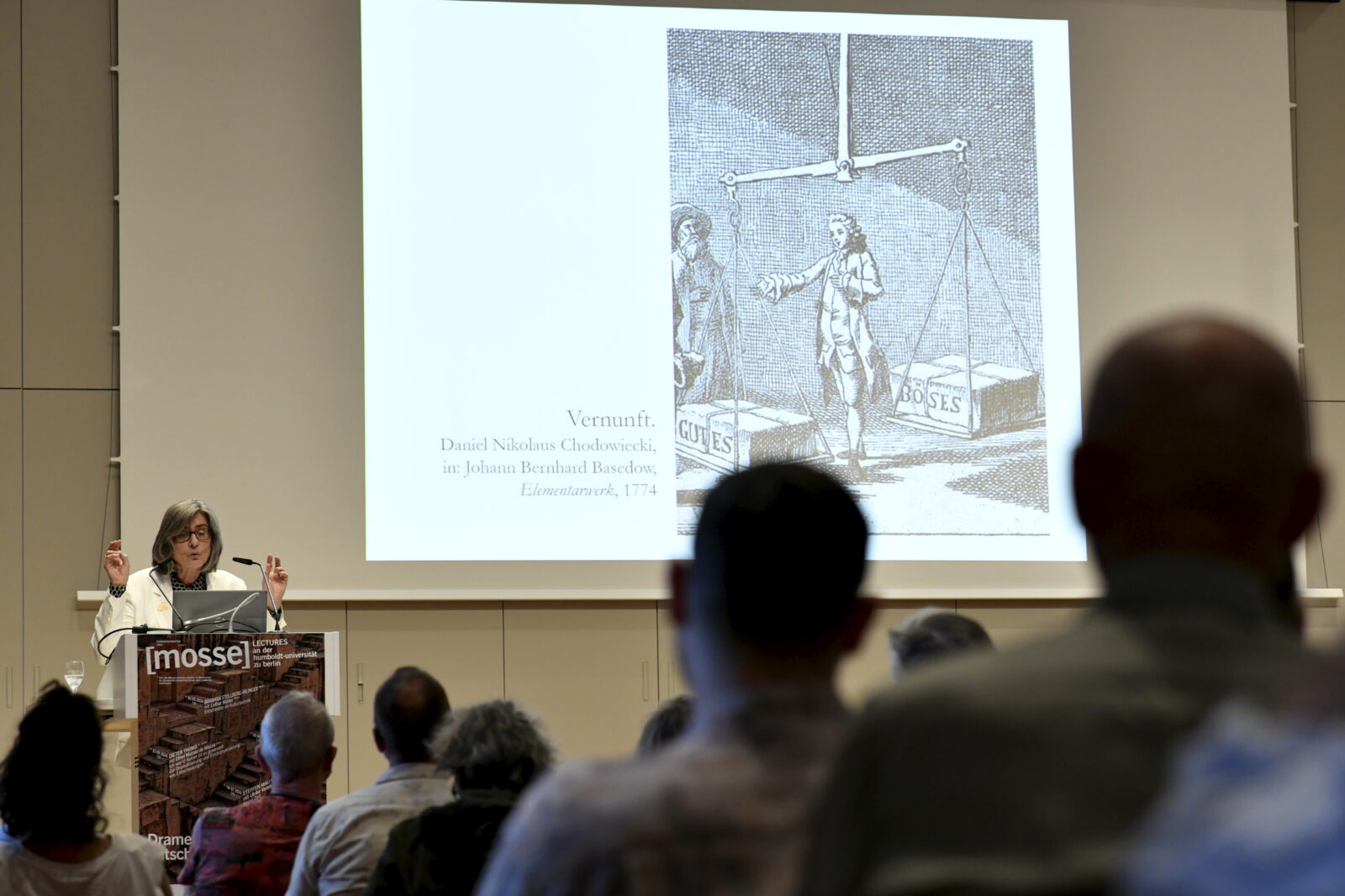
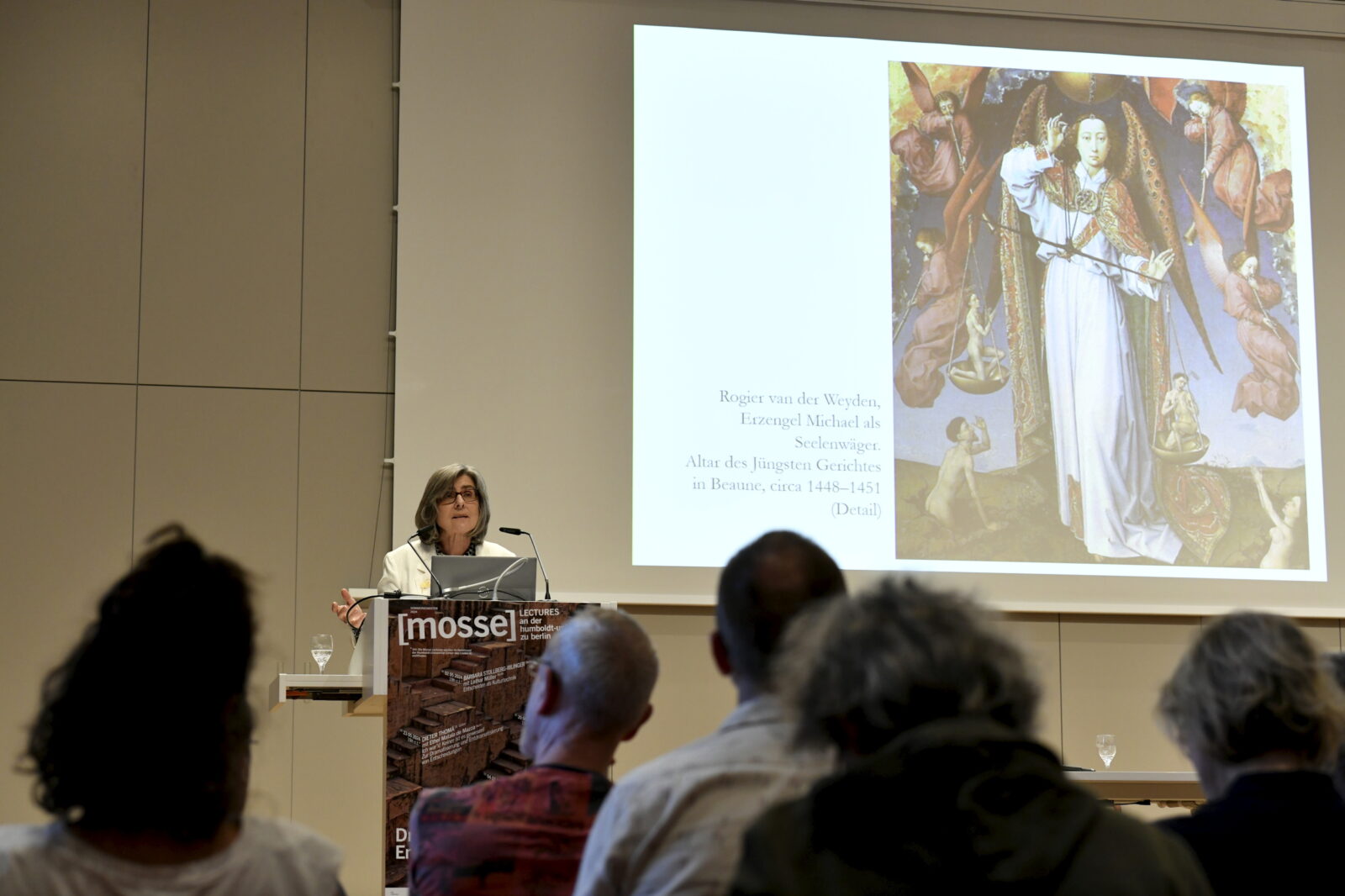
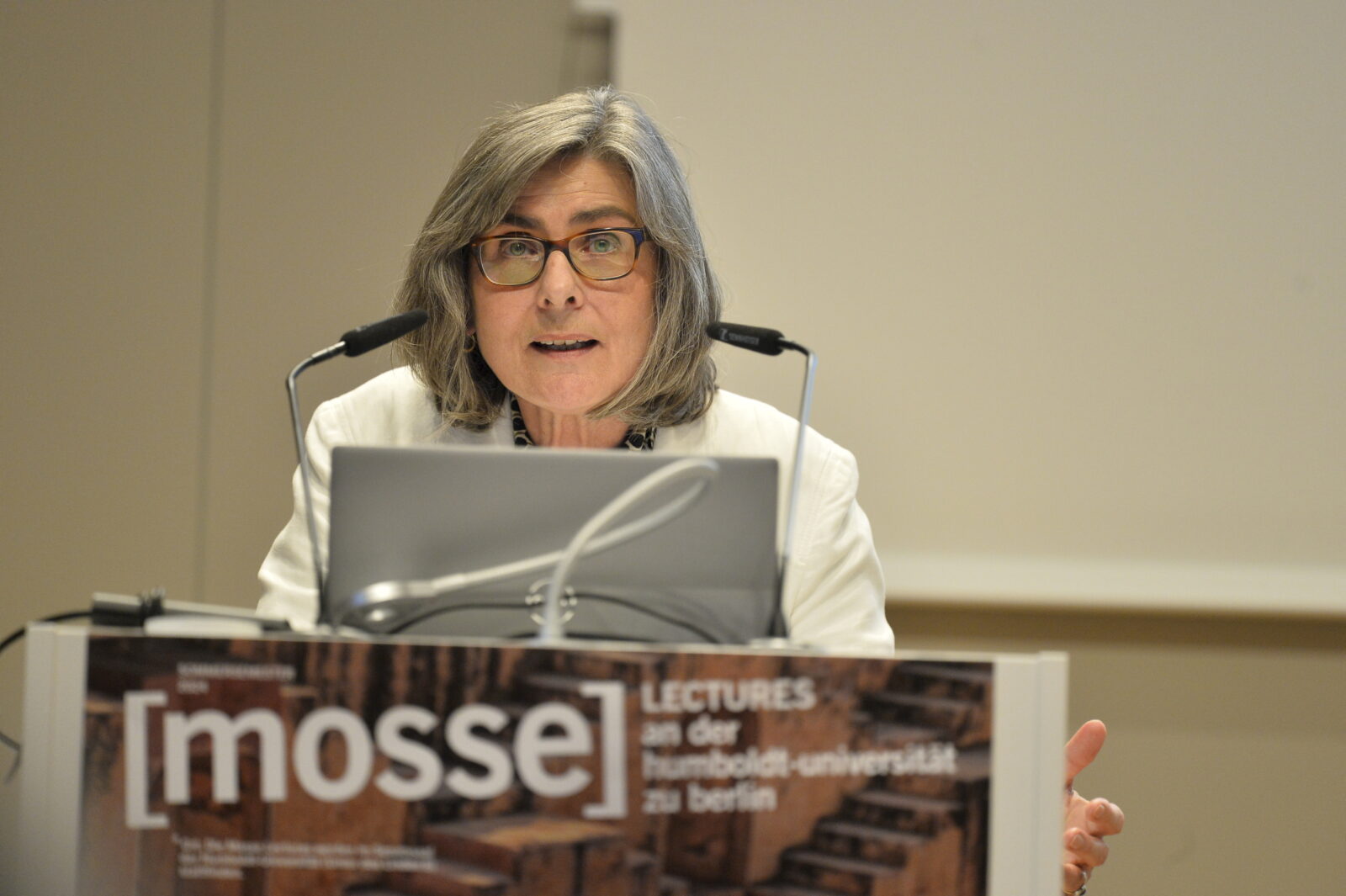
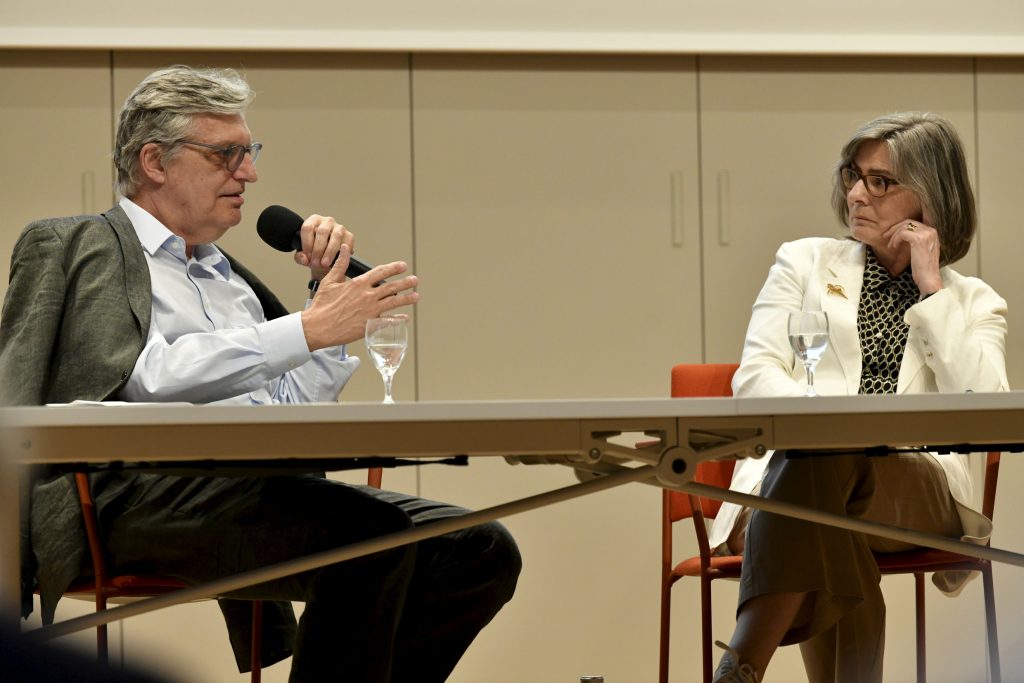
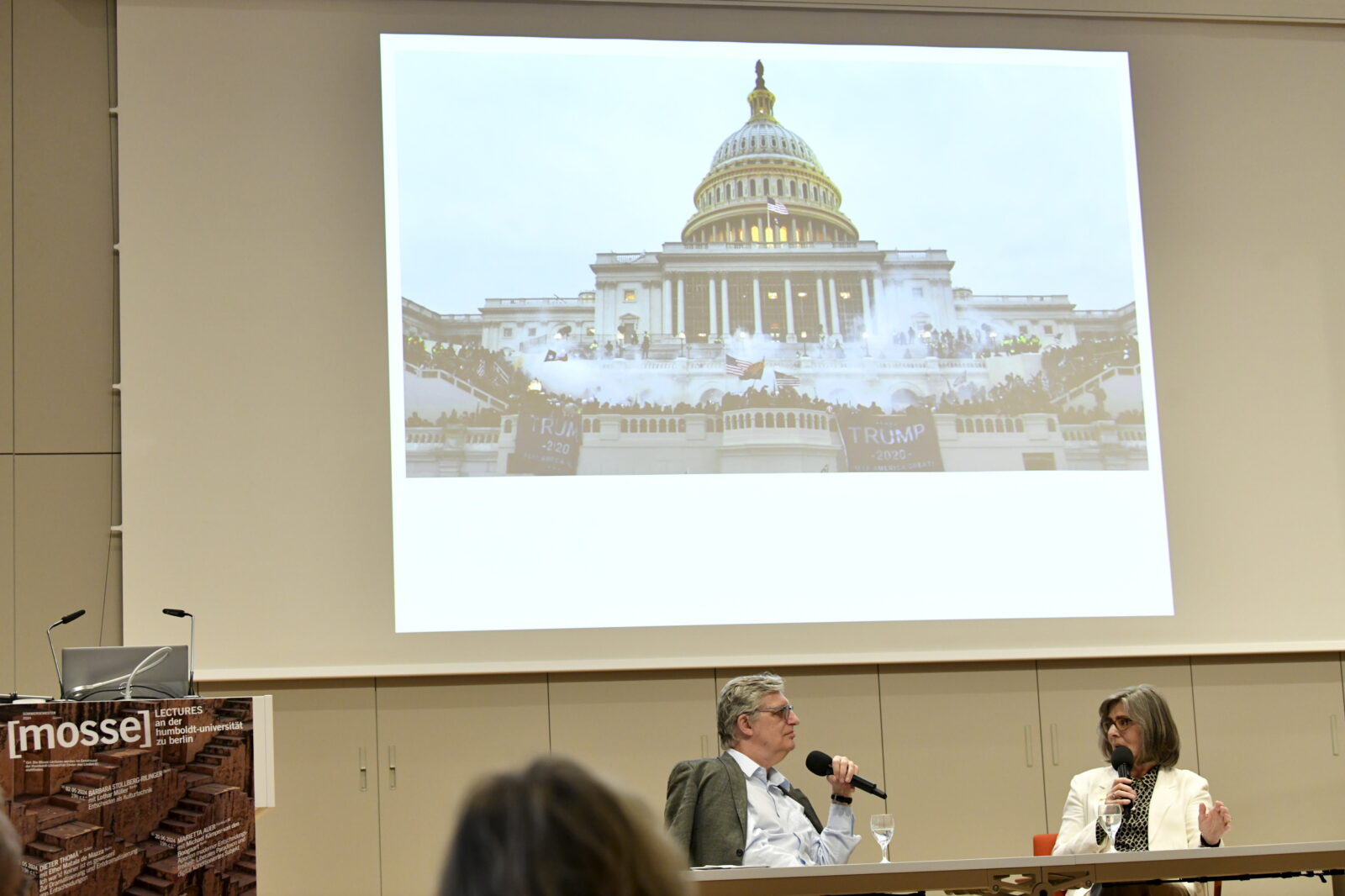
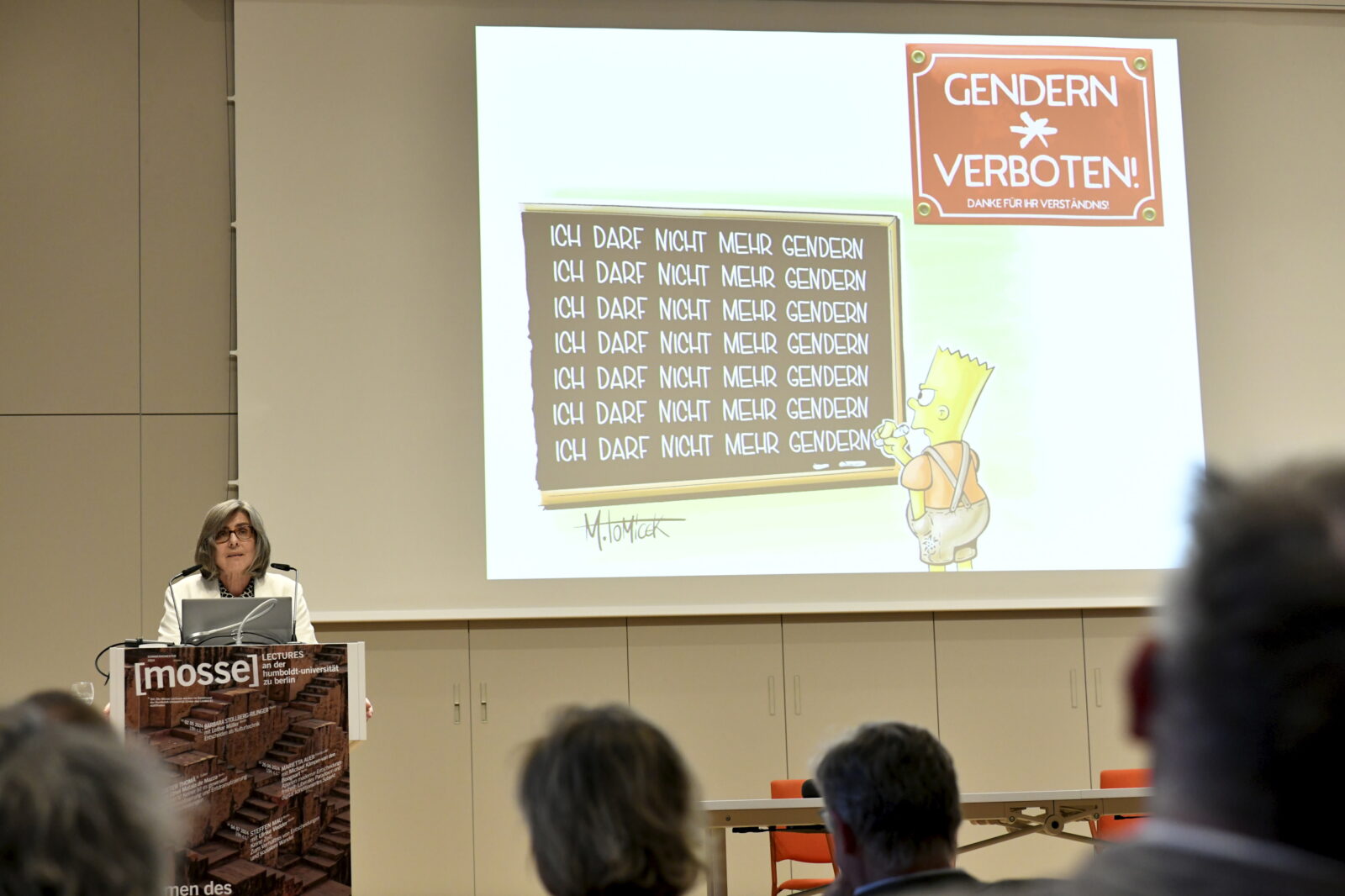
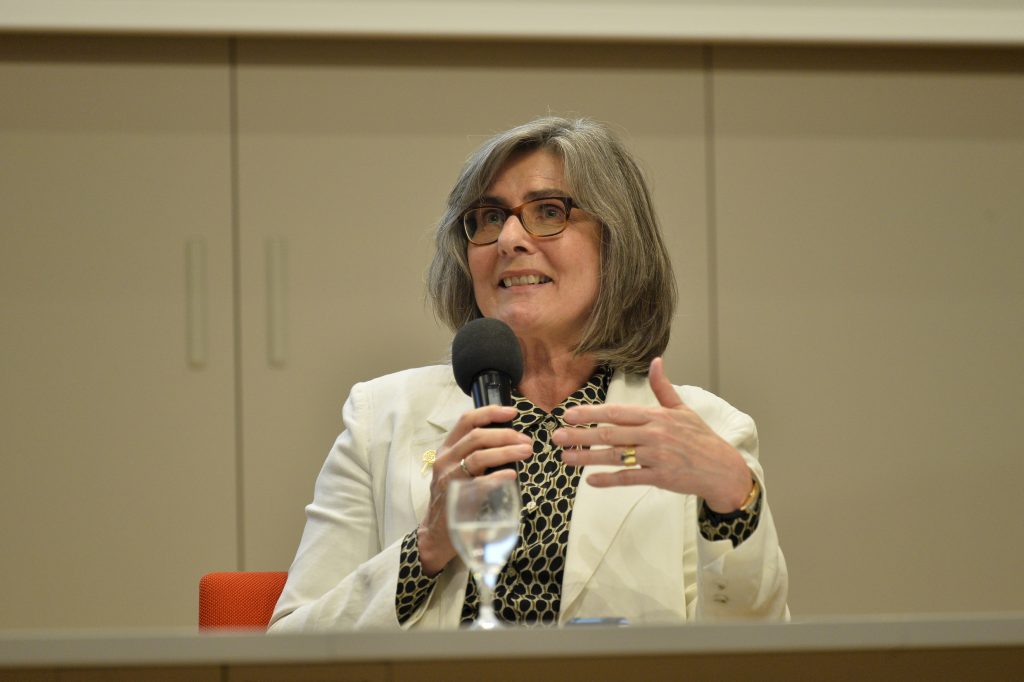
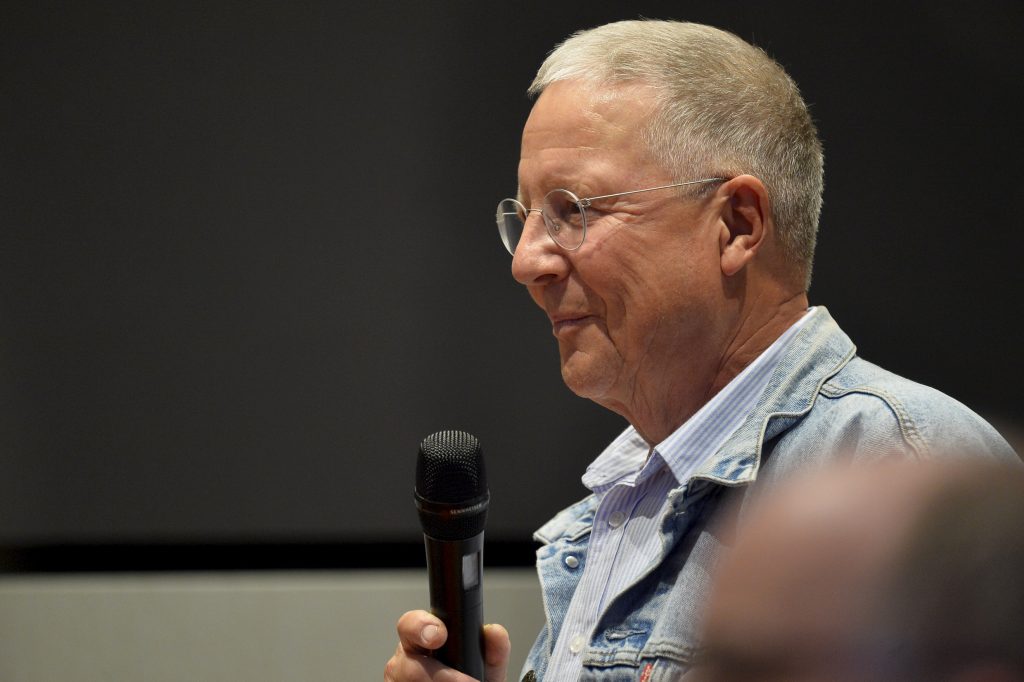
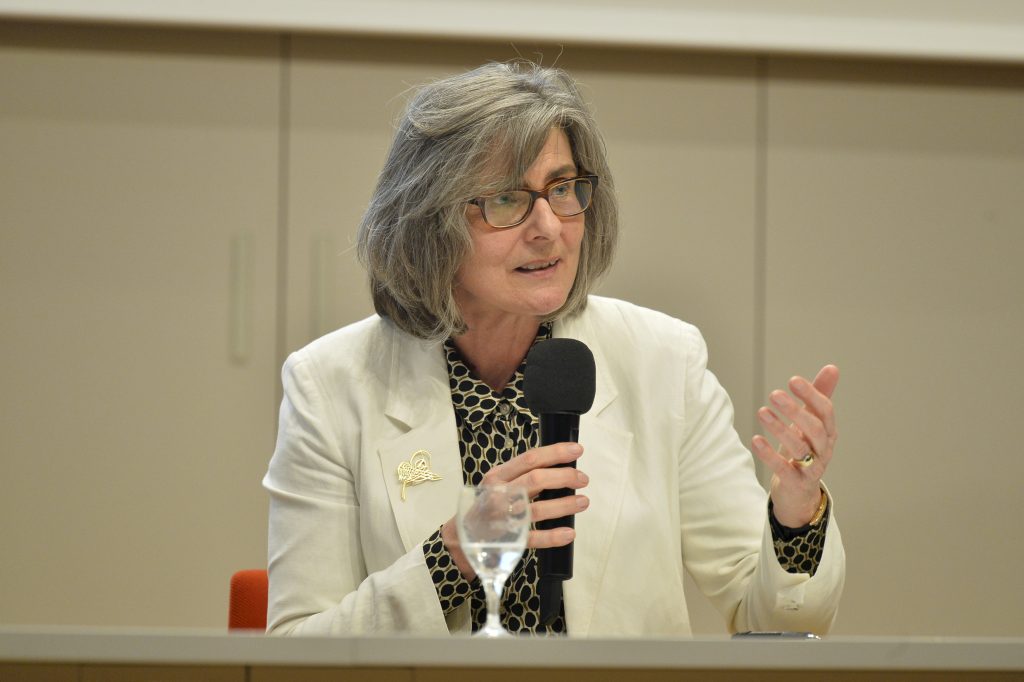
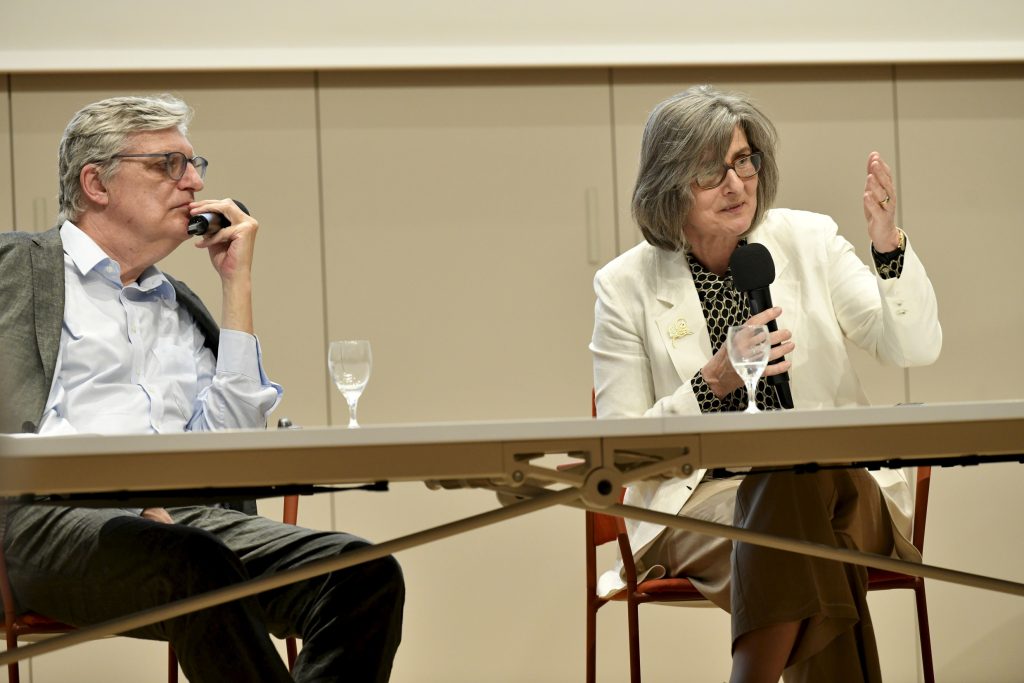
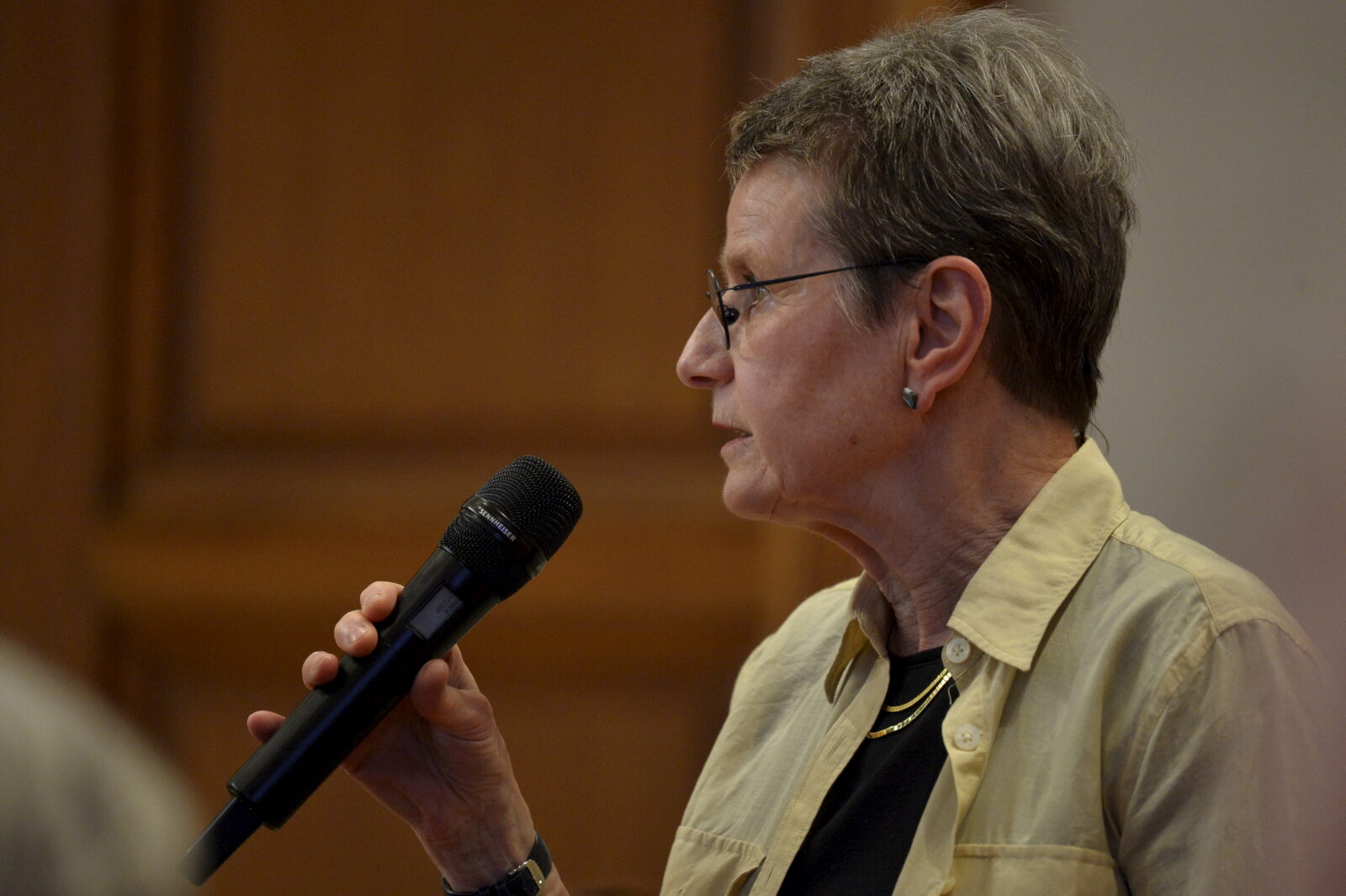
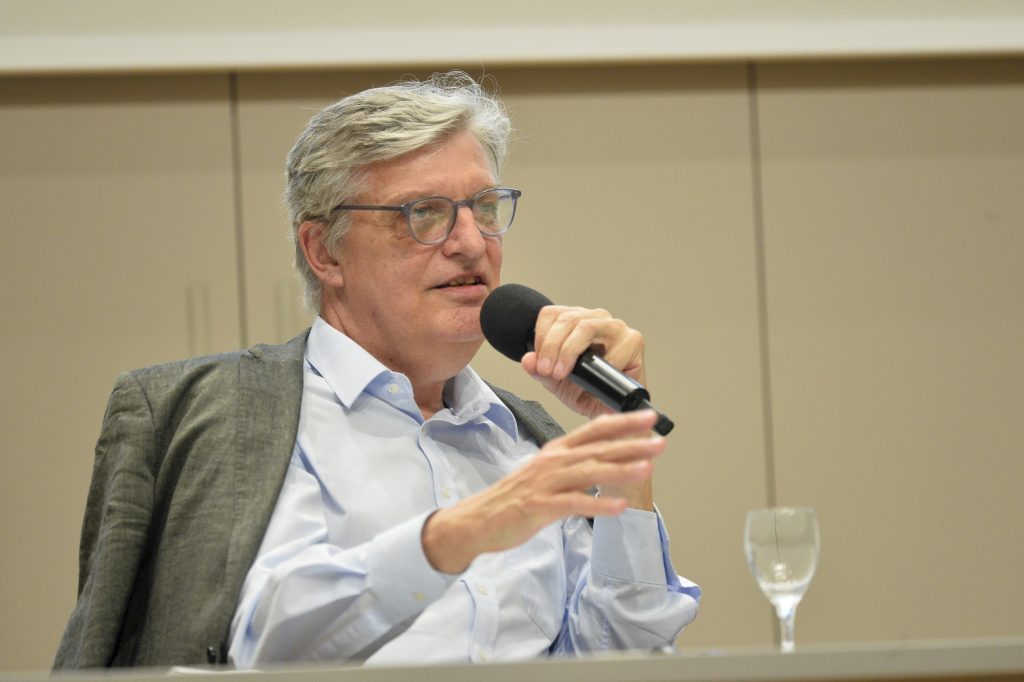
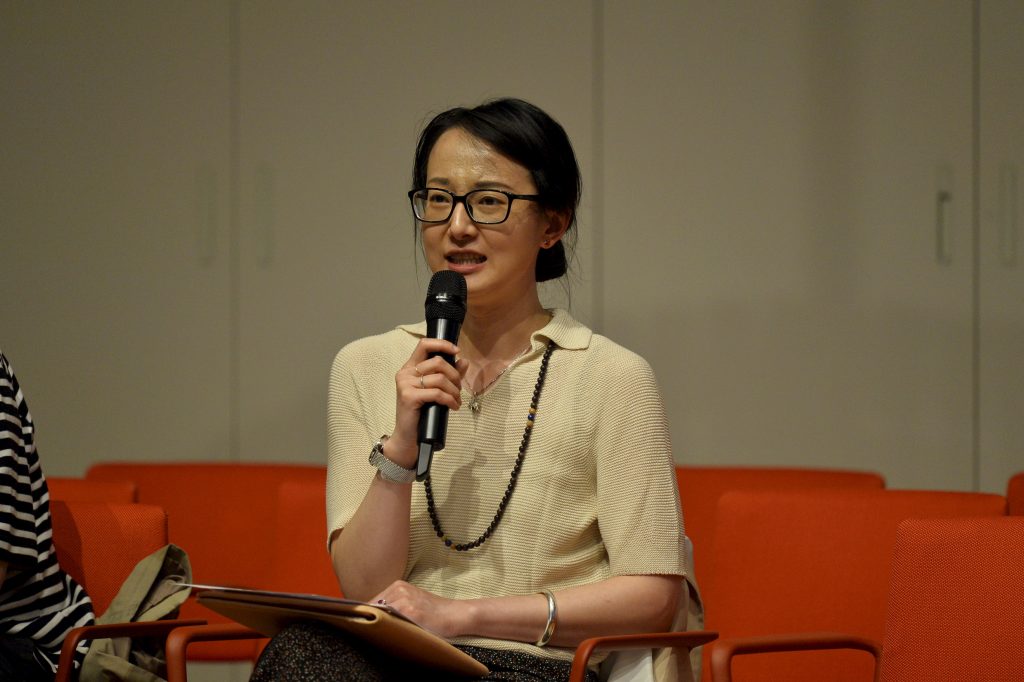
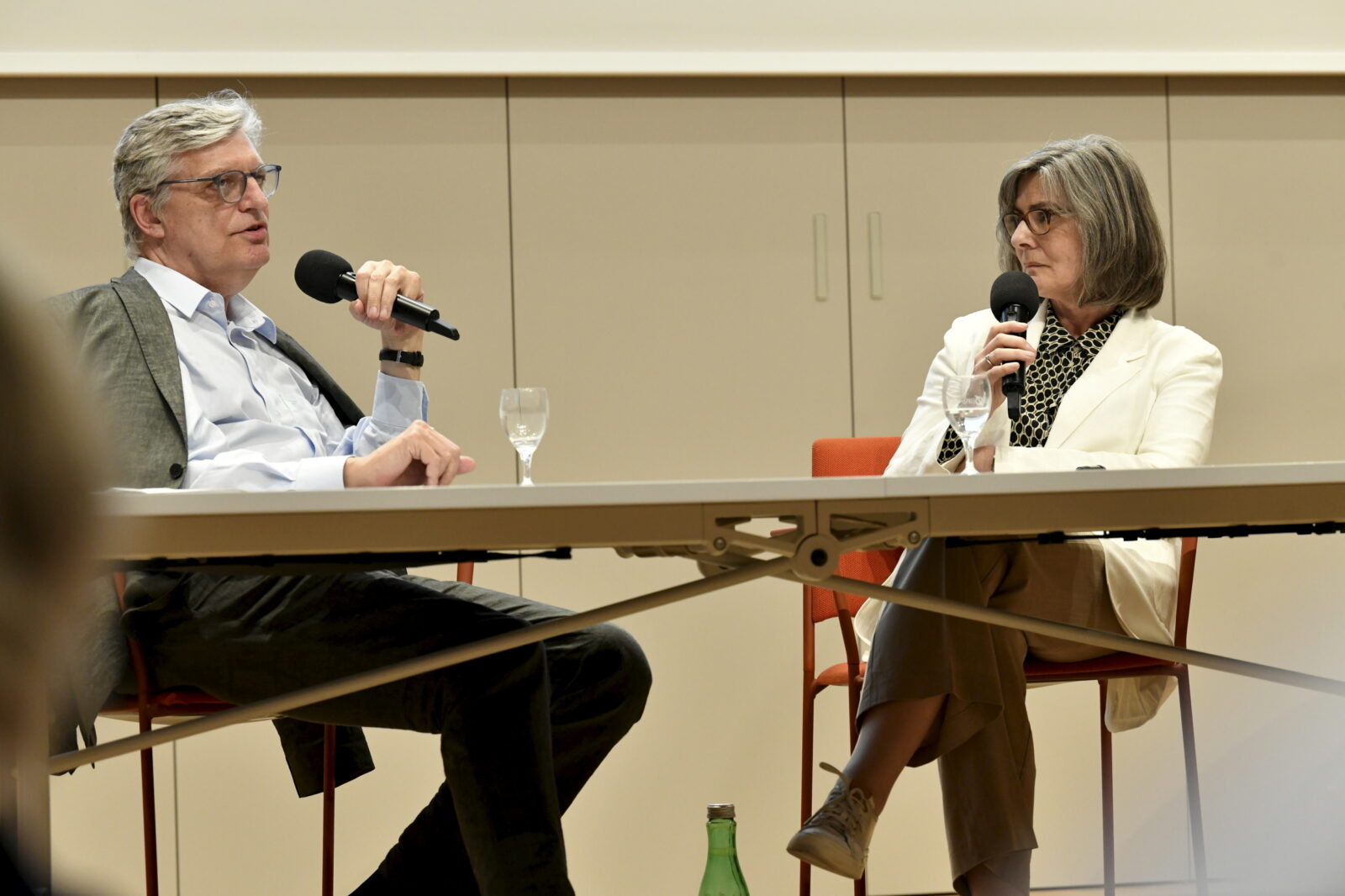
Photo credit: Neils Lesier for the Mosse Lectures
Barbara Stollberg-Rilinger: Historian, Professor of Early Modern History at the University of Münster until 2021; Rector of the Wissenschaftskolleg zu Berlin since 2018; from 2015 to 2019, Stollberg-Rilinger headed the sub-project »Decisions by Lot in the Middle Ages and Early Modern Period« in the special research area »Cultures of Decision-Making« at the University of Münster; her research focuses on the cultural history of politics in the early modern period, in particular political metaphors and symbols, rituals and procedures, the history of ideas of the Enlightenment and the constitutional history of the Holy Roman Empire of the German Nation; her most recent publications include the biography »Maria Theresia. Die Kaiserin in ihrer Zeit« and the anthology »Tyrannen. Eine Geschichte von Caligula bis Putin«.
Lothar Müller has worked as an editor for the Frankfurter Allgemeine Zeitung and the Süddeutsche Zeitung, and lectured at the Institute for Comparative Literature at the Free University. Since 2010, he has served as Honorary Professor in the Institute for German Literature at the Humboldt University Berlin. He is the author of numerous publications, including Adrien Proust und sein Sohn Marcel. Beobachter der erkrankten Welt (2021) and Weiße Magie. Die Epoche des Papiers (2012). He was awarded the Berlin Prize for Literary Criticism in 2013.
