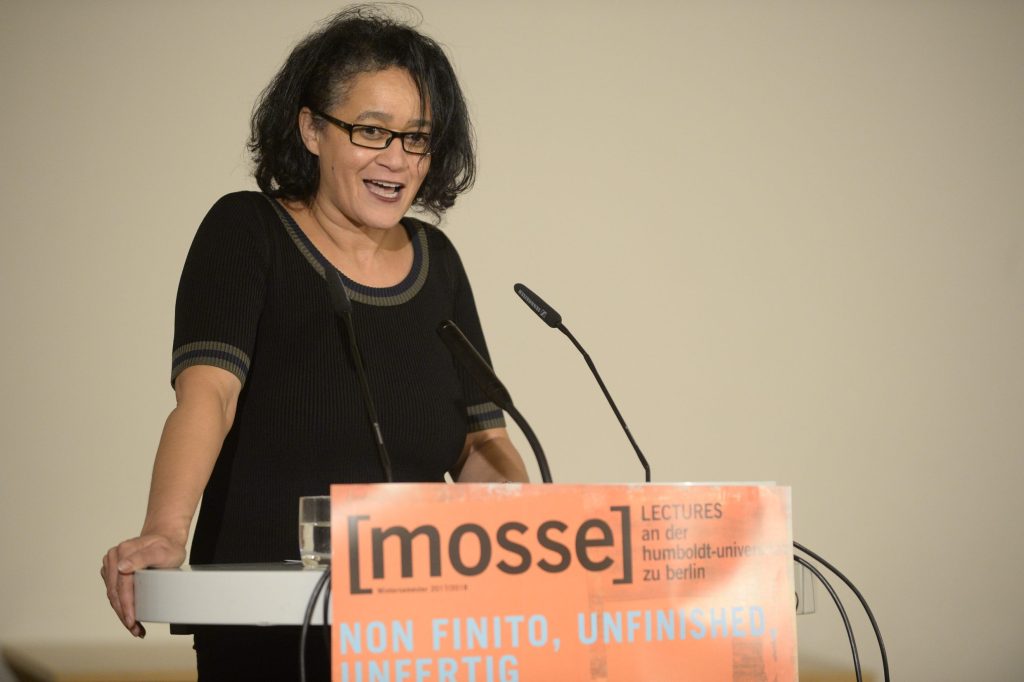
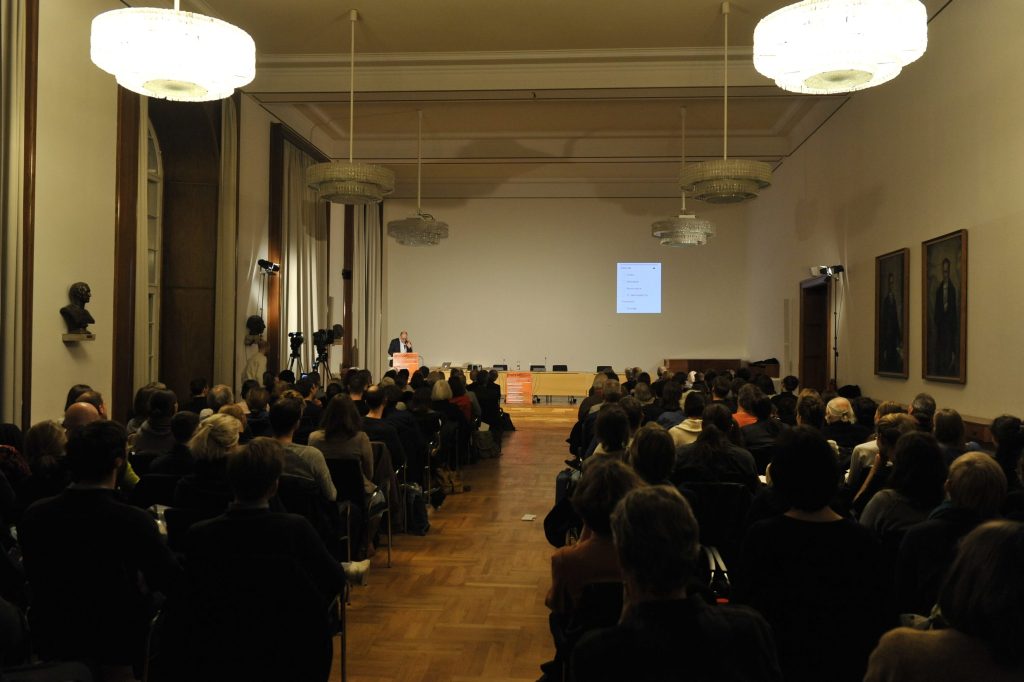
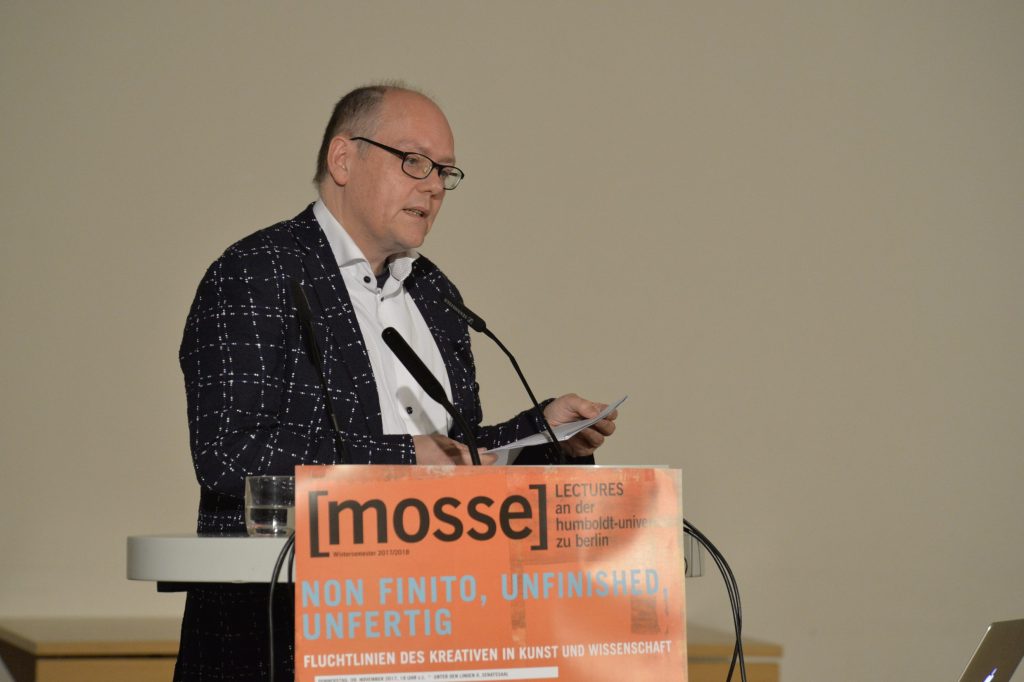
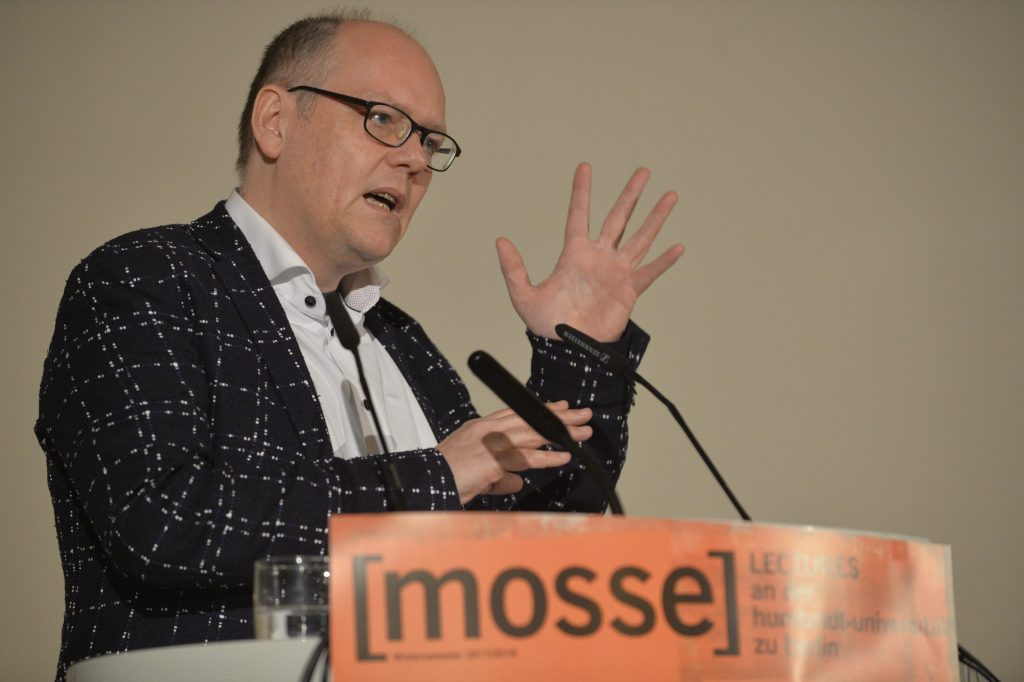
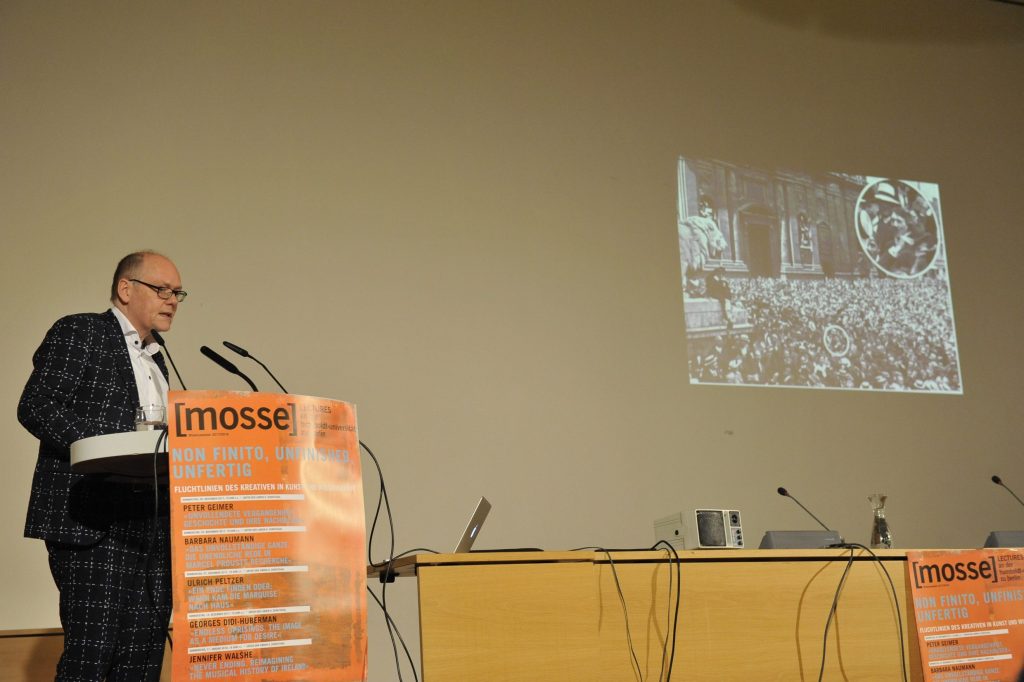
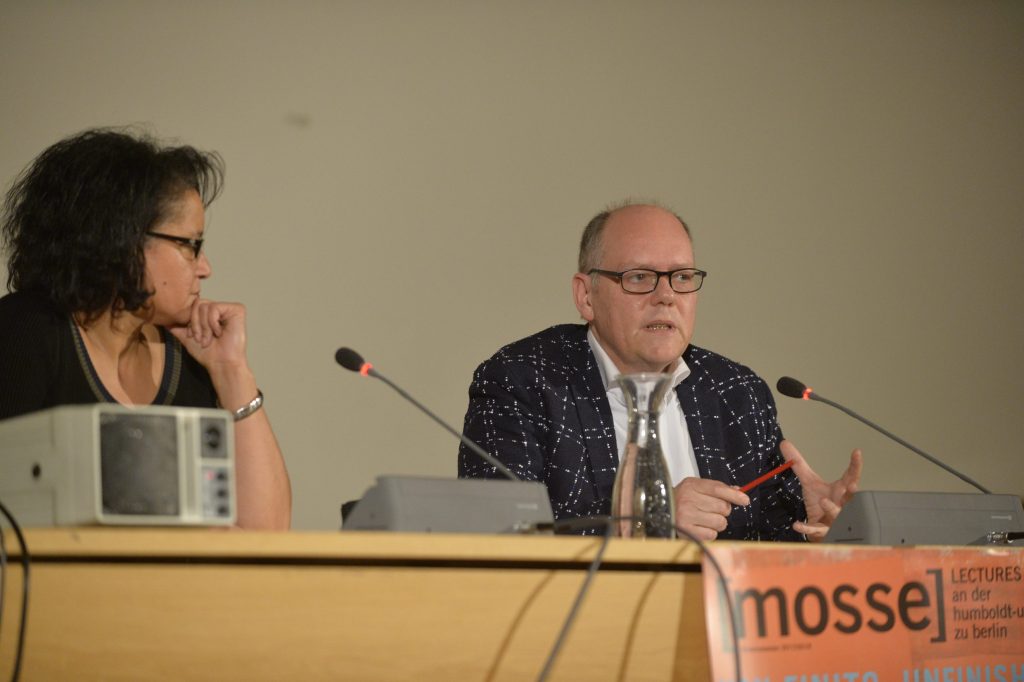
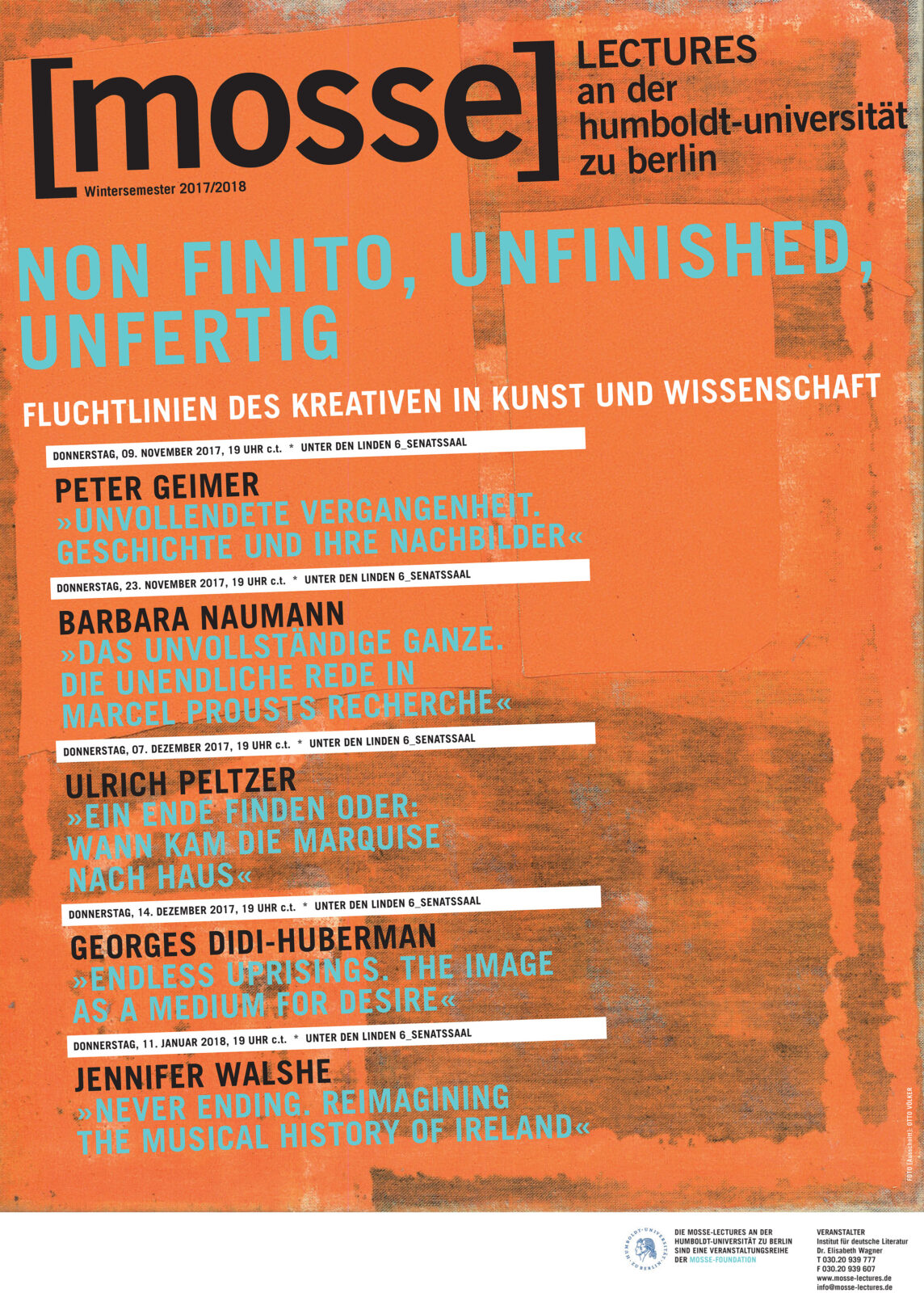
2017: Peter Geimer, “Unvollendete Vergangenheit. Geschichte und ihre Nachbilder” / “Unfinished Past: History and its Afterimages”
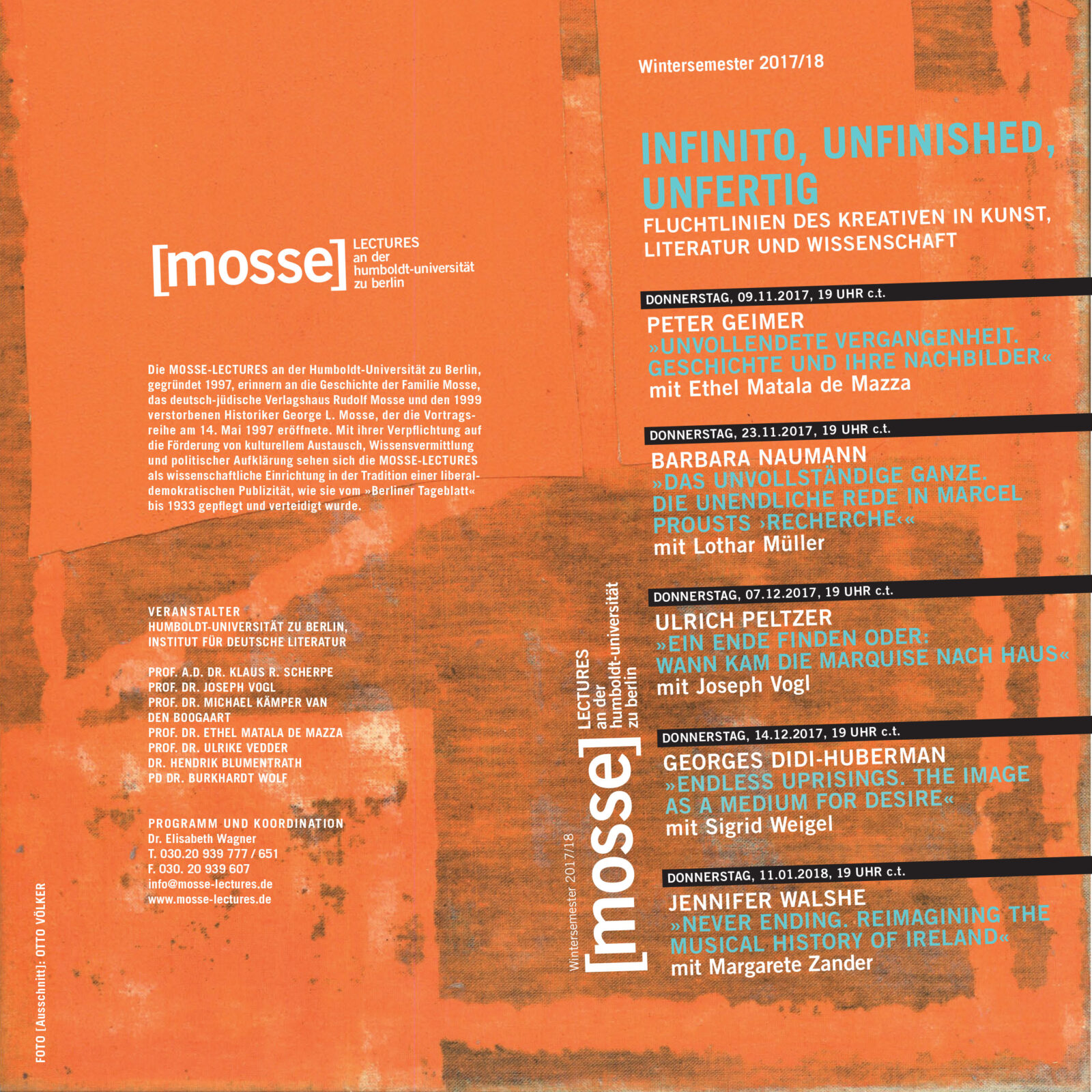
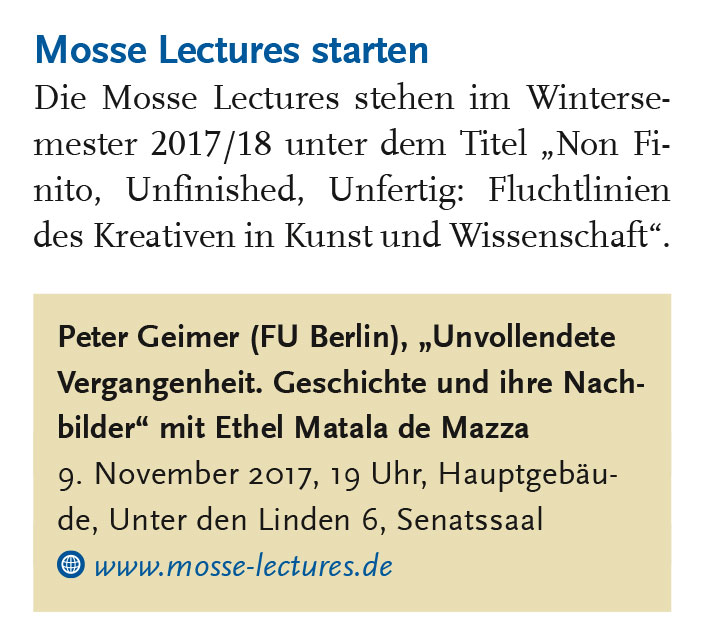
Peter Geimer, “Unvollendete Vergangenheit. Geschichte und ihre Nachbilder” / “Unfinished Past: History and its Afterimages”
Berlin Mosse Lecture
https://mosselectures.wisc.edu/berlin/
Thursday, 9 November 2017, 19:00 CET
Senatssaal of Humboldt University
Unter den Linden 6
1. Stock
10117 Berlin
GERMANY
Sponsored by:
[mosse] LECTURES an der humboldt-universität zu berlin
The Mosse Foundation
Global Mosse Lecture Series
Institut für deutsche Literatur
Humboldt University
Moderator: Ethel Matala de Mazza (Humboldt University)
Lecture Description: Von dem, was nicht mehr ist, schreibt Johann Joachim Winckelmann, »bleibt weniger im Gedächtnis als die Spur von einem Schiff im Wasser«. Wo nicht einmal mehr Reste und Ruinen zu entziffern sind, herrscht völliges Vergessen. Einhundert Jahre später erinnert Friedrich Nietzsche an die ebenso zutreffende Wahrheit, dass das Vergangene gar nicht verschwindet und auch ungefragt erscheinen kann: »der Augenblick, im Husch da, im Husch vorüber, vorher ein Nichts, nachher ein Nichts, kommt doch noch als Gespenst wieder, und stört die Ruhe eines späteren Augenblicks.« Vor dem Hintergrund dieser paradoxen Erscheinung des Vergangenen – als gleichermaßen vergangen und unfertig, vorbei und unvollendet – fragt der Vortrag nach der besonderen Funktion der Bilder. Am Beispiel konkreter Fallstudien aus der Geschichte der Historienmalerei, der Fotografie und des Historienfilms geht es um die Latenz des Vergangenen im Bild, um den Anachronismus und das Nachleben der Bilder.
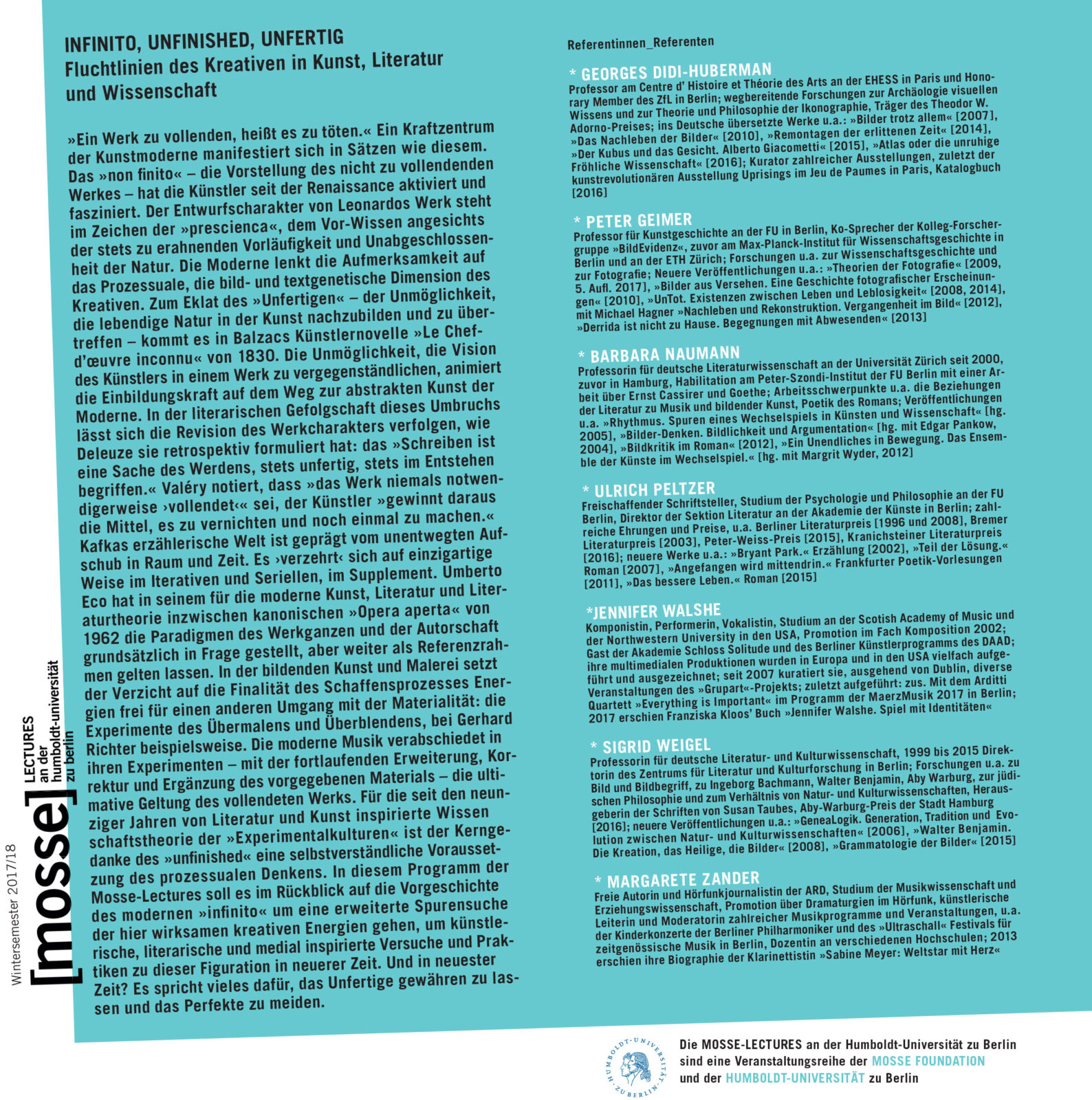
Lecture Series Description: “To complete a work means to kill it.” Manifestos of modern art have their center of energy in such sayings. The non finito – the idea of a work not to be completed – has fascinated artists since the Renaissance. The prospective design of Leonardo’s work acknowledges prescienza: the provisional and unfinished nature of creative work. In modernity process becomes dominant, thus emphasizing the genetic production of texts and images, all the way to the dissolution of the medium of representation itself. The scandal of the unfinished – the sheer impossibility to reproduce and surpass living nature in a work of art – erupts in Balzac’s “Le Chef-d’oeuvre inconnu”, published in 1830. The impossibility to fully materialize the artist’s vision can further be traced in the concept of aesthetic autonomy as it leads to modernist abstraction. In literature, too, we can observe how the original concept of the work as a whole is revised, when Deleuze states retrospectively: “writing is a thing of becoming, always unfinished, always in the making.” Valéry has noted that “by necessity, the work can never be completed”; the writer thus “gains a means to destroy it and make it anew.” Kafka’s narrative world is shaped by a permanent deferral in time and space; it ‘consumes’ itself in its modes of iteration, seriality, and supplementation. In his “Opera aperta” of 1962, canonical by now in literature, literary criticism and art studies, Umberto Eco has questioned the paradigms of authorship and the work as a whole, though still accepting them as an inevitable frame of reference. As the visual arts renounce the finality of the creative process, energies are set free to deal with materiality differently: the cross media experiments of overpainting and superimposing. In their experiments of extending, supplementing and revising the musical material, composers have dismissed the previous validity of completion. In recent times, software supported computer art has explored new ways of unlimited. Since the nineties, the theory of science, creatively inspired by art and literature, has privileged so called “experimental cultures”, where the notion of the unfinished is front and center. This set of Mosse-Lectures will review the past history of the non finito, and search for marks and signs of the unfinished in present day cultural production. We hope to trace and probe the creative energies of this configuration in practical artistic work and in theory.
Peter Geimer: Peter Geimer ist Professor für Kunstgeschichte an der Freien Universität Berlin und Ko-Sprecher der Kolleg-Forschergruppe „BildEvidenz. Geschichte und Ästhetik“. Letzte Buchveröffentlichungen: „Derrida ist nicht zu Hause. Begegnungen mit Abwesenden“ mit einem Nachwort von Marcel Beyer, Hamburg 2013; „Bilder aus Versehen. Eine Geschichte fotografischer Erscheinungen“, Hamburg 2010; „Theorien der Fotografie“, Hamburg 2009 (5. Auflage 2007).