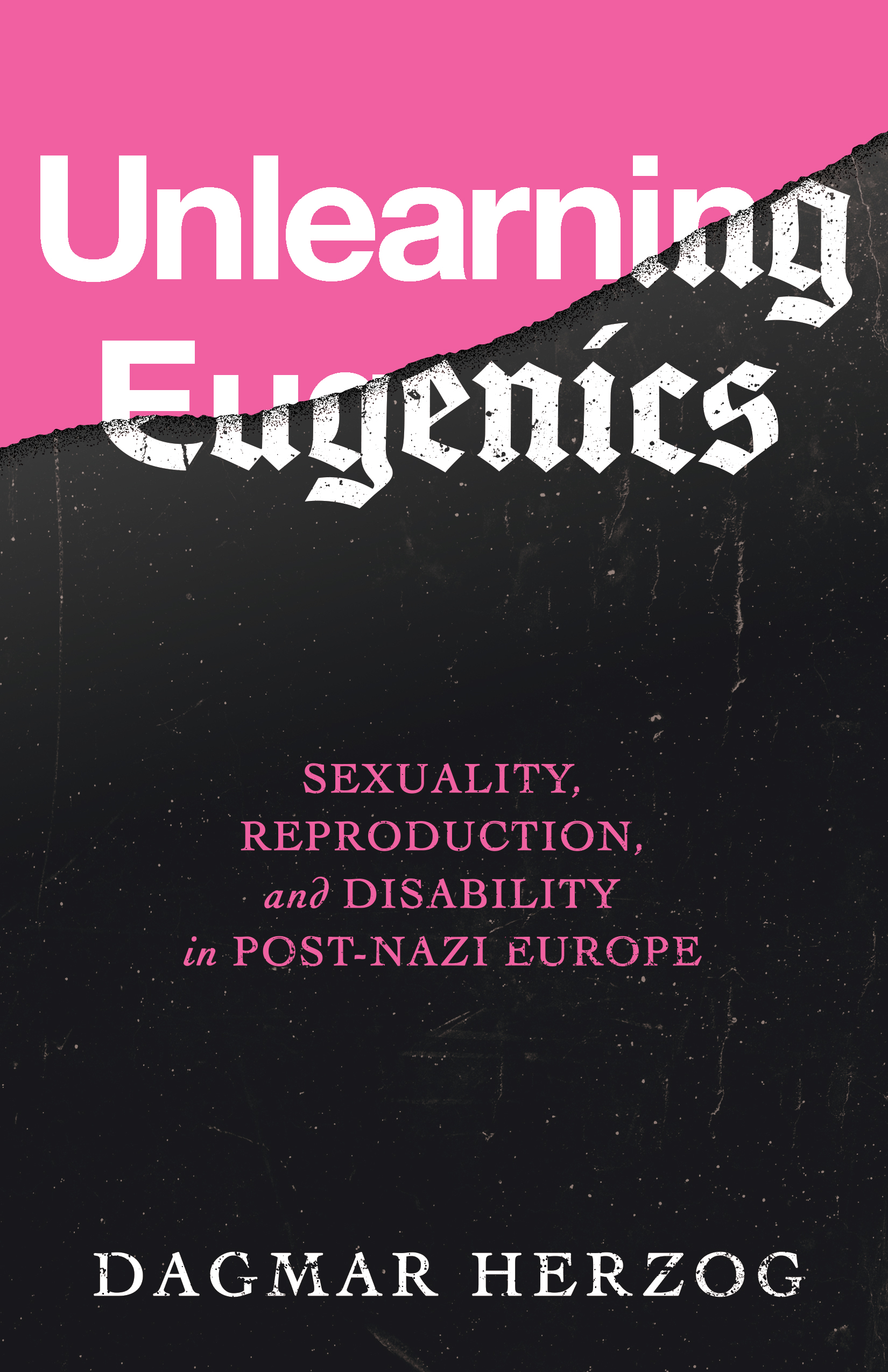
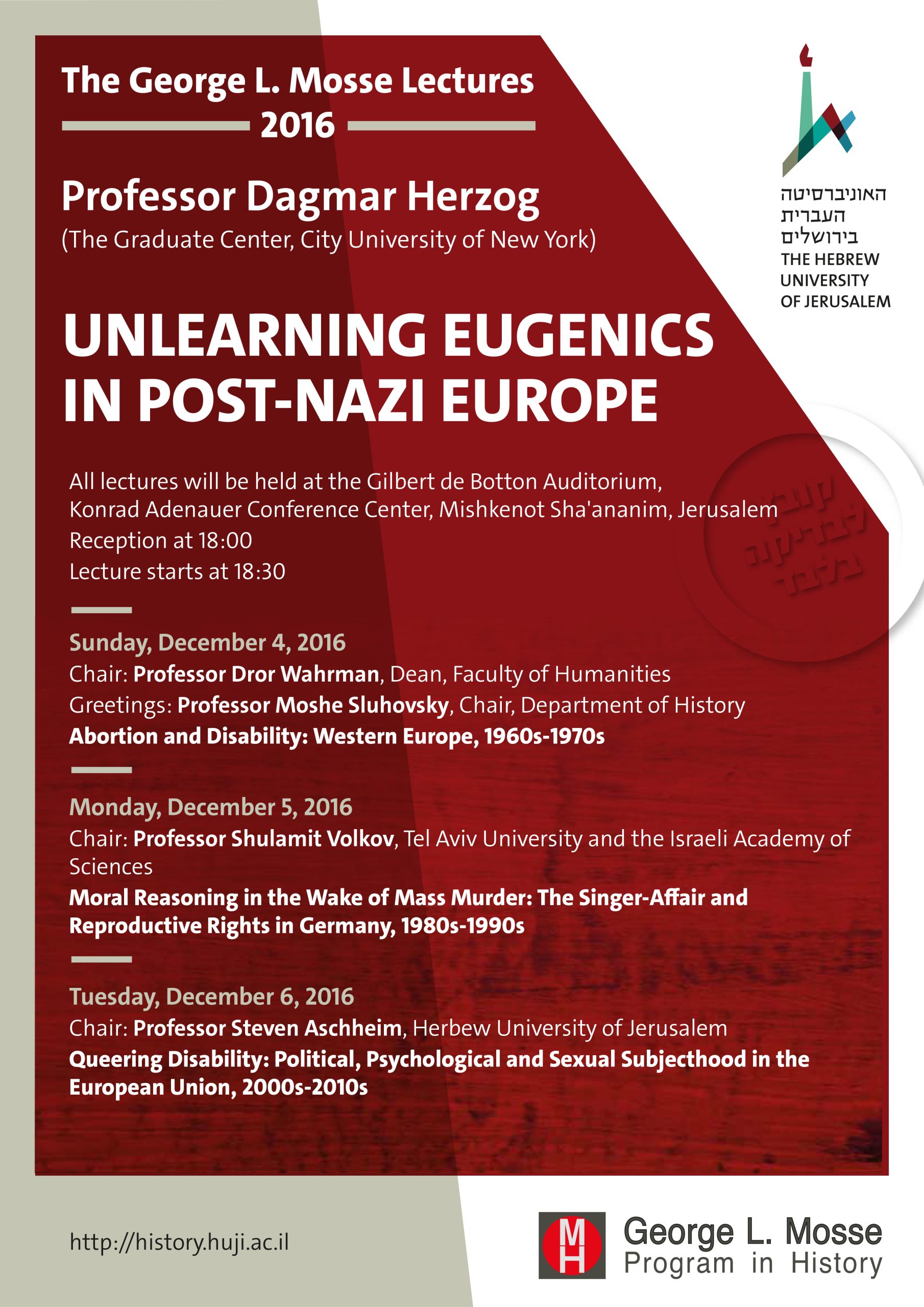
This lecture series was published as Unlearning Eugenics: Sexuality, Reproduction, and Disability in Post-Nazi Europe (Madison: University of Wisconsin Madison, 2020).
Gilbert de Botton Auditorium Konrad Adenauer Conference Center Mishkenot Sha’ananim POB 4572 Jerusalem 9104402 ISRAEL
Introduction: Moshe Sluhovsky (Hebrew University of Jerusalem) Chair: Dror Wahrman (Hebrew University of Jerusalem)
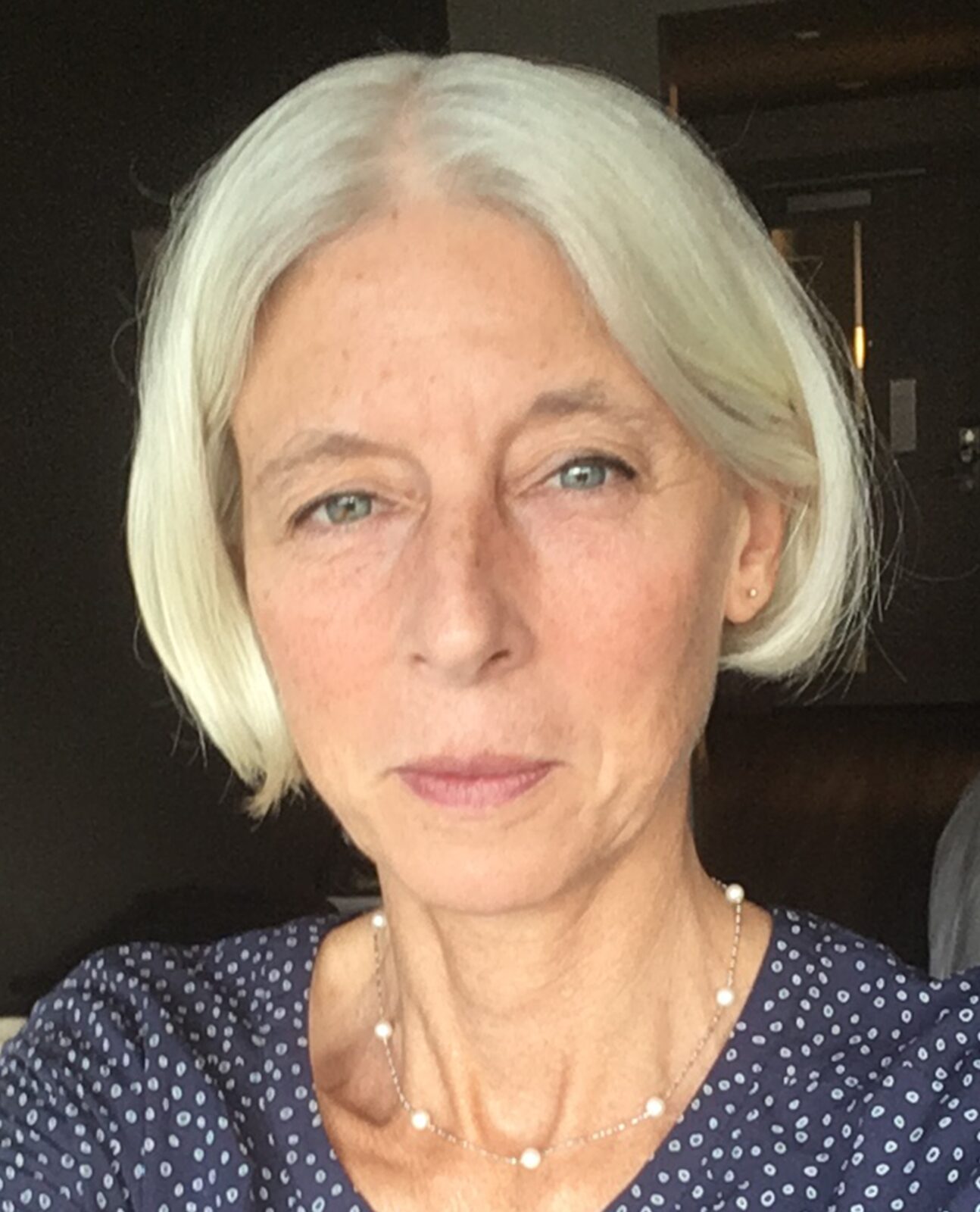
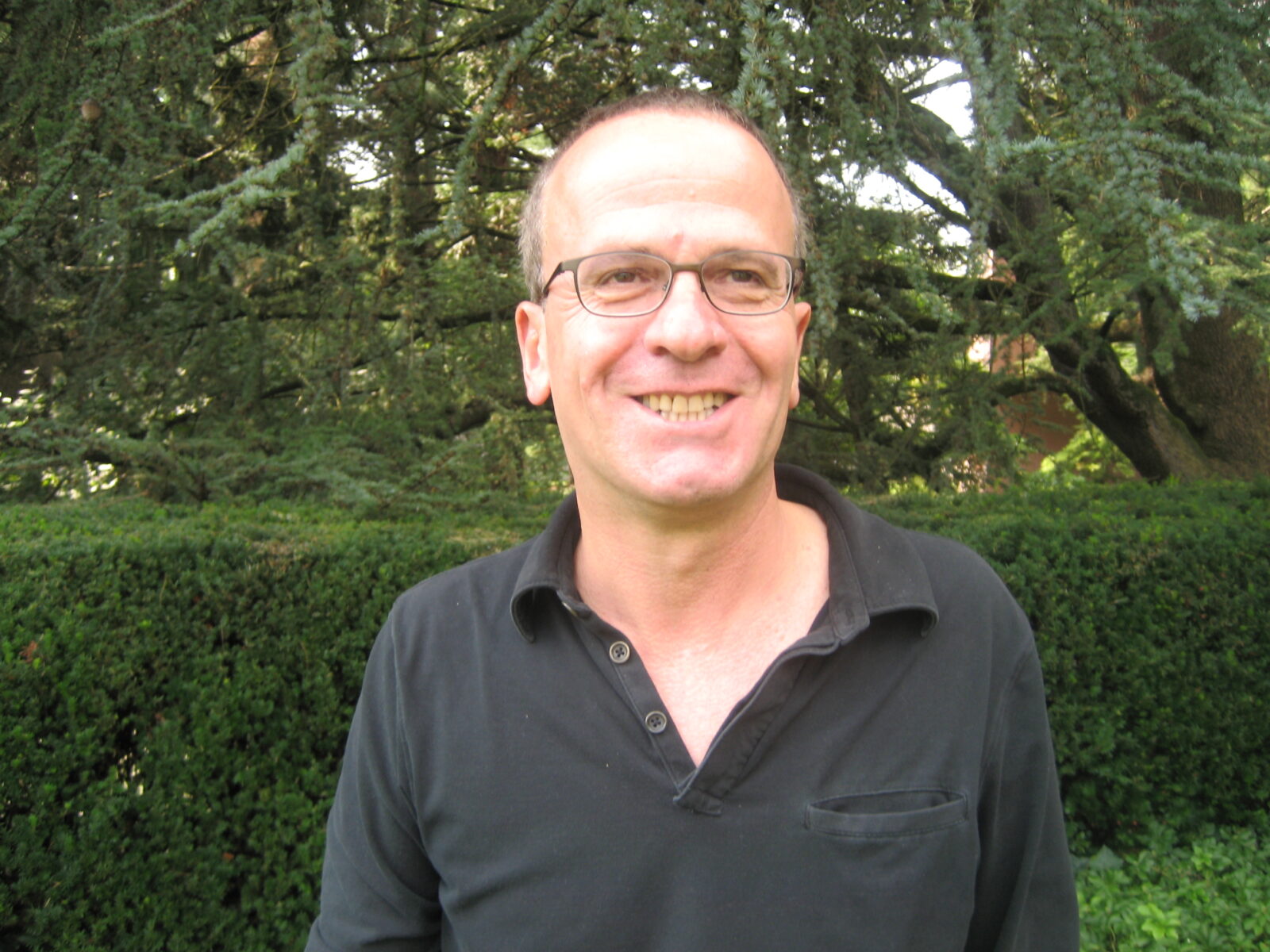
Dagmar Herzog is Distinguished Professor of History at the Graduate Center, City University of New York, where she writes and teaches on interdisciplinary theory and historical method, the history of disability, the histories of gender and sexuality, and the histories of fascism and genocide. She is author of seven books, including Sex after Fascism: Memory and Morality in Twentieth-Century Germany (2005); Sexuality in Europe: A Twentieth-Century History (2011); Cold War Freud: Psychoanalysis in an Age of Catastrophes (2017); Unlearning Eugenics: Sexuality, Reproduction, and Disability in Post-Nazi Europe (2018); and the forthcoming The Question of Unworthy Life: Eugenics and Germany’s Twentieth Century (2024). Her most recent coedited collection, with Chelsea Schields, is The Routledge Companion to Sexuality and Colonialism (2021).
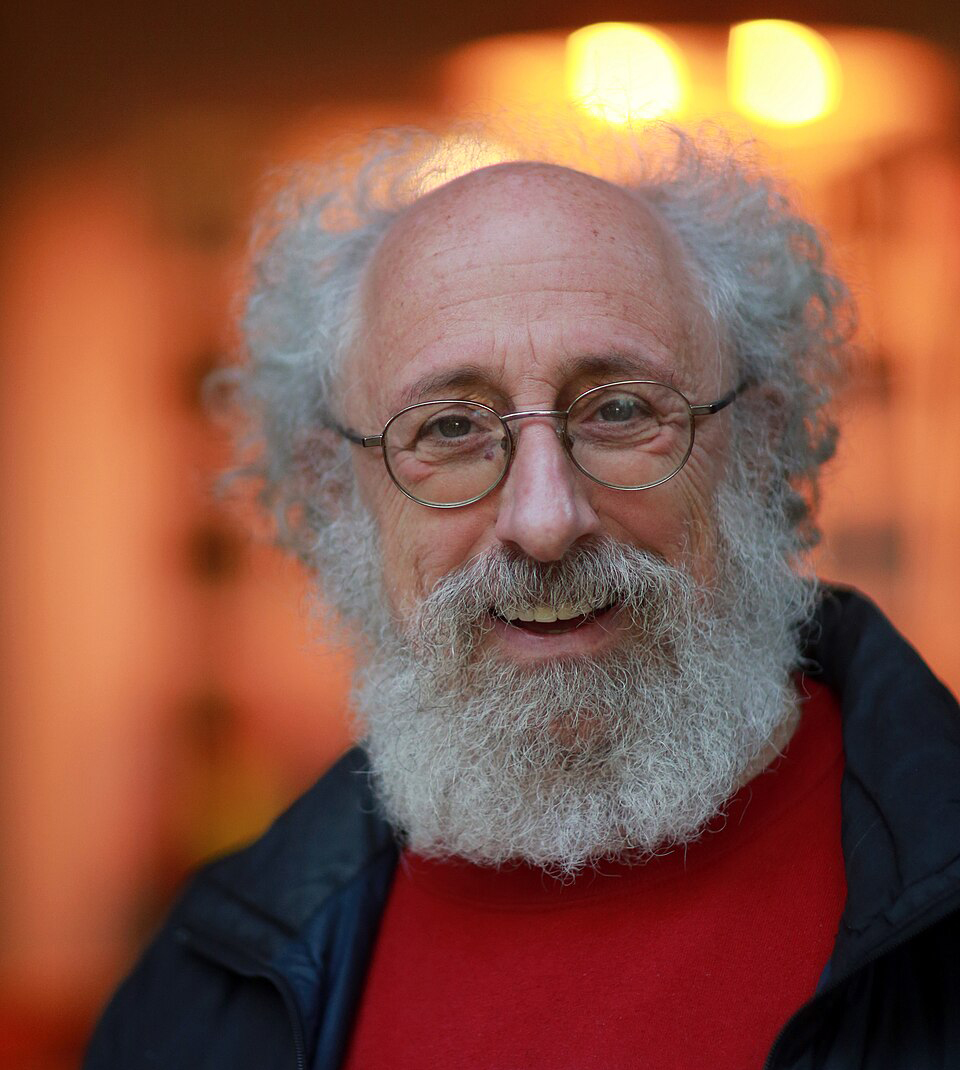
Dror Wahrman is a cultural historian of Western Europe in the transition from the pre-modern to the modern, with a focus on the “long” eighteenth century. Much of this work tries to understand what the terms in the previous sentence actually mean. What are the meaning and characteristics of modernity? How distant are we from our “pre-modern” or “early-modern” ancestors? His first book was about the rise of class society and especially the middle class; and the second, about the emergence of the modern individual or modern self. In both cases he asked where do these narratives come from and what in fact were the historical developments that stood behind them (which were not at all those they claimed to represent).
Subsequently his work, which had begun with a focus on Britain, and has since expanded to much of Europe, especially France, Holland, Venice and Germany, has gone in two directions. One, a recent book with Professor Jonathan Sheehan of the University of California-Berkeley, is about the question of where does order and harmony come from in a world where god is no longer believed to take active care of it itself: this book is titled Invisible Hands: Self Organization and the Eighteenth Century. The other direction is the interface between art and history. This resulted in a book on a mysterious Dutch painter and the print revolution (Mr. Collier’s Letter Racks: A Tale of Art and Illusion at the Threshold of the Modern Information Age), and in his current book-project on the interpretation of an extraordinary complex object in the treasury of the Saxon princes.
His current work expands through the study of material objects and art to a global perspective on the early modern period .Moshe Sluhovsky is Paulette and Claude Kelman Professor of French History at the Hebrew University of Jerusalem and the head of the Lafer Center for the Study of Women and Gender and of the Institute of History. He got his PhD at Princeton University, then taught at CALTECH and UCLA before moving back to Jerusalem. Over the years he has held a number of fellowships, including a Mellon Foundation and NEH fellowships, and was a fellow at the NHC, Davis Center at Princeton University and Advanced Research Distinguished Fellow at the Graduate Center of the City University of New York. His latest books are “Believe not Every Spirit”: Demonic Possession, Mysticism, and Discernment in Early Modern Catholicism and Becoming a New Self: Practices of Belief in Early Modern Catholicism. He is currently working on a GIF project on the Jewish presence in Gay Berlin and on the migration of gay and lesbian German Jews to Palestine in the 1930s.