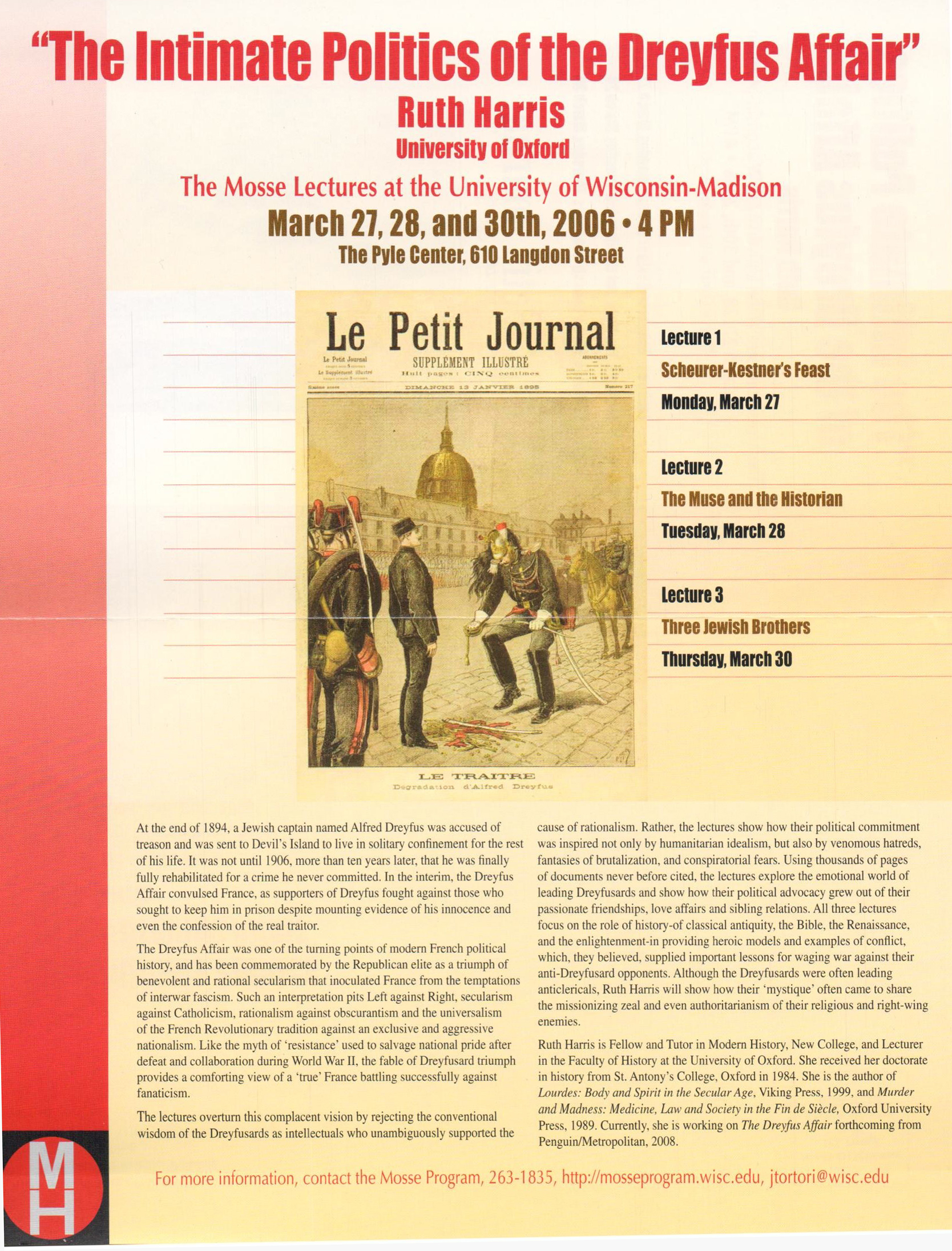
2006: Ruth Harris, “The Intimate Politics of the Dreyfus Affair 01: Scheurer-Kestner’s Feast”
Ruth Harris, “The Intimate Politics of the Dreyfus Affair 01: Scheurer-Kestner’s Feast”
George L. Mosse Distinguished Lectures
https://mosselectures.wisc.edu/program/
Monday, 27 March 2006, 16:00 CST
University of Wisconsin–Madison
Pyle Center
610 Langdon Street
Madison, WI 53706
Sponsored by:
George L. Mosse Program in History
University of Wisconsin–Madison History Department
Chair: David Sorkin (University of Wisconsin–Madison)
Lecture Series Overview: At the end of 1894, a Jewish captain named Alfred Dreyfus was accused of treason and was sent to Devil’s Island to live in solitary confinement for the rest of his life. It was not until 1906, more than ten years later, that he was finally fully rehabilitated for a crime he never committed. In the interim, the Dreyfus Affair convulsed France, as supporters of Dreyfus fought against those who sought to keep him in prison despite mounting evidence of his innocence and even the confession of the real traitor.
The Dreyfus Affair was one of the turning points of modern French political history, and has been commemorated by the Republican elite as a triumph of benevolent and rational secularism that inoculated France from the temptations of interwar fascism. Such an interpretation pits Left against Right, secularism against Catholicism, rationalism against obscurantism and the universalism of the French Revolutionary tradition against an exclusive and aggressive nationalism. Like the myth of ‘resistance’ used to salvage national pride after defeat and collaboration during World War II, the fable of Dreyfusard triumph provides a comforting view of a ‘true’ France battling successfully against fanaticism.
The lectures overturn this complacent vision by rejecting the conventional wisdom of the Dreyfusards as intellectuals who unambiguously supported the cause of rationalism. Rather, the lectures show how their political commitment was inspired not only by humanitarian idealism, but also by venomous hatreds, fantasies of brutalization, and conspiratorial fears. Using thousands of pages of documents never before cited, the lectures explore the emotional world of leading Dreyfusards and show how their political advocacy grew out of their passionate friendships, love affairs and sibling relations. All three lectures focus on the role of history-of classical antiquity, the Bible, the Renaissance, and the enlightenment-in providing heroic models and examples of conflict, which, they believed, supplied important lessons for waging war against their anti-Dreyfusard opponents. Although the Dreyfusards were often leading anticlericals, Ruth Harris will show how their ‘mystique’ often came to share the missionizing zeal and even authoritarianism of their religious and right-wing enemies.

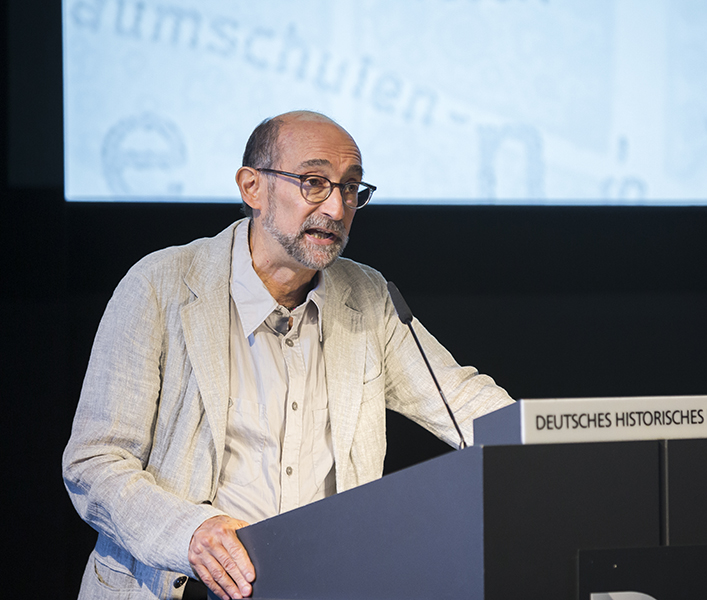
He first examined the formation of Jewish culture in the German states, which he came to understand as a “subculture.” The Transformation of German Jewry, 1780-1840 (1987) won the Present Tense/Joel H. Cavior Literary Award for History. In a commissioned study of Moses Mendelssohn’s Jewish thought he emphasized the neglected Hebrew works. Moses Mendelssohn and the Religious Enlightenment (1996) has been translated into French, German and Italian. In the Sherman Lectures delivered at Manchester University (UK) he used comparison to remove the “Haskalah” (Jewish Enlightenment) from its conventional parochial setting. Those lectures were published as The Berlin Haskalah and German Religious Thought (2000). He crossed confessional boundaries and national borders to reconceive the relationship of the Enlightenment to religion in The Religious Enlightenment: Protestants, Jews and Catholics from London to Vienna (2008), which was featured in a New York Times’ “Beliefs” column (October 11, 2008, A21). In Jewish Emancipation: A History Across Five Centuries (2019), he argued that the attainment of civil and political rights or equality is the principal event of modern Jewish history. His new book, The Emancipationists: Nineteenth-Century Jews’ Campaign for Citizenship (2026), restores emancipation politics to a central place in the development of Jewish political history.
He is the co-editor of four volumes. Profiles in Diversity: Jews in a Changing Europe, 1750-1870 (1998) studies how individual Jews and families experienced major historical changes. New Perspectives on the Haskalah (2001) emerged from the first international conference devoted to the subject. “What History Tells”: George L. Mosse and the Culture of Modern Europe (2004) is a tribute to his undergraduate teacher and mentor. Moses Mendelssohn’s Hebrew Works (2018) (Edward Breuer translator) makes available a broad selection of the Hebrew writings in English for the first time. He also served as Associate Editor of The Oxford Handbook of Jewish Studies (2002), which won the National Jewish Book Award. In his capacity as Vice-President of the American Academy for Jewish research, he edited, A Commitment to Scholarship: The Centenary of the American Academy for Jewish Research (2021).
He has received grants from the British Academy, the National Endowment for the Humanities and the John Simon Guggenheim Memorial Foundation. He has twice been a Visiting Professor at the École des Hautes Études en Sciences Sociales (Paris) and at the Scuola Normale Superiore (Pisa). He has also been a Visiting Fellow at the Max Planck Institut für Geschichte (Göttingen); All Souls College, Oxford; the Center for Advanced Judaic Studies at the University of Pennsylvania; and the Swedish Collegium for Advanced Study, Uppsala.
He previously taught at Brown (1983-86), Oxford (1986-92), the University of Wisconsin–Madison (1992-2011) and the City University of New York-Graduate Center (2011-14).