2012: Martin Jay, “After the Eclipse 03, Reason Eclipsed: From the Age of Reason to the Age of Reasons”
Martin Jay, “After the Eclipse: The Light of Reason in Late Critical Theory 03: From the Age of Reason to the Age of Reasons”
George L. Mosse Distinguished Lectures
https://mosselectures.wisc.edu/program/
Thursday, 15 November 2012, 18:30 IDT
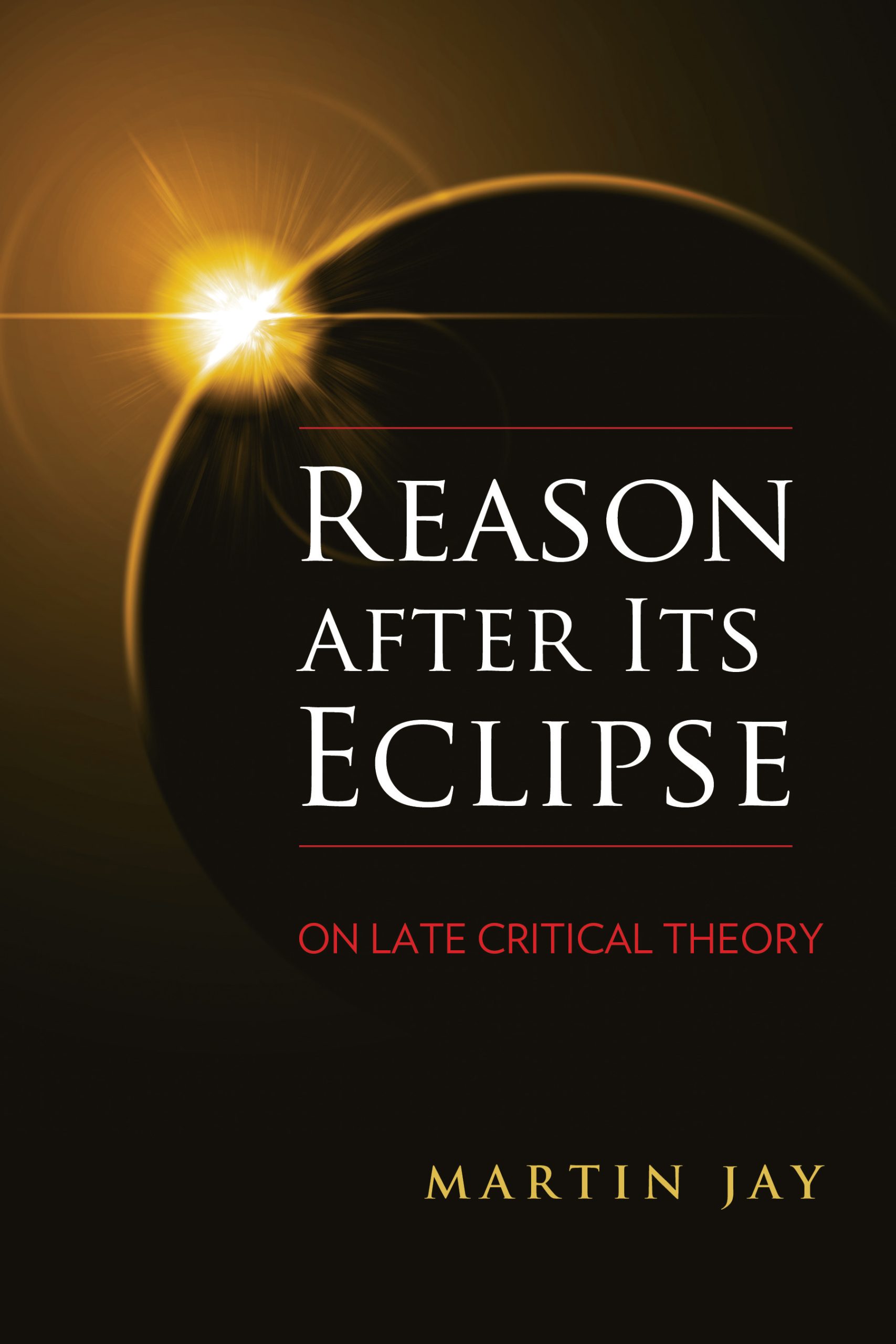
This lecture series was published as Reason after Its Eclipse: On Late Critical Theory (Madison: University of Wisconsin Madison, 2017).
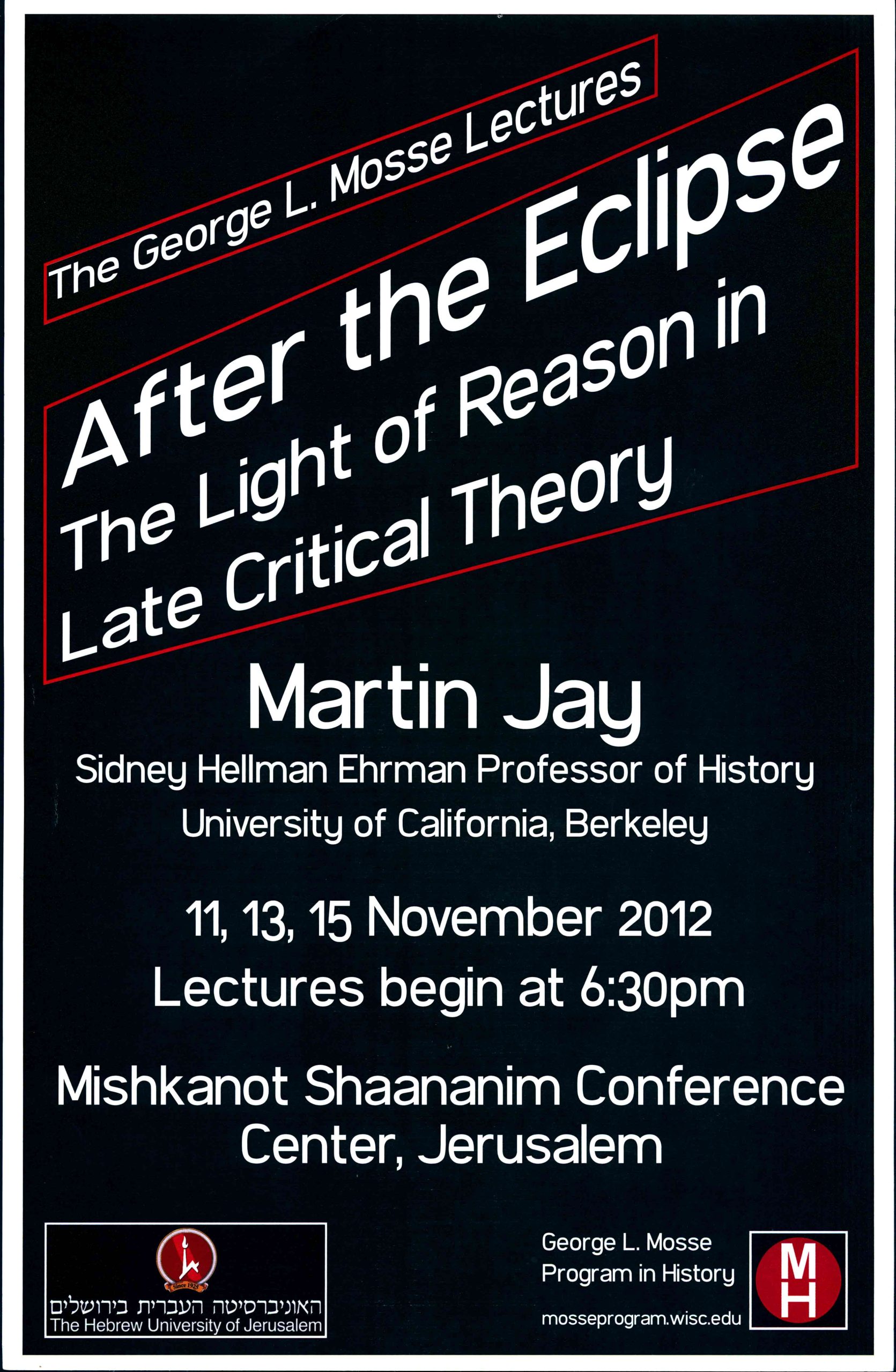
Mishkanot Sha’ananim Conference Center
POB 4572
Jerusalem 9104402
ISRAEL
Sponsored by:
George L. Mosse Program in History
Hebrew University of Jerusalem Department of History
Chair: Dror Wahrman (Hebrew University of Jerusalem)
Lecture Overview: Despite the still unresolved issues in his ambitious system, Habermas’s paradigm shift to a model of rationality stressing the role of intersubjective justification in what Wilfred Sellars famously called “the space of reasons” offers a plausible way to tap the still emancipatory potential in the rationalist tradition. Without depending on a vulnerable metaphysical notion of reason or an untenable universalism, he escapes the charge made by champions of reasons various “others” that reason necessarily excludes and stigmatizes what it cannot colonize and control. In his later work, he modifies his initial faith in a purely discursive model of justification and validity-testing, acknowledging the role of external reality in shaping the never-ending learning process that is made possible by communicative rationality.
Lecture Series Overview: Martin Jay tackles a question as old as Plato and still pressing today: what is reason, and what roles does and should it have in human endeavor? Applying the tools of intellectual history, he examines the overlapping, but not fully compatible, meanings that have accrued to the term “reason” over two millennia, homing in on moments of crisis, critique, and defense of reason.
After surveying Western ideas of reason from the ancient Greeks through Kant, Hegel, and Marx, Jay engages at length with the ways leading theorists of the Frankfurt School—Horkheimer, Marcuse, Adorno, and most extensively Habermas—sought to salvage a viable concept of reason after its apparent eclipse. They despaired, in particular, over the decay in the modern world of reason into mere instrumental rationality. When reason becomes a technical tool of calculation separated from the values and norms central to daily life, then choices become grounded not in careful thought but in emotion and will—a mode of thinking embraced by fascist movements in the twentieth century.
Is there a more robust idea of reason that can be defended as at once a philosophical concept, a ground of critique, and a norm for human emancipation? Jay explores at length the communicative rationality advocated by Habermas and considers the range of arguments, both pro and con, that have greeted his work.
Martin Jay, the Sidney Hellman Ehrman Prof. of History at UC-Berkeley gave the sixth series of George L. Mosse Lectures at the Hebrew University in Jerusalem on November 13, 15, 17, 2012. The well attended lectures, based on Prof. Jay’s current research on the Frankfurt School and its legacy are a continuation of the work he began with his groundbreaking book “The Dialectical Imagination” published in 1973.

His most recent book, Magical Nominalism: Photography and the Reenchantment of the World (University of Chicago Press, 2025), connects the philosophical and aesthetic traditions of the medieval and modern worlds. Focusing on the intellectual movement of the European Middle Ages to reject platonic philosophy in favor of Aristotelian nominalism, Jay’s work demonstrates the “disenchantment” of the visual artistic world as a result of the new theoretical paradigm and positions photography as a medium for “re-enchanting” the modern world.

Subsequently his work, which had begun with a focus on Britain, and has since expanded to much of Europe, especially France, Holland, Venice and Germany, has gone in two directions. One, a recent book with Professor Jonathan Sheehan of the University of California-Berkeley, is about the question of where does order and harmony come from in a world where god is no longer believed to take active care of it itself: this book is titled Invisible Hands: Self Organization and the Eighteenth Century. The other direction is the interface between art and history. This resulted in a book on a mysterious Dutch painter and the print revolution (Mr. Collier’s Letter Racks: A Tale of Art and Illusion at the Threshold of the Modern Information Age), and in his current book-project on the interpretation of an extraordinary complex object in the treasury of the Saxon princes.
His current work expands through the study of material objects and art to a global perspective on the early modern period.