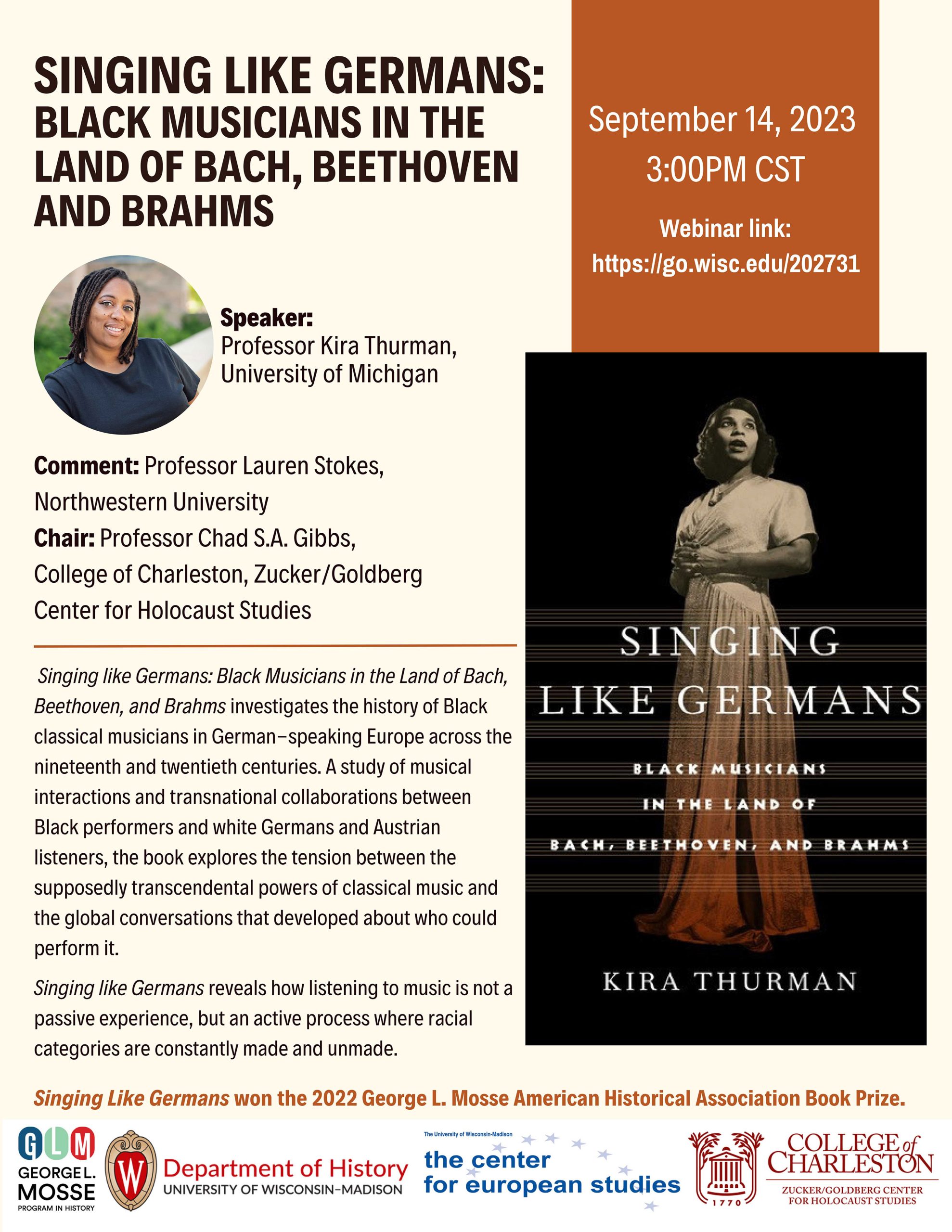
2023: Kira Thurman, “Singing Like Germans: Black Musicians in the Land of Bach, Beethoven, and Brahms”
Kira Thurman, Singing Like Germans: Black Musicians in the Land of Bach, Beethoven, and Brahms (Ithaca, NY: Cornell University Press, 2021).
Winner of the 2022 George L. Mosse American Historical Association Prize
College of Charleston Mosse Lecture
https://mosselectures.wisc.edu/charleston/
Thursday, 14 September 2023, 15:00 CST
Zoom
Chair: Chad S.A. Gibbs (College of Charleston)
Comment: Lauren Stokes (Northwestern University)
Sponsored by:
Global Mosse Lecture Series
George L. Mosse Program in History
The Mosse Foundation
College of Charleston Zucker/Goldberg Center for Holocaust Studies
Center for German & European Studies at the University of Wisconsin–Madison
University of Wisconsin–Madison Department of History
Lecture Description: In Singing Like Germans, Kira Thurman tells the sweeping story of Black musicians in German-speaking Europe over more than a century. Thurman brings to life the incredible musical interactions and transnational collaborations among people of African descent and white Germans and Austrians. Through this compelling history, she explores how people reinforced or challenged racial identities in the concert hall.
Throughout the nineteenth and twentieth centuries, audiences assumed the categories of Blackness and Germanness were mutually exclusive. Yet on attending a performance of German music by a Black musician, many listeners were surprised to discover that German identity is not a biological marker but something that could be learned, performed, and mastered. While Germans and Austrians located their national identity in music, championing composers such as Bach, Beethoven, and Brahms as national heroes, the performance of their works by Black musicians complicated the public’s understanding of who had the right to play them. Audiences wavered between seeing these musicians as the rightful heirs of Austro-German musical culture and dangerous outsiders to it.
Thurman explores the tension between the supposedly transcendental powers of classical music and the global conversations that developed about who could perform it. An interdisciplinary and transatlantic history, Singing Like Germans suggests that listening to music is not a passive experience, but an active process where racial and gendered categories are constantly made and unmade.”
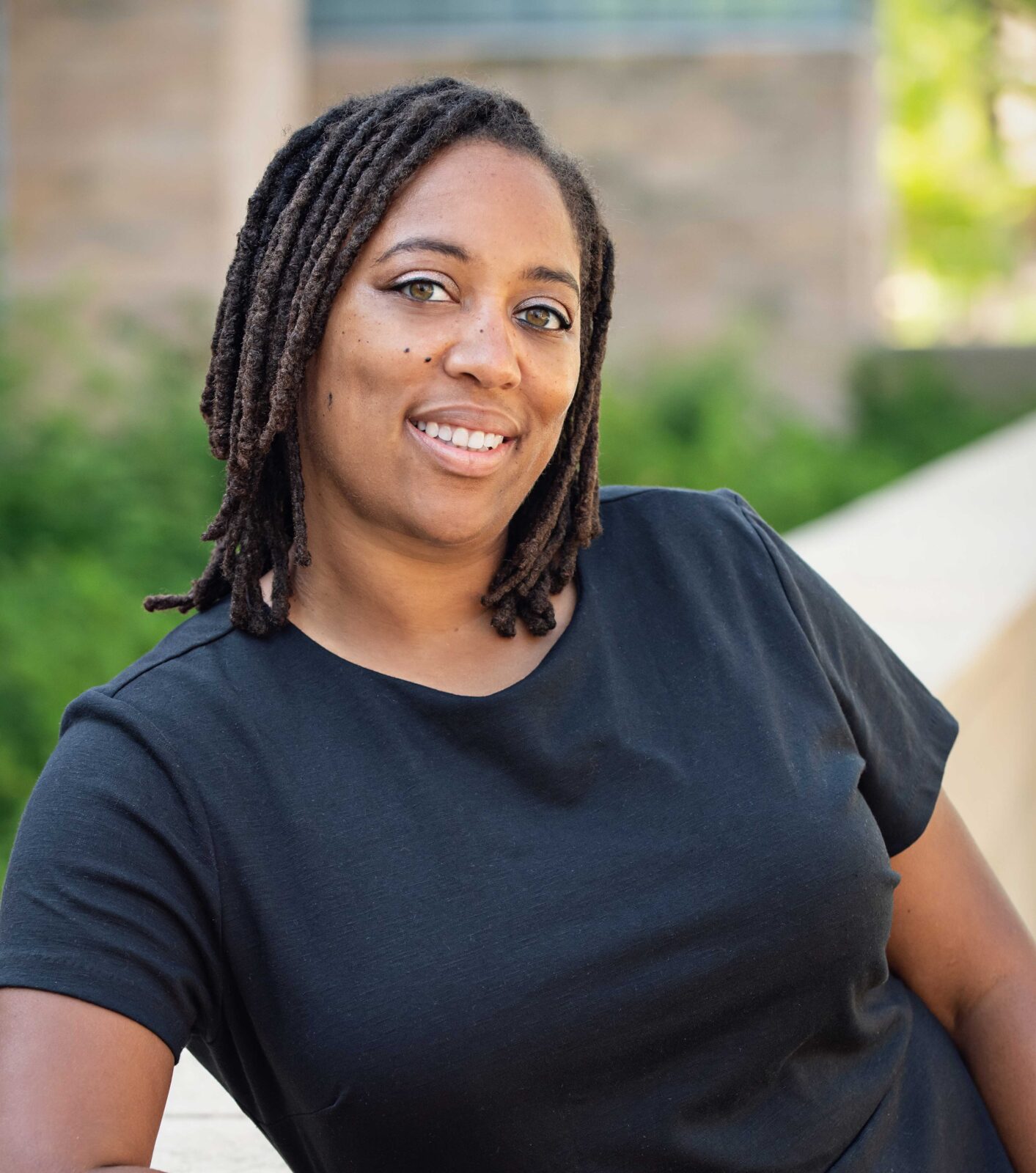
Her first book, Singing Like Germans: Black Musicians in the Land of Bach, Beethoven and Brahms (Cornell University Press, 2021), traces the history of Black classical musicians in German-speaking Europe across the nineteenth and twentieth centuries. New Yorker music critic Alex Ross praised it as “one of the most original and revelatory books to have been written about classical-music history in many years…An instant classic that deserves the widest possible audience.” Singing like Germans won seven prizes: the Marfield Prize (National Award for Arts Writing), the Rock and Roll Hall ofo Fame Gleason Book Award, the German Studies Association’s DAAD prize for best book in History/Social Sciences, the Royal Musical Association’s Best Monograph Prize, the American Historical Association’s George Mosse Prize, the American Musicological Society’s Judy Tsou Critical Race Studies Award, and the Modern Language Association’s Aldo and Jeanne Scaglione Prize for Studies in Germanic Languages and Literatures (honorable mention). NPR named it one of the Best Books of 2021.

She is author of Fear of the Family: Guest Workers and Family Migration in the Federal Republic of Germany (Oxford 2022), and several articles on migration history, including “The Permanent Refugee Crisis in the Federal Republic, 1949—” and “Racial Profiling on the U-Bahn: Policing the Berlin Gap during the Schönefeld Airport Refugee Crisis.”
She has also co-edited both a special issue of Central European History on the borders of the German Democratic Republic (with Ned Richardson-Little) and a collection of essays on Racism and Anti-Racism in Divided Germany (with Michelle Kahn).
She currently serves as book review editor for Contemporary European History (please get in touch if you have an idea for a review essay) and is honored to serve as a “Member at Large” in the Central European History Society (please say hello at our traditional AHA Bierabend). Her past research has been supported by organizations including the Alexander von Humboldt Foundation, the Council on European Studies, the Central European History Society, and the Hamburg Institute for Advanced Study.