
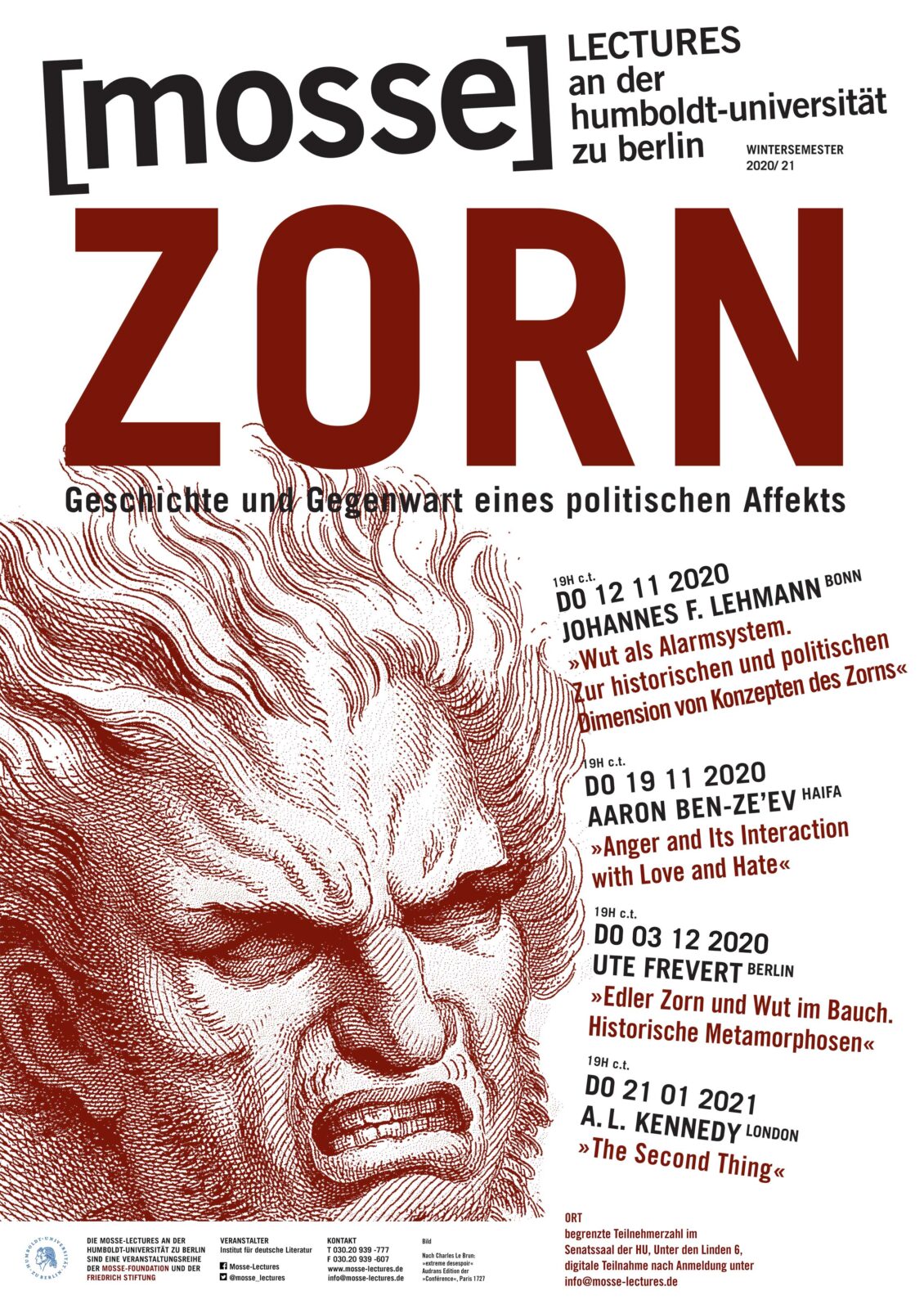
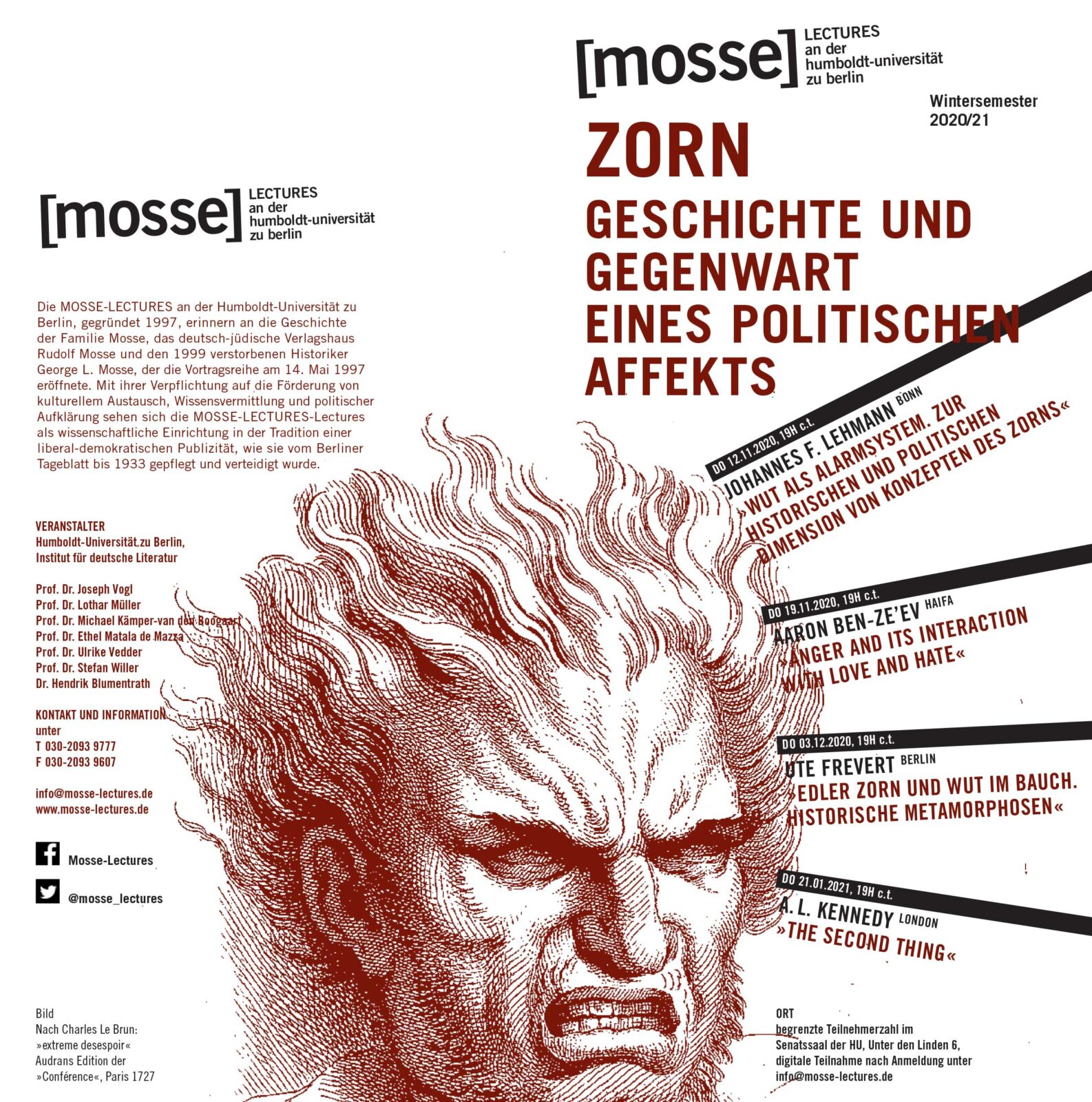
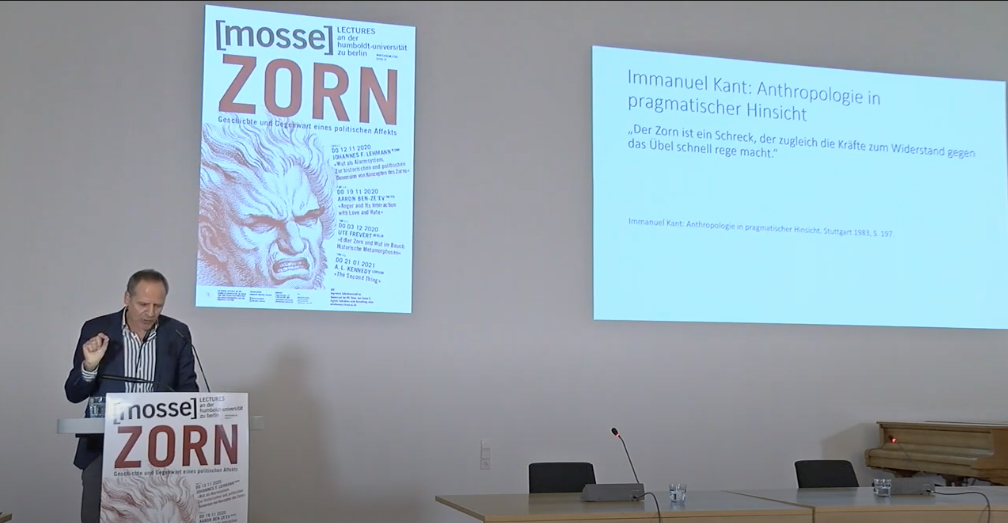
2020: Johannes F. Lehmann, “Wut als Alarmsystem. Zur historischen und politischen Dimension von Konzepten des Zorns” / “Anger as an Alarm System: On the Historical and Political Dimension of Concepts of Anger”
Johannes F. Lehmann, “Wut als Alarmsystem. Zur historischen und politischen Dimension von Konzepten des Zorns” / “Anger as an Alarm System: On the Historical and Political Dimension of Concepts of Anger”
Berlin Mosse Lecture
https://mosselectures.wisc.edu/berlin/
Thursday, 12 November 2020, 19:00 CET
Senatssaal of Humboldt University
1. Stock
Unter den Linden 6
10117 Berlin
GERMANY
Sponsored by:
[mosse] LECTURES an der humboldt-universität zu berlin
The Mosse Foundation
Global Mosse Lecture Series
Friedrich Stiftung
Institut für deutsche Literatur
Humboldt University
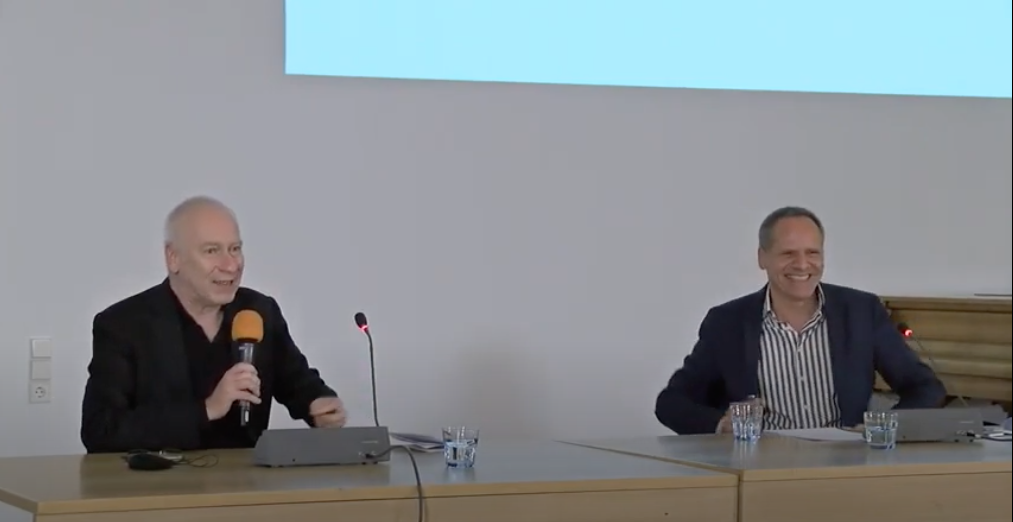
Moderator: Joseph Vogl (Humboldt University)
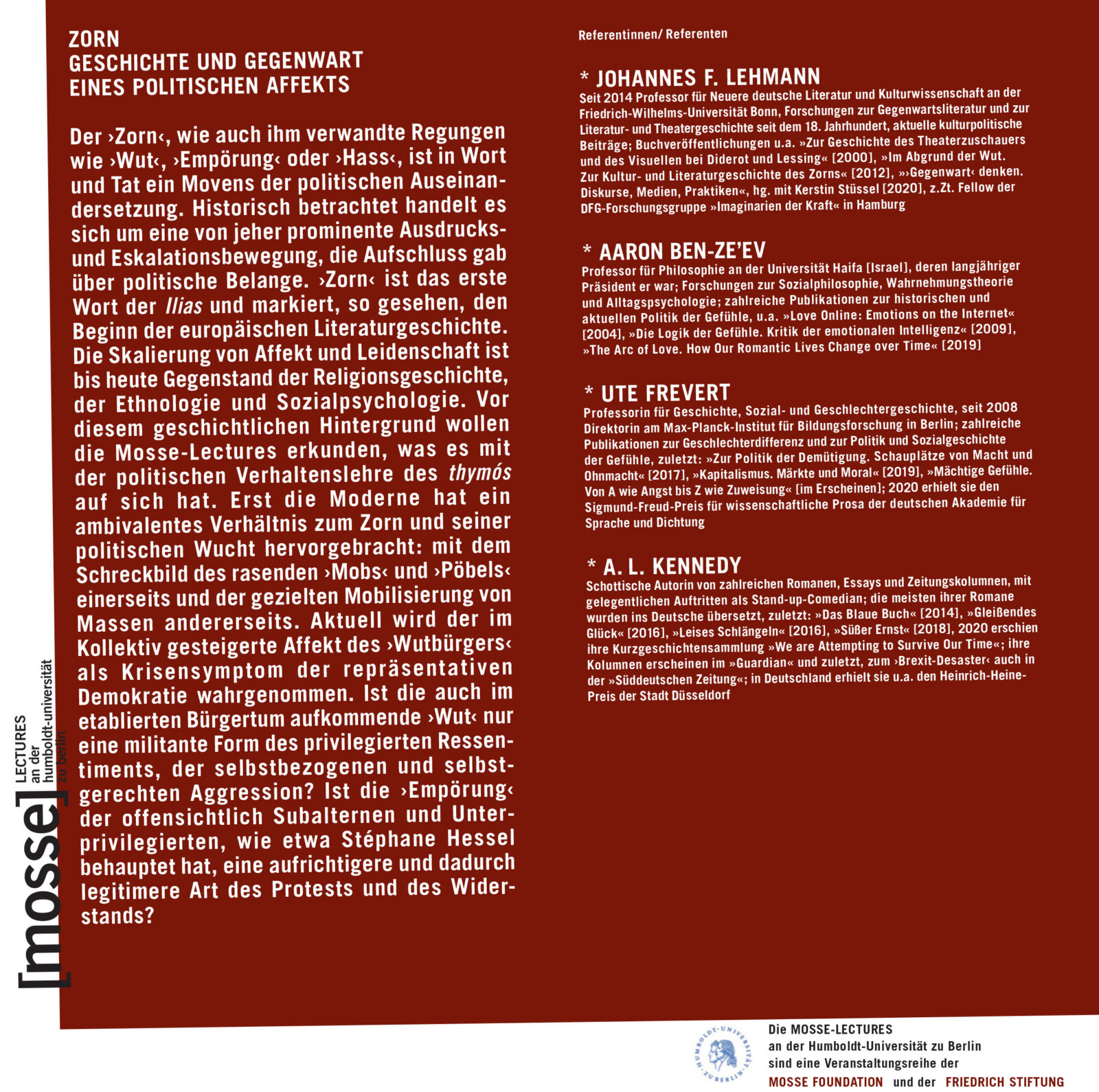
Lecture Series Description: Anger, as similar emotions like wrath, outrage and hate, has become, in word and deed, a driving force of political wrangling. Well known in history, it points to a particular escalation of emotions, ground-breaking in political affairs. Art, religion, anthropology and the law have addressed its particular nature. ‘Anger’ is the very first word of Homer’s “Illiad”, and thus it marks the beginning of European literary history. Time and again Sophocles and Shakespeare in drama, Kleist and Melville in their narratives have explored the connection and the synergetic effects of expression and affect, of sign and emotion. ‘Anger’, is it an affect of divine nature? And why and when does it turn over into metaphysical hatred, into fundamental hostility, or nothing more than resentment, a need of revenge? This significant scaling of affect and passion has been, until today, a prominent issue in the history of religion, in ethnology and social psychology. More recently this feeling, collectively exalted in the reactions of so called ‘angry citizens’ (‘Wutbürger’), has been recognized as a symptom of crisis of the representative democracy, a strong factor in the political game.
Against this background the Mosse-Lectures will explore what is at the core of thymós as a habit of political conduct and action, tracing its tradition and public interest, its recent populist drive, termed “anger marketing” (“Zorngeschäft”) by Peter Sloterdijk. As a part of the arcanain the classical art of governing, the ruling class well calculated emotional control rather than a control system for possible public anger. It is only in modernity that an ambivalent attitude to the political affect of anger and its collective force emerged: spreading horror images of a raging mob on the one hand, deliberately mobilizing the masses on the other. This seems to be even more true these days as it remains debatable what shape of the affect may serve what kind of political concept. Wrath and rage also breakthrough in the established middle class. Is this a resentment of the privileged, militantly self-centered, aggressively self-righteous? And how about Stéphane Hessel’s claim, that anger, the outrage of those obviously underprivileged (the subalterns, the disadvantaged) has to be considered as a more honest, justified and therefore more legitimate kind of protest and resistance?
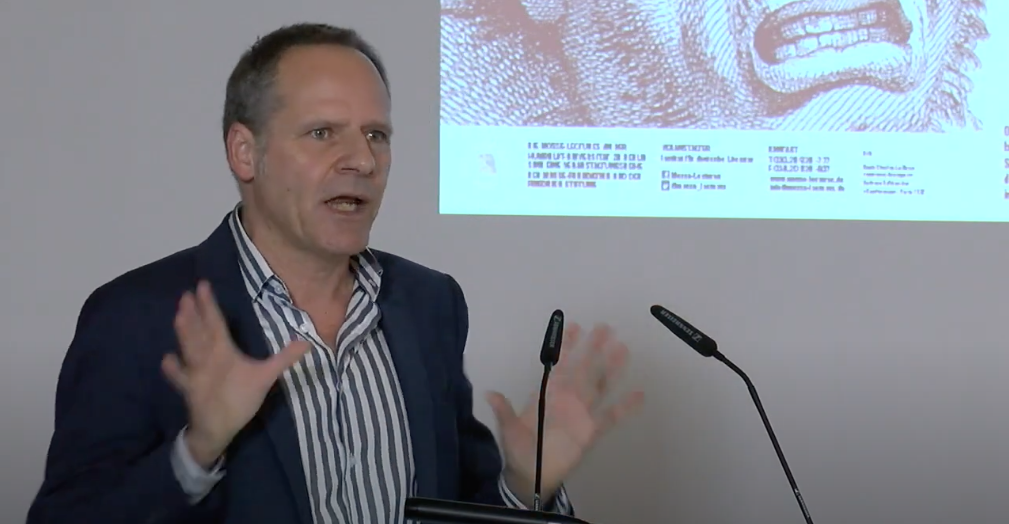
Johannes F. Lehmann: Johannes F. Lehmann has been Professor of Modern German Literature and Cultural Studies at the Rheinische Friedrich-Wilhelms-Universität in Bonn since 2014. He received his doctorate in Freiburg with the thesis “Der Blick durch die Wand. Zur Geschichte des Theaterzuschauers und des Visuellen bei Diderot und Lessing.” Freiburg i. Br. 2000; Habilitation in Duisburg-Essen: “Im Abgrund der Wut. Zur Kultur- und Literaturgeschichte des Zorns”. Freiburg i. Br. 2012 (Rombach: Litterae 107). Main areas of research: Literature of the 18th and 19th centuries, cultural and literary studies on the genealogy of modernity: theatre, anthropology, law, anger, life-saving, history of the ‘present’.
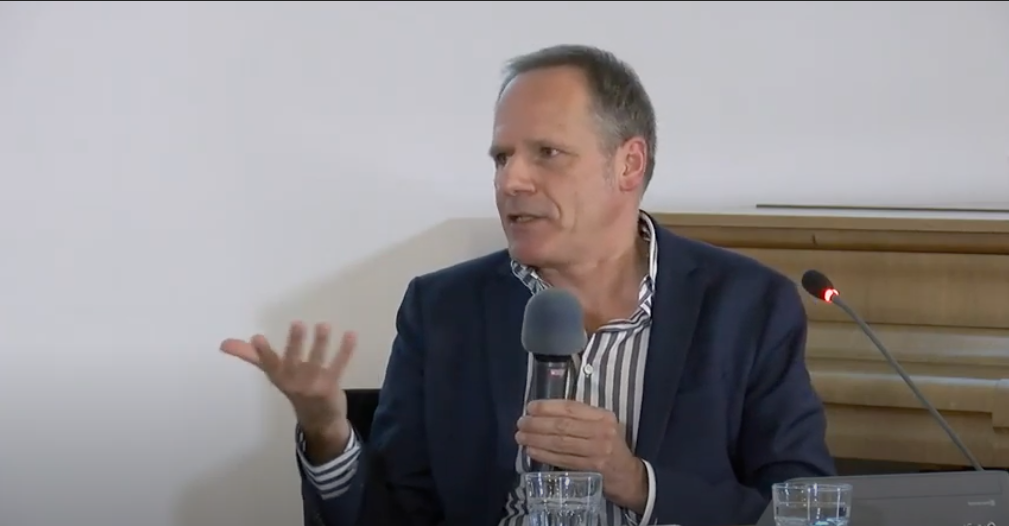
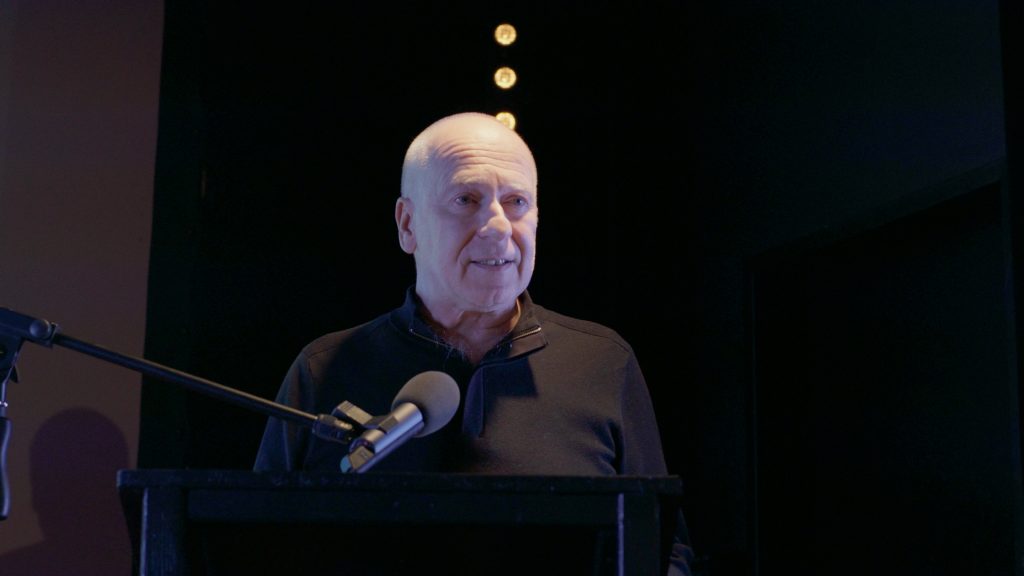
His research and teaching comprises literature from the eighteenth to the twentieth century, media and aesthetics, cultural and political theory. Recent research focuses on the history of financial economy, literature and economics, and the “poetics of knowledge” – the study of the relationships and interactions between forms of knowledge and poetic or aesthetic figures. He is the director or principal investigator of a range of research projects including “The Knowledge of Literature” (PhD-Net), “Small Forms in the History of Literature and Sciences” (Research Training Group), and “Matters of Activity: Image Space Material” (Cluster of Excellence).
Joseph Vogl published more than a hundred articles and book chapters, as well as numerous books and monographs. Among his most important written works are the monographs Ort der Gewalt. Kafkas literarische Ethik (1990); Kalkül und Leidenschaft. Poetik des ökonomischen Menschen (2002); Über das Zaudern (2007; On Tarrying, 2011). Besides his research in literature, cultural and media studies, he is well known for his intensive work on modern and present-day finance and economics, analyzing finance theories from the perspective of cultural history. This work culminated in his books Das Gespenst des Kapitals (2010; The Specter of Capital, 2014), Der Souveränitätseffekt (2015; The Ascendancy of Finance, 2017) and Kapital und Ressentiment. Eine kurze Theorie der Gegenwart (2021; Capital and Ressentiment: A Brief Theory of the Present, 2022), which received wide recognition in the fields of cultural studies as well as economics, and initiated a public debate. Further workings include translations from French to German (Deleuze, Lévi-Strauss, Lyotard) and numerous interviews on TV with Alexander Kluge (see Soll und Haben. Fernsehgespräche, 2009; Senkblei der Geschichten. Gespräche, 2020).
He was awarded the Günther Anders Prize for Critical Thinking (2022). For his book Der Souveränitätseffekt (The Ascendancy of Finance) Vogl was on the shortlist for the Leipzig Book Fair Prize 2015 in the category of non-fiction. In 1988 he received the Translation Prize for the Promotion of Franco-German Relations (DVA Foundation) for his translations of key works of modern French philosophy.
